Home
Class 11
CHEMISTRY
Compound (A) reacts with [Cu(NH3)2]^(+) ...

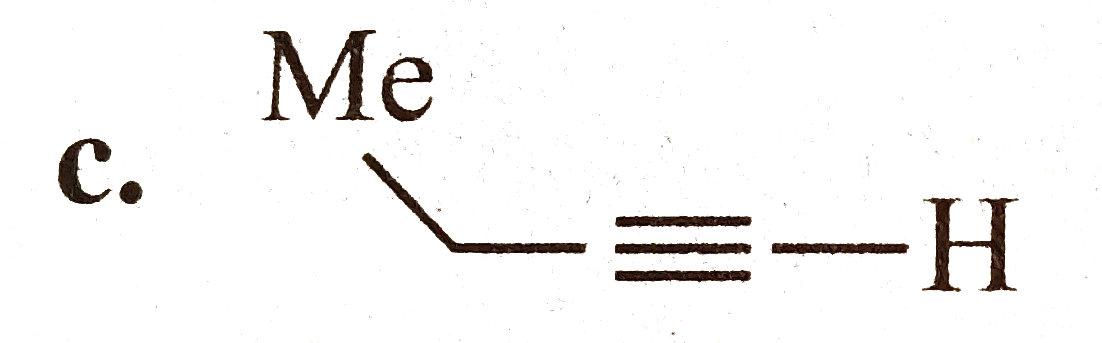
Compound (A) reacts with `[Cu(NH_3)_2]^(+)` and Tollens reagent, but after with alc: KOH it does not give the above test. Compound (A) is:

A

(a) `Me--=-Me`

B

(b) `Me--=-H`

C

D

(d) `Ph--=-H`

Text Solution

AI Generated Solution

The correct Answer is:

To solve the question, we need to analyze the behavior of compound (A) with the reagents mentioned: `[Cu(NH_3)_2]^(+)` (which is a copper(II) complex) and Tollens' reagent, and then its behavior with alcoholic KOH. ### Step-by-Step Solution: 1. **Identify the Reagents and Their Reactions**: - The compound (A) reacts with `[Cu(NH_3)_2]^(+)` and Tollens' reagent. Both of these reagents are known to react with terminal alkynes. - The reaction with `[Cu(NH_3)_2]^(+)` produces a red precipitate (copper(I) acetylide), and the reaction with Tollens' reagent produces a white precipitate (silver acetylide). 2. **Determine the Structure of Compound (A)**: - Since compound (A) reacts with both reagents, it must be a terminal alkyne. Terminal alkynes have the general structure R-C≡C-H, where R is an alkyl group. 3. **Analyze the Reaction with Alcoholic KOH**: - The question states that after treatment with alcoholic KOH, compound (A) does not give the above tests. Alcoholic KOH can lead to elimination reactions, converting terminal alkynes to internal alkynes. - If compound (A) is a terminal alkyne, treatment with alcoholic KOH could convert it into an internal alkyne, which would not react with `[Cu(NH_3)_2]^(+)` or Tollens' reagent. 4. **Consider the Options**: - We need to evaluate the given options (not provided here) to identify which one is a terminal alkyne that can be converted to an internal alkyne upon treatment with alcoholic KOH. 5. **Conclusion**: - Based on the analysis, the correct compound (A) must be a terminal alkyne that, upon treatment with alcoholic KOH, forms an internal alkyne. This is consistent with the behavior described in the question. ### Final Answer: The compound (A) is a terminal alkyne that converts to an internal alkyne upon treatment with alcoholic KOH.

To solve the question, we need to analyze the behavior of compound (A) with the reagents mentioned: `[Cu(NH_3)_2]^(+)` (which is a copper(II) complex) and Tollens' reagent, and then its behavior with alcoholic KOH. ### Step-by-Step Solution: 1. **Identify the Reagents and Their Reactions**: - The compound (A) reacts with `[Cu(NH_3)_2]^(+)` and Tollens' reagent. Both of these reagents are known to react with terminal alkynes. - The reaction with `[Cu(NH_3)_2]^(+)` produces a red precipitate (copper(I) acetylide), and the reaction with Tollens' reagent produces a white precipitate (silver acetylide). ...
Promotional Banner

Topper's Solved these Questions

  • ALKYNES

    CENGAGE CHEMISTRY ENGLISH|Exercise Exercises (Single Correct Answers Type)|30 Videos
  • ALKYNES

    CENGAGE CHEMISTRY ENGLISH|Exercise Exercises (Archives - Single Correct Answer Type)|6 Videos
  • ALKYNES

    CENGAGE CHEMISTRY ENGLISH|Exercise Exercises (Linked Comprehension Type)|51 Videos
  • ALKENES AND ALKADIENES

    CENGAGE CHEMISTRY ENGLISH|Exercise Single correct Answer|14 Videos
  • APPENDIX - INORGANIC VOLUME 1

    CENGAGE CHEMISTRY ENGLISH|Exercise chapter-7 Single correct answer|1 Videos

Similar Questions

Explore conceptually related problems

Compound (A) does not react with Tollens or Grignard reagent, but after treatment with NaNH_2 , it gives the above test. The compound (A) is/are:

The compound which does not give iodoform test is

A dihalogen derivative (A) with three C-atoms gives a hydrocarbon (B) on reacting with alc KOH. (B) gives a white precipitate with Tollen’s reagent. (A) on heating with aqueous KOH gives a ketone. Compound (A) is:

Which of the following compound does not give Tollen's test ?

Compound A(C_(3)H_(5)N) gives precipitate with Tollen's reagent and H_(2) gas is also evolved on addition of Li metal. Compound A can be :

Which of the following compound does not react with Tollen's reagent?

An organic compound does not reacts with Tollen's reagent but undergoes Baeyer Villiger oxidation. The compound is

CENGAGE CHEMISTRY ENGLISH-ALKYNES-Exercises (Multiple Correct Answers Type)
  1. In the following sequence of reactions, Which of the statements a...

    Text Solution

    |

  2. Acetylene is thermodynamically unstable and readily explodes, therefor...

    Text Solution

    |

  3. Which of the statements are correct for alkyne with molecular formul...

    Text Solution

    |

  4. For the conversion of alkyne to cis-alkene, H2+ Lindlar's catalyst is ...

    Text Solution

    |

  5. i. Me--=-Hunderset((ii)H2O2//overset(Ө)OH)overset((i) Sia2BH)rarrA i...

    Text Solution

    |

  6. Which of the following statements are correct?

    Text Solution

    |

  7. Which of the following statement(s) is/are correct:

    Text Solution

    |

  8. Compound (B) is same when (A) is:

    Text Solution

    |

  9. Which of the statements are correct? R--=-R^'underset(+EtOH)overset(...

    Text Solution

    |

  10. Which of the statements are correct? R--=-Runderset(Catalyst)overset...

    Text Solution

    |

  11. Hydroboration oxidation and acid hydration will yield the same produ...

    Text Solution

    |

  12. C4H6underset(1 mol)overset(H2+Pt)rarrC4H8overset(O3//H2O)rarr Acedic a...

    Text Solution

    |

  13. All reagents, [Cu(NH3)2]^(o+), [Ag(NH3)2]^(o+), CH3MgBr, and NaNH2 r...

    Text Solution

    |

  14. Compound (A) does not react with Tollens or Grignard reagent, but afte...

    Text Solution

    |

  15. Compound (A) reacts with [Cu(NH3)2]^(+) and Tollens reagent, but after...

    Text Solution

    |

  16. Which of the statements are correct?

    Text Solution

    |

  17. Reagents used in conversion from (A) to (B) are:

    Text Solution

    |

  18. Which gas is in an antidote of Lewisite (a poisonous gas used in World...

    Text Solution

    |

  19. Which statements are correct:

    Text Solution

    |

  20. Which statements are correct for reagents A, B, C, and D?

    Text Solution

    |
