Home
Class 11
CHEMISTRY
In the conversion of alkyne to trans-alk...

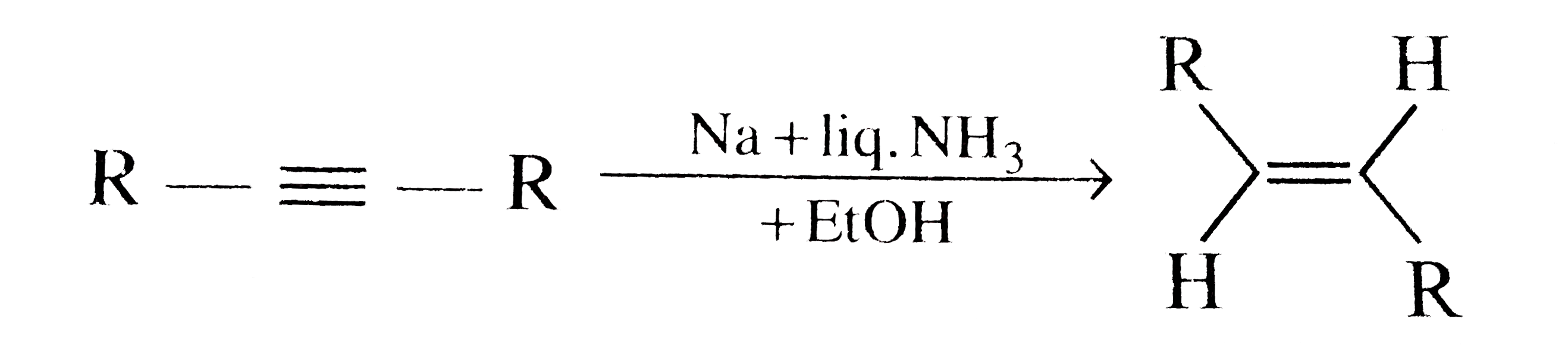
In the conversion of alkyne to trans-alkene by Birch reduction using alkali metals (such as `Na` or `K`) in liquid `NH_3` and alcohol (`MeOH` or `EtOH`),
`R - -= - R overset(Na +liq. NH_(3))underset(+EtOH)rarr`
the mechanism takes place in the formation of intermediate species in the following sequence:

A

(a) Radical anion `rarr` vinylic radical `rarr` trans-vinylic anion `rarr` trans-alkene

B

(b) Radical anion `rarr` trans-vinylic anion `rarr` vinylic radical `rarr` trans-alkene

C

(c) Vinylic radial `rarr` radical anion `rarr` trans-vinylic anion `rarr` trans-alkene

D

(d) Vinylic radical `rarr` trans-vinylic anion `rarr` radical anion `rarr` trans-alkene

Text Solution

Verified by Experts

The correct Answer is:

A
Promotional Banner

Topper's Solved these Questions

  • ALKYNES

    CENGAGE CHEMISTRY ENGLISH|Exercise Exercises (Archives - Single Correct Answer Type)|6 Videos
  • ALKYNES

    CENGAGE CHEMISTRY ENGLISH|Exercise Exercises (Archives - Fill in the Blanks Type)|3 Videos
  • ALKYNES

    CENGAGE CHEMISTRY ENGLISH|Exercise Exercises (Multiple Correct Answers Type)|25 Videos
  • ALKENES AND ALKADIENES

    CENGAGE CHEMISTRY ENGLISH|Exercise Single correct Answer|14 Videos
  • APPENDIX - INORGANIC VOLUME 1

    CENGAGE CHEMISTRY ENGLISH|Exercise chapter-7 Single correct answer|1 Videos

Similar Questions

Explore conceptually related problems

Consider the following reactions : I Me- underset((A))(-=)-Me overset(Na+Liq. NH_(3))underset(EtOH)to (B) . Which statement is wrong about the reactions (i) and (ii) ?

Consider the following reactions : I Me- underset((A))(-=)-Me overset(Na+Liq. NH_(3))underset(EtOH)to (B) . Which statement is wrong about the reactions (iii) and (iv) ?

Consider the following reactions : I Me- underset((A))(-=)-Me overset(Na+Liq. NH_(3))underset(EtOH)to (B) . Which statement is wrong about the reactions (ix) and (x) ?

Consider the following reactions : I Me- underset((A))(-=)-Me overset(Na+Liq. NH_(3))underset(EtOH)to (B) . Which statement is wrong about the reaction (v) and (vi) ?

Consider the following reactions : I Me- underset((A))(-=)-Me overset(Na+Liq. NH_(3))underset(EtOH)to (B) . Which statement is wrong about the reactions (vii) and (viii) ?

Which of the statements are correct? R--=-R^'underset(+EtOH)overset(Na+liq. NH_3)rarr(A)overset(Br_2//C Cl_4)rarrB+C where (B) and (C) are:

Terminal alkynes (RC-=CH) are not reduced by alkali metals (e.g., Na, K, or Li) in liq. NH_3 , but reduction takes place when (NH_4)_2SO_4 is added in the reaction mixture. Explain why.

Consider the following reactions : (I) Me - underset ((A)) -= - Me overset (H_2 +) underset (Pd + BaSO_4) rarr underset ((B)) ? overset (D_2//Pd//C)rarr (C) (II) Me - underset ((A))-= - Me overset (Na + Liq. NH_3) underset (+EtOH)rarr underset ((D)) ? overset (D_2//Pt//C)rarr (E) Which of the following statements are correct ?

Alkali metals oxide are obtained by combustion of the metals.Although Na normally gives Na_2O_2 ,it will take up further oxygen at elevated pressure and temperature to form NaO_2 .The per and superoxides of the heavier alkalies can also be prepared by passing stoichiometric amounts of oxygen into their solution in liquid ammonia. The different alkali metal oxides can be distinguished by reaction with water.The superoxides reacts with CO_2 and give oxygen gas.The stability of per and superoxides is based upon that larger cation can stablise larger anion, due to larger lattice energy. Alkali metals dissolve in liquid ammonia.Dilute solutions are dark blue in colour but as the concentration increases above 3M, the colour changes to copper bronze and the solution acquires the metallic lusture due to the formation of metal ions clusters.The solutions of alkali metals in liquid ammonia are good conductors of electricity due to the presence of ammoniated cations and ammoniated electrons.However, the conductivity decreases as the concentrations increases, since ammoniated electrons and ammoniated cation associate. On dissolving smaller (less than 3M) amount of sodium metal in liquid ammonia at low temperature , which one of the following does not occur ?

The rate law expresison is given for a typical reaction, n_(1)A + n_(2) B rarrP as r = k[A]^(n)[B]^(n2) . The reaction completes only in one step and A and B are present in the solution. If the reaction occurs in more than one step, then the rate law is expressed by consdering the slowest step, i.e., for S_(N)l reaction r = k[RX] . If the eraction occurs in more than one step and the rates of the steps involved are comparable, then steady state approximation is conisdered, i.e., the rate of formation of intermediate is always equal to the rate of decompoistion of the intermediate. Conisder the reaction: [[I_(2) underset(k_(1))overset(k_(2))hArr2I("rapid equilibrium")],[H_(2)+2I overset(k_(3))rarr 2HI("slow")]] If we increase the concentration of I_(2) two times, then the rate of formation of HI will
