Home
Class 11
CHEMISTRY
Cl3-underset((X))-=-Hunderset(D2+P-2cata...

`Cl_3-underset((X))-=-Hunderset(D_2+P-2catalyst)rarr(A)overset(HCl)rarr(B)`
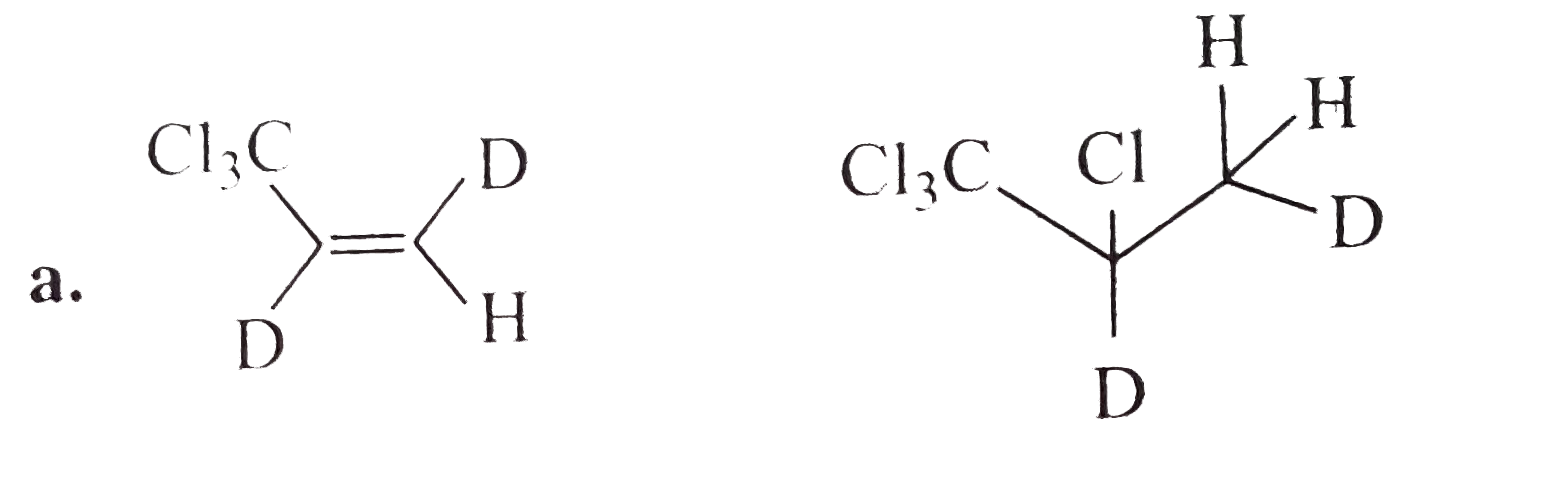
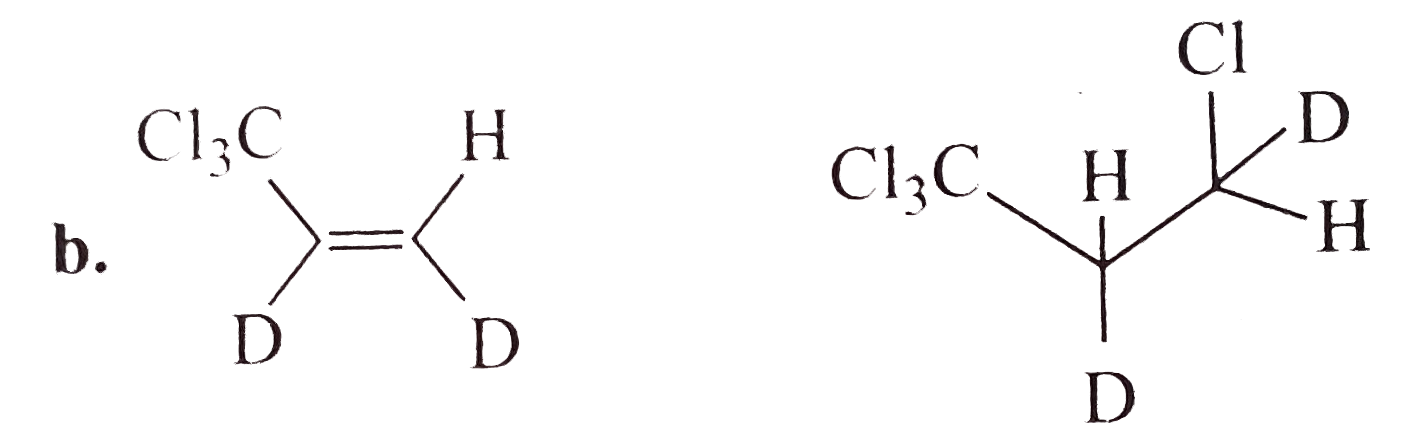
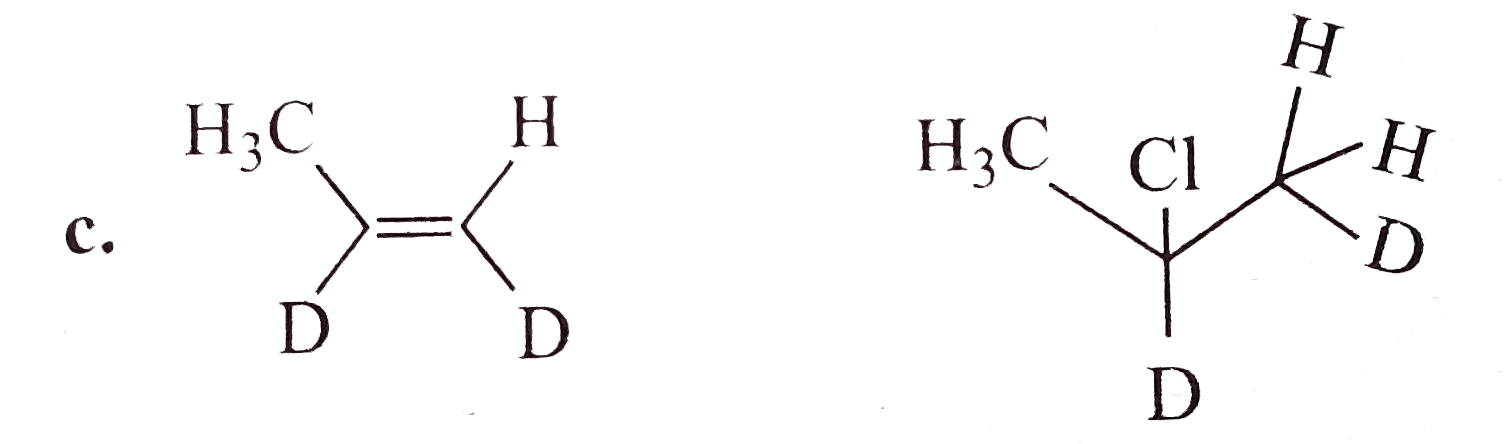
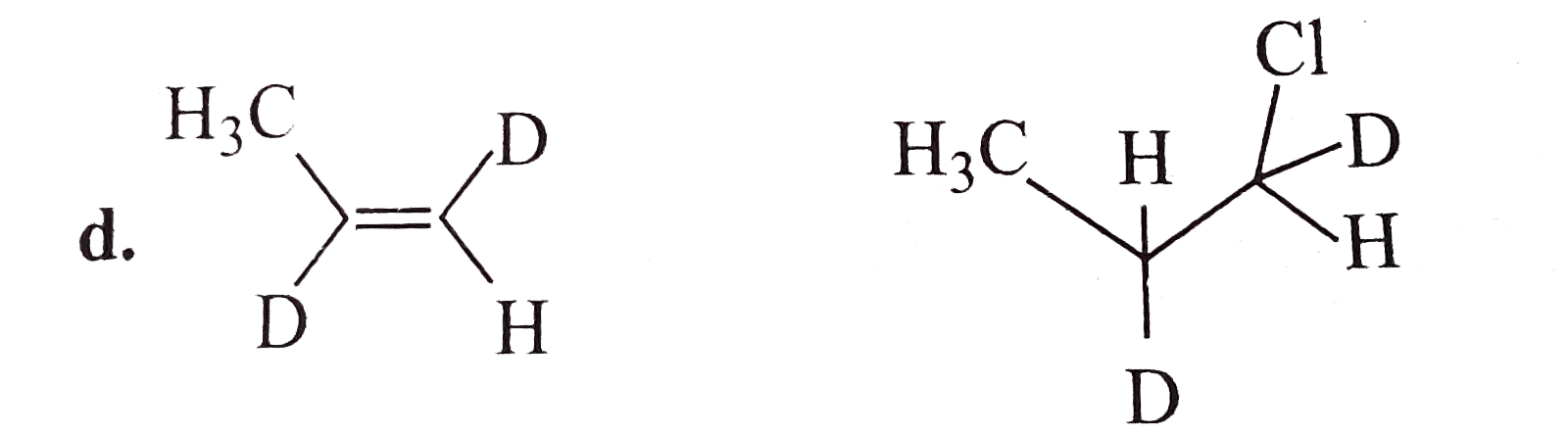
Compounds (A) and (B) are:

A

B

C

D

Text Solution

AI Generated Solution

The correct Answer is:

To solve the problem, we need to identify the compounds A and B based on the given reactions. Let's break down the steps systematically. ### Step 1: Identify Compound X The question states that we start with a compound represented as Cl₃-X-H, where X is a carbon atom with a triple bond. This means that X is likely a terminal alkyne with three chlorine atoms attached to it. **Hint:** Look for the structure of a terminal alkyne with three chlorine substituents. ### Step 2: Reaction with D₂ and P₂ Catalyst When compound X reacts with D₂ in the presence of a P₂ catalyst, it undergoes hydrogenation. This reaction will add hydrogen atoms across the triple bond. Since the reaction is a syn addition, both hydrogen atoms will add to the same side of the triple bond. **Hint:** Remember that syn addition means both substituents add to the same side of the double bond. ### Step 3: Structure of Compound A After the syn addition of D₂, compound A will have two hydrogen atoms added to the triple bond, converting it into a double bond. The structure of compound A can be represented as Cl₃C-CH=DH, where D represents the deuterium atoms added. **Hint:** Visualize the addition of hydrogen atoms to the triple bond and how it affects the overall structure. ### Step 4: Reaction with HCl Next, compound A reacts with HCl. In this reaction, HCl will add across the double bond. The hydrogen from HCl will add to the carbon with fewer substituents (following Markovnikov's rule), while the chlorine will add to the other carbon. **Hint:** Apply Markovnikov's rule to determine where the H and Cl will add. ### Step 5: Structure of Compound B After the addition of HCl to compound A, compound B will be formed. The structure can be represented as Cl₃C-CH₂Cl, where one chlorine atom remains attached to the first carbon, and the other chlorine atom is now attached to the second carbon. **Hint:** Ensure to account for the addition of H and Cl correctly based on the structure of compound A. ### Final Structures - **Compound A:** Cl₃C-CH=DH - **Compound B:** Cl₃C-CH₂Cl ### Conclusion Based on the above steps, we have identified the compounds A and B as follows: - **Compound A:** Cl₃C-CH=DH - **Compound B:** Cl₃C-CH₂Cl

To solve the problem, we need to identify the compounds A and B based on the given reactions. Let's break down the steps systematically. ### Step 1: Identify Compound X The question states that we start with a compound represented as Cl₃-X-H, where X is a carbon atom with a triple bond. This means that X is likely a terminal alkyne with three chlorine atoms attached to it. **Hint:** Look for the structure of a terminal alkyne with three chlorine substituents. ### Step 2: Reaction with D₂ and P₂ Catalyst ...
Promotional Banner

Topper's Solved these Questions

  • ALKYNES

    CENGAGE CHEMISTRY ENGLISH|Exercise Exercises (Archives - Single Correct Answer Type)|6 Videos
  • ALKYNES

    CENGAGE CHEMISTRY ENGLISH|Exercise Exercises (Archives - Fill in the Blanks Type)|3 Videos
  • ALKYNES

    CENGAGE CHEMISTRY ENGLISH|Exercise Exercises (Multiple Correct Answers Type)|25 Videos
  • ALKENES AND ALKADIENES

    CENGAGE CHEMISTRY ENGLISH|Exercise Single correct Answer|14 Videos
  • APPENDIX - INORGANIC VOLUME 1

    CENGAGE CHEMISTRY ENGLISH|Exercise chapter-7 Single correct answer|1 Videos

Similar Questions

Explore conceptually related problems

2HC-=CHoverset(CH_2Cl_2)underset(+NH_4Cl)rarr(A)overset(1 mol)underset(HCl)rarr(B) Compounds (A) and (B) are:

overset((i)CH_(3)CHO)underset((ii)H_(3)O^(+))rarr (A) overset(HBr)rarr (B) The compounds (A) and (B)

2HC-=Choverset(Cu^(2+)+O_2)rarr(A)overset(1 mol)underset(HCl)rarr(B) Compound (A) and (B) are:

R-underset((A))-=--=-Roverset("Lindlar's catalyst" +H_2)rarr(B) Compounds (B) and (C) are:

(CH_(3))_(2)COoverset(NaCN)underset(HCI)rarr(A)underset(Delta)overset(H_(3)^(+)O)rarr(B) In the above sequence of reactions, (A) and (B) are :

Which of the statements are correct? R--=-Runderset(Catalyst)overset(H_2+P-2)rarr(A)overset(MMPP)rarr(B)overset(H^(+)//H_2O)rarr+(C) (D)overset(MMPP)rarr(E)overset(H^(+)//H_2O)rarr(F)

CH_(3)-C-=CHunderset("catalyst")overset("Linddar's")rarr(A)underset(H_(2)O)overset("Conc"H_(2)SO_(4))rarr(B) What are the products (A) and (B) in the given reaction?

Et-N^(o+)-=C^(ɵ) underset(or HgO or O_(3))overset(Cl_(2)+DMSO)(rarr) . The compound (A) is:

(CH_(3))_(2)CHI overset(KOH)underset(EtOH)rarr A overset(SO_(2)Cl_(2))underset(475 K)rarr B The compound B in the sequence is

(A)(C_(4)H_(8)O)overset(H_(3)O^(o+))rarr(B)overset(CrO_(3))underset("acetic acid")rarr(C )overset(CH_(2)N_(2))underset(Delta)rarr(D) The compound 'D' is
