
Home
Class 11
CHEMISTRY
H--=-Hoverset((i)O3)underset((ii)(H2O)//...

`H--=-Hoverset((i)O_3)underset((ii)(H_2O)//(Zn))rarr(A)overset(Zn//CH_3COOH)rarr(B)`
Compound (B):

A

B

(b) `Me-COOH`

C

D

d.

Text Solution

AI Generated Solution

The correct Answer is:

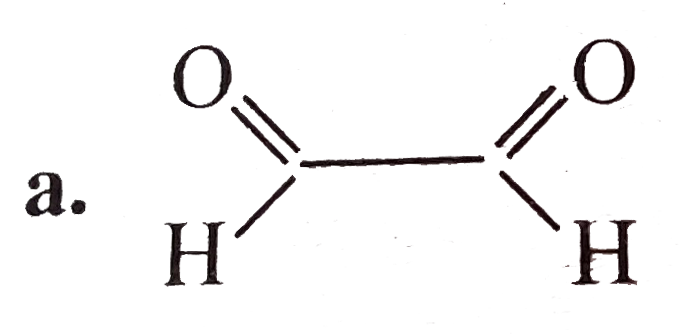
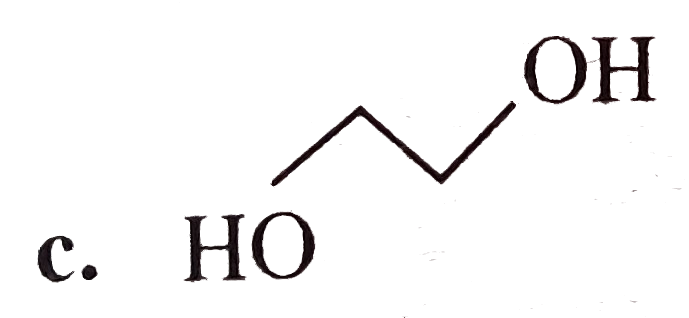
To solve the problem, we will go through the reactions step by step, starting from the alkyne and determining the final compound (B) formed after the reactions with ozone (O3), zinc (Zn), and acetic acid (CH3COOH). ### Step 1: Identify the starting compound The starting compound is an alkyne, which is represented as H-C≡C-H (ethyne or acetylene). ### Step 2: Ozonolysis of the alkyne When the alkyne reacts with ozone (O3), it undergoes ozonolysis. This reaction cleaves the triple bond and forms carbonyl compounds. The reaction can be represented as follows: \[ \text{H-C≡C-H} + \text{O}_3 \rightarrow \text{H-C(=O)-C(=O)-H} \] This results in the formation of a compound known as an aldehyde, specifically glyoxal (H2C=O-C(=O)H). ### Step 3: Reduction of the ozonolysis product Next, the product from the ozonolysis (glyoxal) is treated with zinc (Zn) and water (H2O). The zinc reduces the carbonyl groups (C=O) to hydroxyl groups (C-OH). The reaction can be represented as: \[ \text{H-C(=O)-C(=O)-H} + \text{Zn} + \text{H}_2\text{O} \rightarrow \text{H-C(OH)-C(OH)-H} \] This results in the formation of a compound with two hydroxyl groups, specifically glycerol (C3H8O3). ### Step 4: Final product formation with acetic acid Finally, when glycerol is treated with acetic acid (CH3COOH) in the presence of zinc, no significant change occurs to the structure of glycerol. Therefore, the final compound (B) remains as glycerol. ### Conclusion The final compound (B) formed after the reactions is glycerol (C3H8O3). ### Summary of the steps: 1. Start with the alkyne (H-C≡C-H). 2. React with O3 to form glyoxal (H-C(=O)-C(=O)-H). 3. Reduce glyoxal with Zn and H2O to form glycerol (H-C(OH)-C(OH)-H). 4. Treat glycerol with acetic acid, resulting in no change. ### Final Answer: Compound (B) is Glycerol (C3H8O3).

To solve the problem, we will go through the reactions step by step, starting from the alkyne and determining the final compound (B) formed after the reactions with ozone (O3), zinc (Zn), and acetic acid (CH3COOH). ### Step 1: Identify the starting compound The starting compound is an alkyne, which is represented as H-C≡C-H (ethyne or acetylene). ### Step 2: Ozonolysis of the alkyne When the alkyne reacts with ozone (O3), it undergoes ozonolysis. This reaction cleaves the triple bond and forms carbonyl compounds. The reaction can be represented as follows: \[ \text{H-C≡C-H} + \text{O}_3 \rightarrow \text{H-C(=O)-C(=O)-H} \] ...
Promotional Banner

Topper's Solved these Questions

  • ALKYNES

    CENGAGE CHEMISTRY ENGLISH|Exercise Exercises (Archives - Single Correct Answer Type)|6 Videos
  • ALKYNES

    CENGAGE CHEMISTRY ENGLISH|Exercise Exercises (Archives - Fill in the Blanks Type)|3 Videos
  • ALKYNES

    CENGAGE CHEMISTRY ENGLISH|Exercise Exercises (Multiple Correct Answers Type)|25 Videos
  • ALKENES AND ALKADIENES

    CENGAGE CHEMISTRY ENGLISH|Exercise Single correct Answer|14 Videos
  • APPENDIX - INORGANIC VOLUME 1

    CENGAGE CHEMISTRY ENGLISH|Exercise chapter-7 Single correct answer|1 Videos

Similar Questions

Explore conceptually related problems

overset((i)CH_(3)CHO)underset((ii)H_(3)O^(+))rarr (A) overset(HBr)rarr (B) The compounds (A) and (B)

What is the final product of the reaction? (CH_3)_(2)C = CHCH_2CH_(3) overset((i) BH_3//THF)underset((ii)H_2O_2, OH^-)(rarr)overset(PC C)(rarr) underset((ii)H_2O^+)overset((i) CH_3MgBr)(rarr)

Phenol overset("(i) NaOH")underset("(ii) "CO_(2))rarr(A)overset(H^(+)//H_(2)O)rarr (B)overset(Ac_(2)O)rarr(C) In this reaction , identify the incorrect statement?

Give the formulae of [A] and [B] CH_(3)CH_(2)MgBr+CO_(2)overset((i)"Dry ether")underset((ii)H^(+)//H_(2)O)rarr[A]overset(PCl_(5))rarr[B]

Complete the following reaction sequence : CH_(3)-overset(O)overset(||)C-CH_(3)overset((i)CH_(3)MgBr)underset((ii)H_(2)O)rarr(A)overset("Na metal")underset("ether")rarr(B)overset(CH_(3)-Br)rarr(C)

Complete the following reaction sequence : CH_(3)-overset(O)overset(||)C-CH_(3)overset((i)CH_(3)MgBr)underset((ii)H_(2)O)rarr(A)overset("Na metal")underset("ether")rarr(B)overset(CH_(3)-Br)rarr(C)

Consider the following reaction (A)overset((i)O_3)underset((ii)H_2"O"//Zn)rarrCH_3-overset(O)overset(||)C-CH_2-overset(O)overset(||)C-CH_2-overset(O)overset(||)C-CH_3+3HCHO Compound 'A' will be

Consider the following sequence of reactions C_(2)H_(5)C -= CH overset(CH_(3)MgBr)rarr A underset((2)H_(2)O^(+))overset((1)HCHO) rarr B The product (B) is

The missing structures A and B in the recation sequence: R -CH_(2)-CH_(2)OH overset(AI(2)O_(3))underset(350^(@)C)rarrR-CH=CH_(2)overset((i)O_(3))underset((ii)Zn//H_(3)O)rarr RCHO +A, RCHO overset(Reduct)rarrB , are
