
Home
Class 12
CHEMISTRY
Which of the following halides does for...

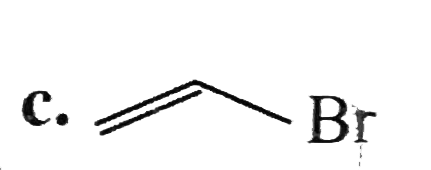
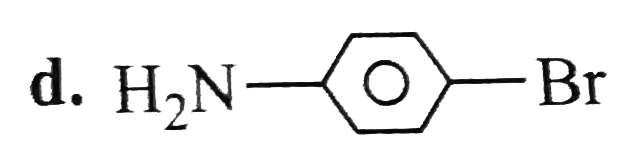
Which of the following halides does form `G.R` when treated with magnesium in the presence of ether ?

A

`PhBr`

B

C

D

Text Solution

AI Generated Solution

The correct Answer is:

To determine which halides form Grignard reagents when treated with magnesium in the presence of ether, we need to analyze each option based on the presence of active hydrogen atoms. Grignard reagents are formed from alkyl or aryl halides that do not contain acidic hydrogens. ### Step-by-Step Solution: 1. **Understanding Grignard Reagents:** - Grignard reagents are organometallic compounds represented as R-MgX, where R is an alkyl or aryl group, and X is a halogen. - They are formed when alkyl or aryl halides react with magnesium in the presence of an ether solvent. 2. **Identifying Active Hydrogen:** - Active hydrogens are typically found in compounds such as alcohols, amines, and carboxylic acids. These hydrogens can interfere with the formation of Grignard reagents. 3. **Analyzing Each Option:** - **Option A: Phenyl Bromide (C6H5Br)** - This compound does not have any active hydrogen atoms. Therefore, it can react with magnesium to form a Grignard reagent (C6H5-MgBr). - **Option B: Alkyl Halide (e.g., 1-Bromopropane)** - Similar to phenyl bromide, this compound does not have active hydrogen atoms. It can also react with magnesium to form a Grignard reagent (C3H7-MgBr). - **Option C: Another Alkyl Halide (e.g., 1-Bromo-2-methylpropane)** - This compound also lacks active hydrogen atoms, allowing it to form a Grignard reagent (C4H9-MgBr). - **Option D: Parabromoaniline (C6H4BrNH2)** - This compound contains an amine group (NH2), which has an active hydrogen. When reacted with magnesium, the active hydrogen will interfere with the formation of the Grignard reagent, leading to the formation of an unstable compound instead. 4. **Conclusion:** - Options A, B, and C can form Grignard reagents, while option D cannot due to the presence of active hydrogen. ### Final Answer: **Options A, B, and C form Grignard reagents when treated with magnesium in the presence of ether. Option D does not form Grignard reagent.** ---

To determine which halides form Grignard reagents when treated with magnesium in the presence of ether, we need to analyze each option based on the presence of active hydrogen atoms. Grignard reagents are formed from alkyl or aryl halides that do not contain acidic hydrogens. ### Step-by-Step Solution: 1. **Understanding Grignard Reagents:** - Grignard reagents are organometallic compounds represented as R-MgX, where R is an alkyl or aryl group, and X is a halogen. - They are formed when alkyl or aryl halides react with magnesium in the presence of an ether solvent. ...
Promotional Banner

Topper's Solved these Questions

  • GRIGNARD REAGENTS AND ORGANOMETALLIC REAGENTS

    CENGAGE CHEMISTRY ENGLISH|Exercise Exercises (Single Correct)|47 Videos
  • GRIGNARD REAGENTS AND ORGANOMETALLIC REAGENTS

    CENGAGE CHEMISTRY ENGLISH|Exercise Exercises Archives (Single Correct)|4 Videos
  • GRIGNARD REAGENTS AND ORGANOMETALLIC REAGENTS

    CENGAGE CHEMISTRY ENGLISH|Exercise Exercises (Linked Comprehension)|33 Videos
  • GENERAL PRINCIPLES AND PROCESS OF ISOLATION OF ELEMENTS

    CENGAGE CHEMISTRY ENGLISH|Exercise Archives (Subjective)|14 Videos
  • NCERT BASED EXERCISE

    CENGAGE CHEMISTRY ENGLISH|Exercise Nuclear Chemistry (NCERT Exercise)|29 Videos

Similar Questions

Explore conceptually related problems

Which of the following halides does not form G.R when treated with magnesium in the presence of ether ?

Which of the following halide does not exist

Which of the following halide does not hydrolyse

Which of the following does not form Grignard reagent on reaction with Mg in the presence of ether?

Which of the following reaction does not form an ether ?

Which of the following pairs will not form ether?

Which of the following compounds are formed when BCI_(3) is treated with water?

Which of the following halides does not hydrolyse at room temperature?

Which of the following product is formed , when ether is exposed to air :

Which of the following pairs of reagents will not form ether?
