Home
Class 12
CHEMISTRY
Identify A, B, and C, i. Isomeric alc...

Identify A, B, and C,
i. Isomeric alcohols (A), (B), and (C) `(C_(5)H_(12)O)`.
ii. (A) and (B) react with chromic acid solution. (B) gives an acid (D).
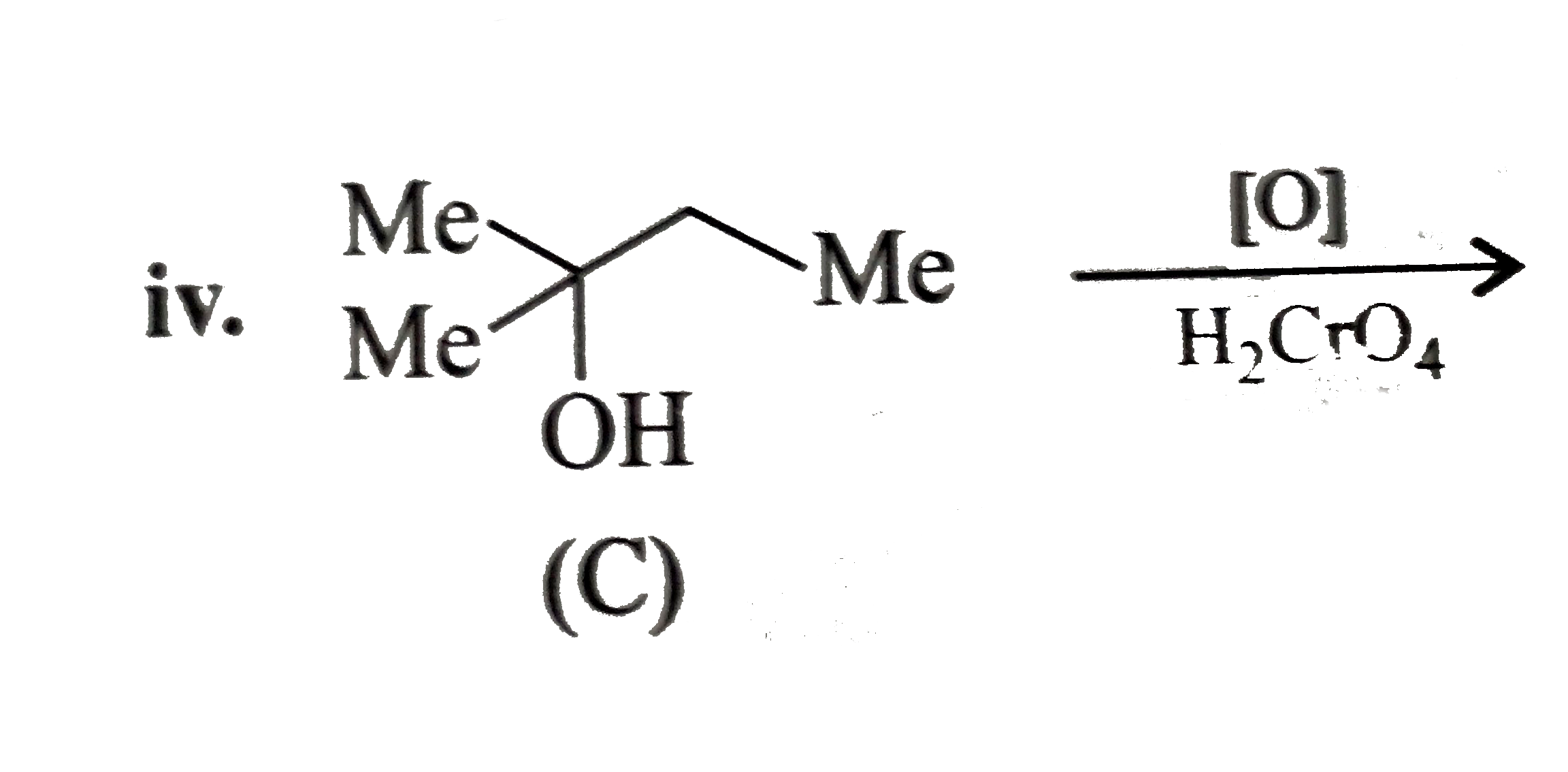
iii. Reactivity with HBr is `C gt A gtgt B` . All give the same compound, `C_(5)H_(11)Br` (E).
iv. Only (A) is oxidised by NaOI.

Text Solution

Verified by Experts
i. Zero DU in all alcohols suggests the absence of ring or `(C=C)` or `(C-=C)` bond.
ii. `overset ((B)) underset (ROH)` `overset (H_(2)CrO_(4)) rarr` Acid (D) suggests that (B) is `1^(@)`
`overset ((A)) underset (ROH)` `overset (H_(2)CrO_(4)) rarr` No acid suggests that (A) is `2^(@)`
iii. Reactivity with HBr suggests, (C) is `3^(@)` ROH. Reaction of (A) with NaOI (Iodoform test) suggests. `(R-underset(OH)underset(|)(C )H-CH_(3))` type of alcohol.
(A), (B), and (C) `overset (HBr) rarr` Same `C_(5)H_(11)Br` (E) suggests that rearrangement is taking place by `H^(-)` or Me shift.
iv. `overset ([O]) underset (H_(2)CrO_(4) rarr` No reaction


Promotional Banner

Topper's Solved these Questions

  • ALCOHOL,PHENOL AND ETHERS

    CENGAGE CHEMISTRY ENGLISH|Exercise Exercises Concept Application|33 Videos
  • ALCOHOL,PHENOL AND ETHERS

    CENGAGE CHEMISTRY ENGLISH|Exercise Exercises Linked Comprehension|60 Videos
  • ALCOHOL,PHENOL AND ETHERS

    CENGAGE CHEMISTRY ENGLISH|Exercise Solved Examples|17 Videos
  • ALIPHATIC AND AROMATIC ALDEHYDES AND KETONES

    CENGAGE CHEMISTRY ENGLISH|Exercise Archives Subjective|26 Videos

Similar Questions

Explore conceptually related problems

Compound (A)(C_(12)H_(16)) on oxidation with acidic KMnO_(4) solution gives acetone and . Identify compound (A) .

Compound (A) C_(8)H_(9)Br . Gives a white precipitate when warmed with alcoholic AgNO_(3) . Oxidation of (A) gives an acid (B). C_(8)H_(6)O_(4) . (B) easily forms anhydride on heating. Identify the compound (A)

Compound (A) C_(8)H_(9)Br . Gives a white precipitate when warmed with alcoholic AgNO_(3) . Oxidation of (A) gives an acid (B). C_(8)H_(6)O_(4) . (B) easily forms anhydride on heating. Identify the compound (A)

Deduct the structural formul of a compound (A) (C_(10)H_(16)) the gives (B) as the only compound on oxidation with acidic KMnO_(4) .

An organic compound (A) (C_(8)H_(14)O) forms an oxime and gives a positive haloform reaction. On ozonolysis, it gives acetone and a compound (B) (C_(5)H_(8)O_(2)) . (B) forms a dioxime and on subjecting to oxidation reaction gives an acid (C ) (C_(4)H_(6)O_(4)) . On treatment with excess of ammonia and strong heating, (C ) gives a neutral compound (D) (C_(4)H_(5)O_(2)N) . (D) on distillation with zinc dust forms pyrrloe. Suggest the possible structures of (A), (B), (C ), and (D). Explain the chemical reactions involved.

Draw the structures of all isomeric alcohols of molecular formula C_(5)H_(12)O and give their IUPAC names

Find DU of following compound:- (A) C_(8)H_(12) , (B) C_(5)H_(10) , ( C) C_(7)H_(8) , (D)

An organic compound (A) (C_(5)H_(7)OCl) reacts rapidly with ethanol to give (B) (C_(7)H_(12)O_(2)) . (A) also reacts with water to produce an acid which reacts with bromine to give (C ) (C_(5)H_(8)Br_(2)O_(2)) . (B) on boiling with H_(2)SO_(4) forms an acid (D). When (D) is oxidised with KMnO_(4) an acid (E ) (C_(4)H_(6)O_(3)) is produced. On mild heating, (E ) gives (F) (C_(3)H_(6)O) which cannot be oxidised by ammoniacal AgNO_(3) . Identify the compounds (A) to (F).

Compound (A)(C_(8)H_(12)) on oxidation gives an acid B(C_(4)H_(6)O_(2)) . One mole of compound (A) reacts with 3 mol of H_(2) in the presence of Pt catalyst to give octane. Identify compound (A) .

CENGAGE CHEMISTRY ENGLISH-ALCOHOL,PHENOL AND ETHERS-Exercises Subjective
  1. Identify the following compounds : i. overset (C(6)H(6)) underset (...

    Text Solution

    |

  2. Identify A, B, and C, i. Isomeric alcohols (A), (B), and (C) (C(5)H...

    Text Solution

    |

  3. Identify (A)

    Text Solution

    |

  4. C(7)H(14) (A) decolourises Br(2) in C CI(4) and reacts with Hg(OAc)(2)...

    Text Solution

    |

  5. Compound (D), an isomer of (A) in Problem 4, reacts with BH(3). THF an...

    Text Solution

    |

  6. Compound (A), C(8)H(6)NOBr, is optically active. Reduction of (A) give...

    Text Solution

    |

  7. Identify A to E.

    Text Solution

    |

  8. An organic compound (A) (C(8)H(8)O(3)) was insoluble in water, dilute ...

    Text Solution

    |

  9. Neutralisation of 30 gm of a mixture of acetic acid and phenol solutio...

    Text Solution

    |

  10. Find the structure of (A), C(10)H(10)O(2), a sweet-smelling liquid tha...

    Text Solution

    |

  11. a. Isomers (A) and (B), C(10)H(12)O, are isolated form the oil of bay...

    Text Solution

    |

  12. An aromatic compound (A), C(7)H(5)NO(2)CI(2) on reduction with Sn//HCI...

    Text Solution

    |

  13. An organic compound (A) gives opsitive Liebermann reaction and on trea...

    Text Solution

    |

  14. Two isomeric compounds, (A) and (B), have the same formula, C(11)H(13)...

    Text Solution

    |

  15. Nirtobenzene is formed as the major product along with a minor product...

    Text Solution

    |

  16. Identify A, B, and C, in the following reaction.

    Text Solution

    |

  17. Provide a mechanism for the products (A) and (B). Which one will be th...

    Text Solution

    |

  18. Identify the substances (A) through (D) in a sequence. Comment on...

    Text Solution

    |

  19. Identify each of the following glucose derivative. a. A+5HIO(4)rarr...

    Text Solution

    |

  20. If is treated with alkaline NaN(3) and followed by reduction with H(2...

    Text Solution

    |