Home
Class 12
CHEMISTRY
(a) Write the resonance structure of car...

(a) Write the resonance structure of carboxylic acid derivative `(R-underset(O)underset(||)(C)-G)` and account for the stability and electrophilic character of the `(C=O)` group.
(b) Why is the `(C-G)` bond in the acid derivative shorter and stronger than the `(R-G)` bond in alkyl derivative ?

Text Solution

Verified by Experts
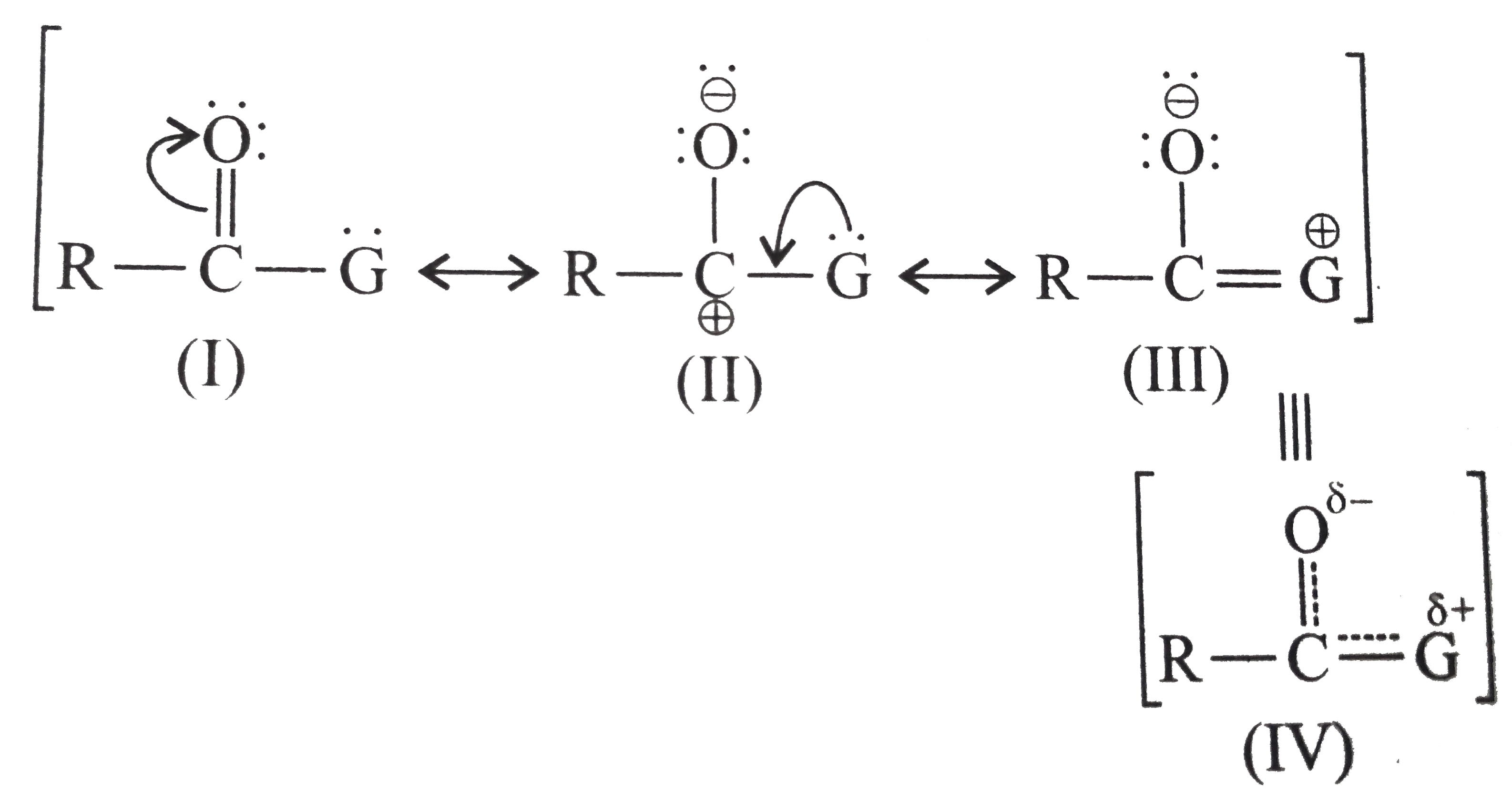
(a)
The `EDG` from `G` to `O` stabilities `(C==O)`, thereby decreasing the electrophilic character of `C`.
(b) In `(R-overset(O)overset(||)(C)-G), C` of `(C=O)`group is `sp^2-hybridised` with `G`, while `C` in `(R-G)(R-Cl , R-NH_2, R-OH R-OR`, etc) is `sp^3-hybridised`. In `sp^2`, the s-character is more than that in `sp^3`, which makes the `(C-G)` bond in acid derivatives shorter and stronger than the `(R-G)` bond in alkyl derivative. The dipolar hybrid structure `(IV)` with a partial double bond between `(C and G)` is also responsible for these bond properties.
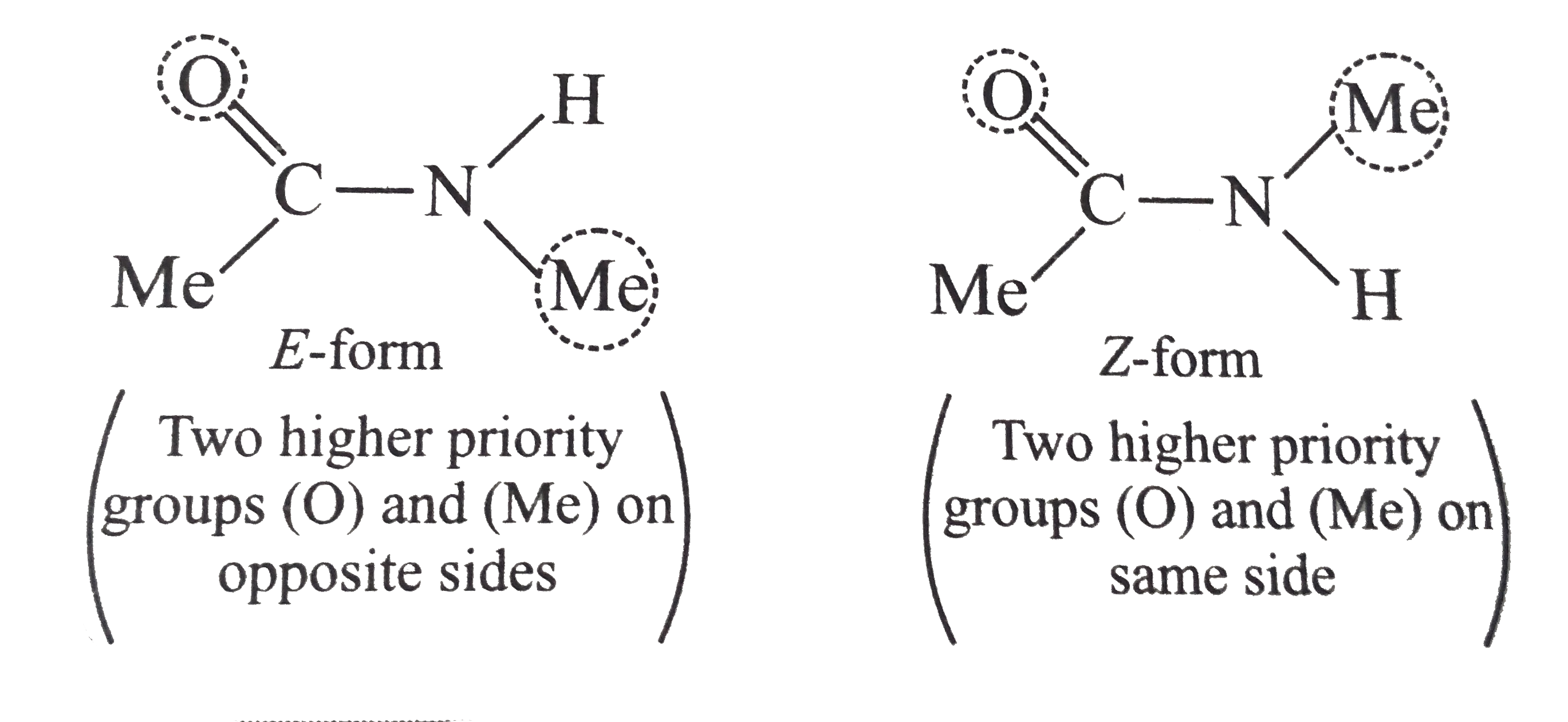
c. `(Me-overset(O)overset(||)(C)-NH-Me)` (N-Methyl ethanamide or N-methyl acetamide).
It exists in two eclipsed configuration structures, i.e., `E-` and `Z-forms`. Although they are not isolable at room `E-` and `Z-forms`. Althrough they ar not isolable at room `E-` and `Z-forms`. Although they are not isolable at room temperature, they can be detected by spectroscopic methods.
.
Promotional Banner

Topper's Solved these Questions

  • CARBOXYLIC ACIDS AND THEIR DERIVATIVES

    CENGAGE CHEMISTRY ENGLISH|Exercise Solved Examples|17 Videos
  • CARBOXYLIC ACIDS AND THEIR DERIVATIVES

    CENGAGE CHEMISTRY ENGLISH|Exercise Exercises (Subjective)|19 Videos
  • BIOMOLECULES

    CENGAGE CHEMISTRY ENGLISH|Exercise Exercises Archives (Analytical And Descriptive)|8 Videos
  • CHEMICAL KINETICS

    CENGAGE CHEMISTRY ENGLISH|Exercise Archives Subjective|23 Videos

Similar Questions

Explore conceptually related problems

(a) Write the resonance structure of RCOOH . (b) Why is (C-O) bond shorter in RCOOH than in ROH

A : CH_(3) - underset(O)underset(||)(C)-COOH gives haloform reaction . R : It is more acidic than acetic acid .

Write the structure of the product A & B C_(2)H_(5)-underset(O)underset(||)C-O^(18)C_(2)H_(5)overset(H_(3)O^(o+))rarrA+B

The given structure of alpha - amino acid will exist at which pH ? overset(o+)(N)H_3-underset(R)underset(|)overset(COOH)overset(|)C-H

Compare the acidities of amide (R-underset(O)underset (||)(C)-NH_(2)) and sulphonamide (R-underset(O)underset(||)overset(O)overset(|)S-NH_(2))

Give reasons for the following: The bond length of C =O bond in carboxylic acids is slightly larger than that in aldehydes and ketones. Why?

a) Draw the stereochemical structure of the product in the following reaction. R-C-=C-R overset(H_(2))underset("Lindlar's catalyst")to b) Write down the structures of the stereoisomers formed when cis-2-butene is reacted with bromine.

The reactivity of acid derivatives in general follows the order : The above order of reactivity can be explained in terms of the : (i) Basicity of leaving group (ii) Resonance effect (iii) Inductive effect Weaker is the basic character of leaving group, more is the reactivity of acid derivative. In general, all the acid derivatives show resonance as follows: More is the stablization, lesser is the reactivity and vice-versa. Acid derivatives although contain -overset(O)overset(||)C- group, yet do not undergo the usual properties of carbonyl group. It is due to

Write down the structures of (G) and (H) where (G) is C_4 H_8 O_3 . .

Protein are nitrogeneous organic compound having very high molecular mass. They are polyamide formed from alpha -amino acid. The bond formed between two amino acid is called peptide bond (-underset(O)underset(||)C-NH-) . The product obtained by this peptide bond formation are called peptide and they may be divided as di, tri, tetra, penta peptide. The given structure of amino acid will exist at which pH?

CENGAGE CHEMISTRY ENGLISH-CARBOXYLIC ACIDS AND THEIR DERIVATIVES-Exercises Archives (Analytical And Descriptive)
  1. (a) Write the resonance structure of carboxylic acid derivative (R-und...

    Text Solution

    |

  2. Write the chemical eqution to show what happens when 'Ethyl acetate is...

    Text Solution

    |

  3. State with balanced equation what happens when 'Acetic anhydride react...

    Text Solution

    |

  4. Give reasons for the following in one or two sentences. 'Acetic acid...

    Text Solution

    |

  5. Write down the reactions involved in the preparation of the following ...

    Text Solution

    |

  6. A certain hydrocarbon (A) was found to contain 85.7 % carbon and 14.3 ...

    Text Solution

    |

  7. Give reason in one or two sentences for the following : 'Formic acid i...

    Text Solution

    |

  8. Arrange the following in order of their increasing ease of hydrolysis ...

    Text Solution

    |

  9. Complete the following with appropriate structures : (CH(3) CO)(2) O...

    Text Solution

    |

  10. A liquid (X) having a molecular formula C(6) H(12) O(2) is hydrolysed ...

    Text Solution

    |

  11. Write the balanced equations for the following reaction : 'Acetamide...

    Text Solution

    |

  12. An organic compound (A) on treatment with acetic acid in the presence ...

    Text Solution

    |

  13. Give reasons for the following : 'Carbon-oxygen bond lengths in form...

    Text Solution

    |

  14. Conversion of Ethanoic acid to mixture of methanoic acid and diphenyl ...

    Text Solution

    |

  15. The sodium salt of a carboxylic acid, A, was produced by passing a gas...

    Text Solution

    |

  16. In the following, identify the compounds/reaction conditions represent...

    Text Solution

    |

  17. Arrange the following as stated : 'Increasing order of acidic streng...

    Text Solution

    |

  18. In the following identify the compounds/reaction conditions represente...

    Text Solution

    |

  19. Complete the following sequence of the reactions with approprite struc...

    Text Solution

    |

  20. Identify the major product in the following reactions : (i) (ii) ...

    Text Solution

    |

  21. In the following reactions, identify the compounds A, B, C and D. (i...

    Text Solution

    |