Home
Class 12
CHEMISTRY
(a) Why is DMF (dimethyl formamide) a us...

(a) Why is `DMF` (dimethyl formamide) a useful solvent ?
(b) Why is formyl chloride unstable ?

Text Solution

Verified by Experts
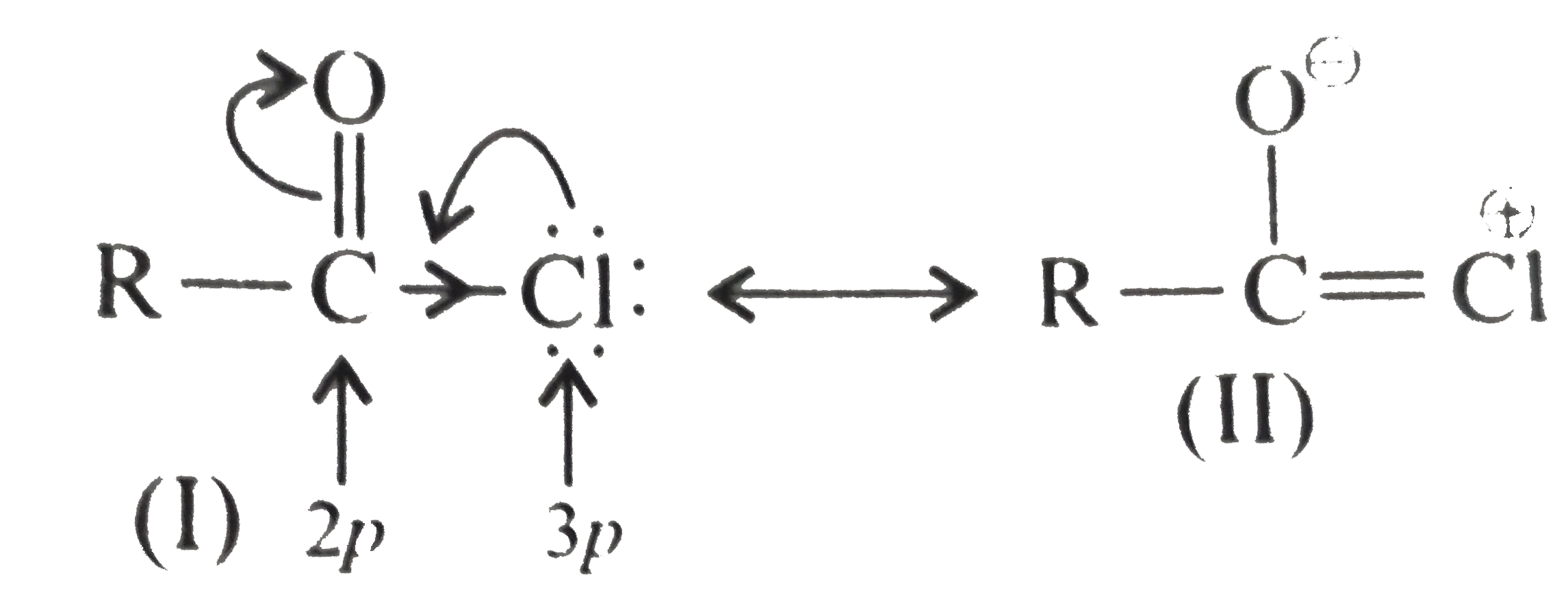
(a) Nearly te same `(C-Cl)` bond length in `(R-overset(O)overset(||)(C)-CI)` and `(R-Cl)` suggests that the extent of delocalisation by `Cl` in `(R-overset(O)overset(||)(C)-CI)` is very small or non-existent `[(-I)` and `(+R)` effects of `Cl, (+R)` effect or `pi-bond` overlap is not effective because of `2p` of `C` and `3p` of `Cl` overlap]. So, the contribution of resonance hybrid structure `(II)` is very small or non-existent.

(b) The relative importance of delocalisation decreases in the order `RCONH_2 gt RCOOR' gt RCOX`. as the `EN` (electronegativity) of `G` increases in the same period (i.e., `(-I)` effect increase, from `N gt O gt X`.
The `(C-Cl)` bond is longer than the `(C-F)` bond, although `EN` of `F` is greater than `Cl`. However, `(+R)` effect is not effective in `(C-Cl)` but effective in `(C-F)` because of the effective overlap of `2p` of `C` with `2p` of `F`.
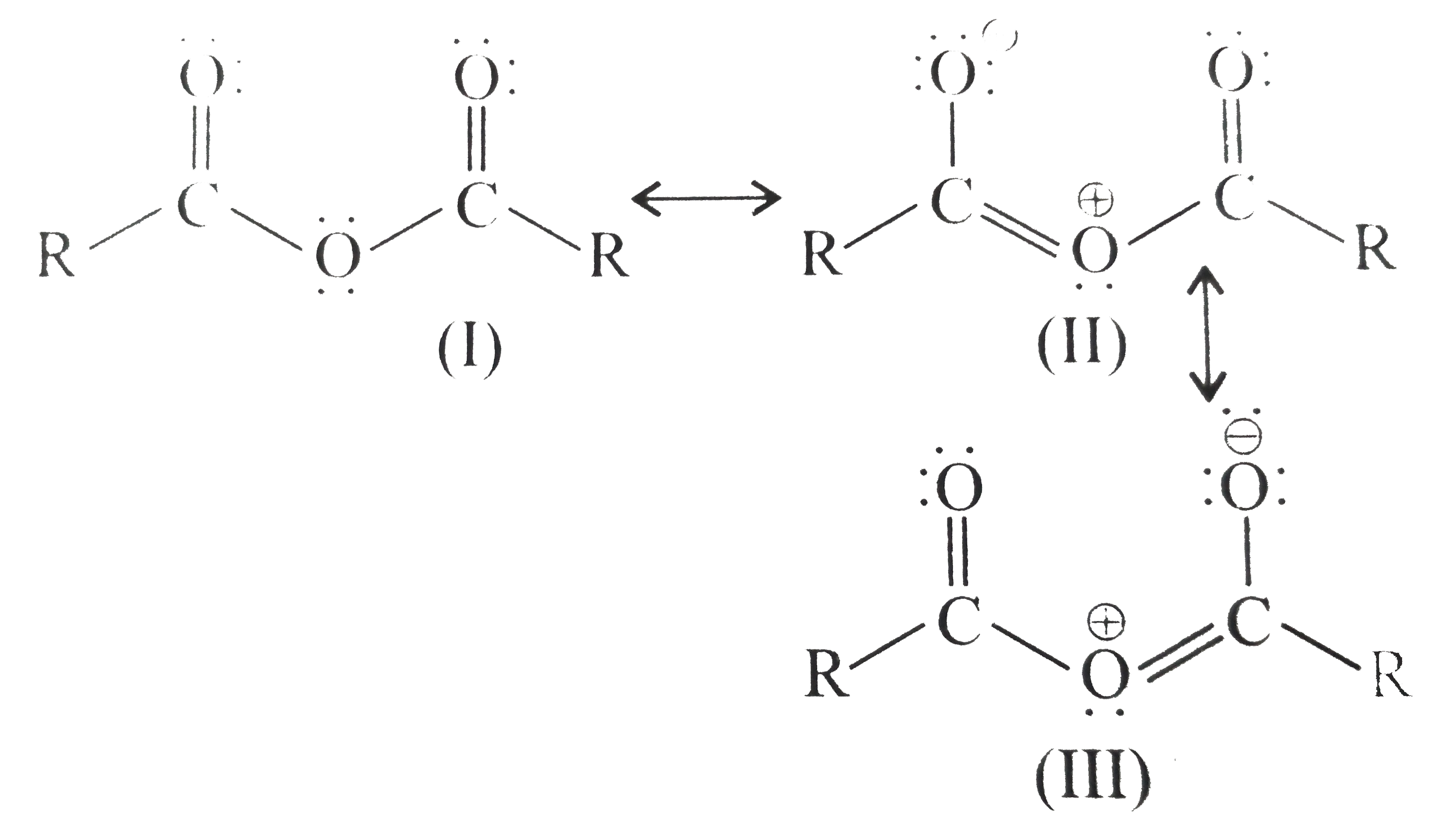
( c) Resonance structure of anhydride.

Cross conjugation in the resonance structures of anhydride decreases the delocalisation of each `O` of `(C=O)` group and gives `(C-O) sigma-bond` less double-bond characte. Thus, the `(C-O)` bond length is longer in anhydrides than in esters.
(d) Resonance structure of esters :

Due to delocalisation of `overline e^, s` in esters, the positive charge on `C` of the `(C=O)` group is more spread out. This results in a smaller dipole moment and weater dipole-dipole attraction in esters than in ketones. So, esters have low boiling in ester points than ketones.
Acids have strong intermolecular `H-`bonding, while esters do not have. So the boiling points of esters are lower than those of acids.
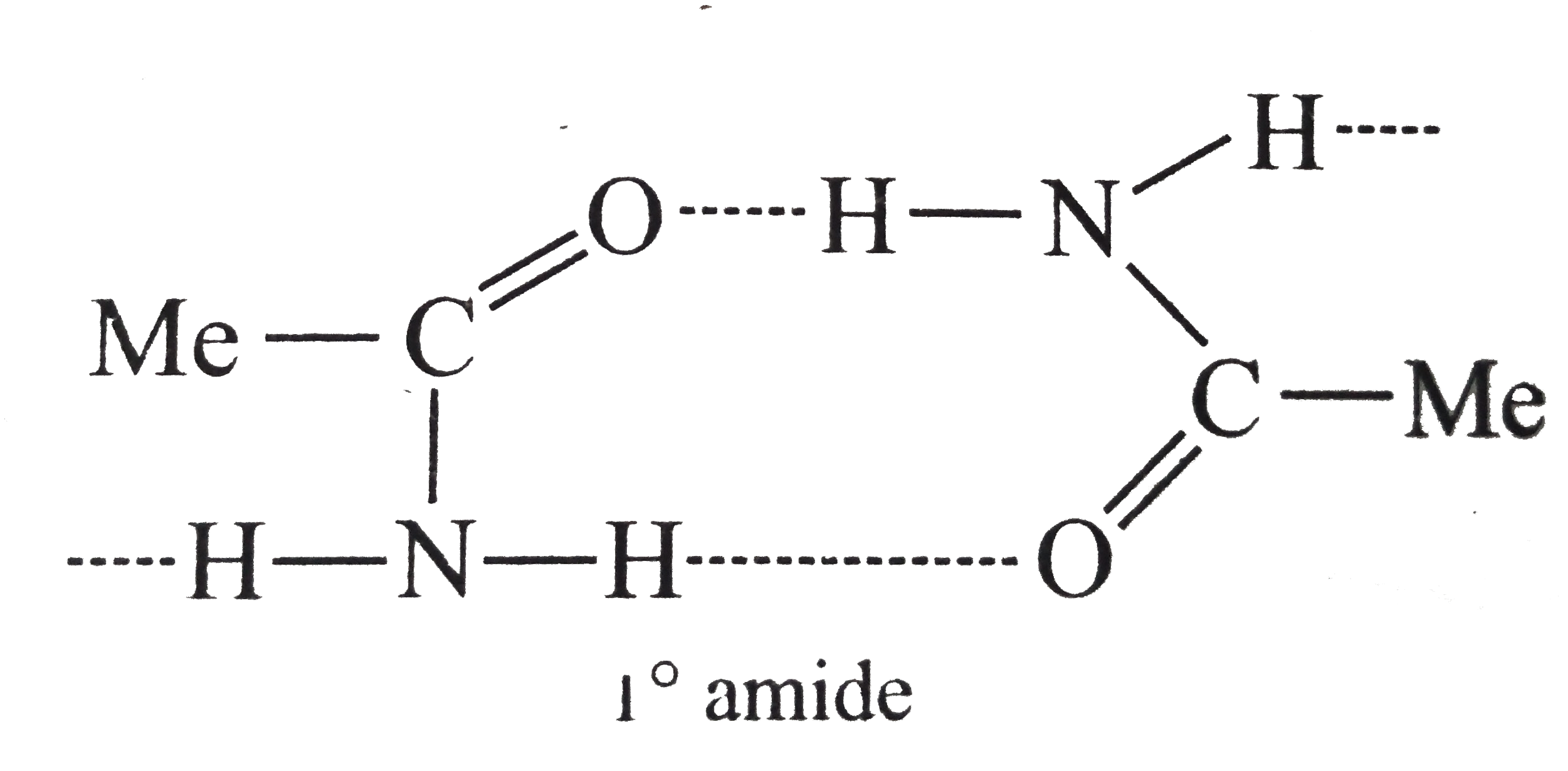
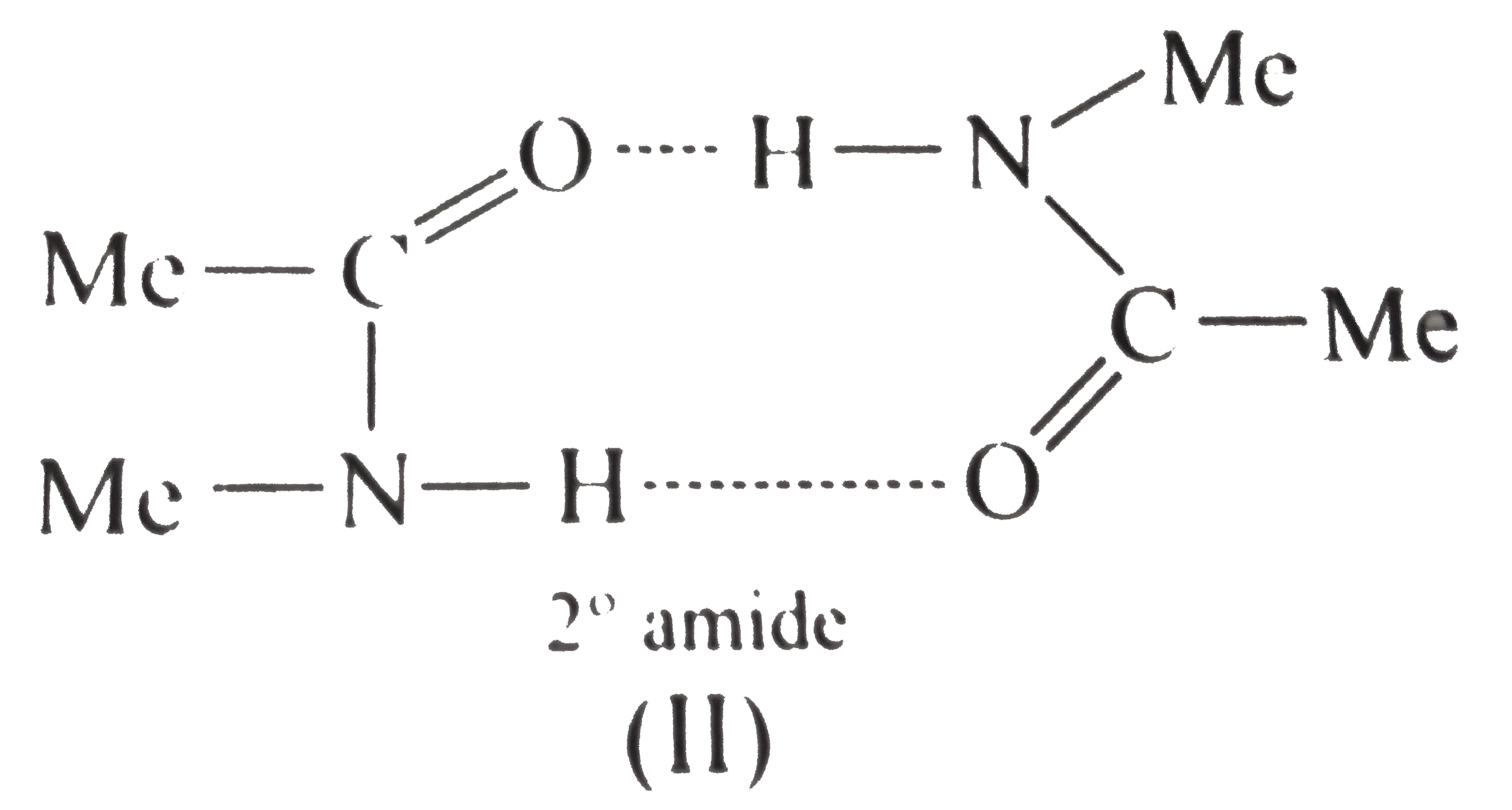
( e) `1^@` and `2^@` amides exist as dimer in the solid and pure liquid state through intermolecular `H-`bonding. `1^@` amides have two `H` atoms. While `2^@` amides have one `H` atom. So intermolecular `H-`bonding is more in `1^@` amide than in `2^@` amides. `3^@` amdies lack `H` atoms and thus do not have `H-`bonding.
So, the boinling points of `1^@ amide (I) gt 2^@ amide (II) gt 3^@ amide (III)`.

(f) `DMF, (H-overset(O)overset(||)(C)-underset(Me)underset(|)(N)-Me)` , is an aprotic solvent, i.e., it has no `H` atom for `H-bonding` and has a high dipole moment. So `DMF` does not form `H-bonds` with anions although it dissolves many ionic compounds. The salts are dissolved through solvation of the cation by the attraction towards the end of the `(C-O)` dipole. The positive end of the dipole shielded within the molecule and solvates anion very weakly.

(g) `(H-overset(O)overset(||)(C)-CIoverset(Delta)rarr C-=O +HX)`
The decomposition reaction is favoured since the `Delta H_(f)^(@)` of `CO` is high (more negative) which indicates the stability of `(C -= O)` bond. Formyl chloride is unstable above `213 K(-60^@ C)`.
Promotional Banner

Topper's Solved these Questions

  • CARBOXYLIC ACIDS AND THEIR DERIVATIVES

    CENGAGE CHEMISTRY ENGLISH|Exercise Solved Examples|17 Videos
  • CARBOXYLIC ACIDS AND THEIR DERIVATIVES

    CENGAGE CHEMISTRY ENGLISH|Exercise Exercises (Subjective)|19 Videos
  • BIOMOLECULES

    CENGAGE CHEMISTRY ENGLISH|Exercise Exercises Archives (Analytical And Descriptive)|8 Videos
  • CHEMICAL KINETICS

    CENGAGE CHEMISTRY ENGLISH|Exercise Archives Subjective|23 Videos

Similar Questions

Explore conceptually related problems

Why are heavy nuclei usually unstable?

Why is water called a universal solvent ? How is this useful ?

Why Cr is used for coating Fe ?

Why is water called the universal solvent?

What is chromyl chloride test? Why is it so named?

Why the halogen compounds used as solvents in industry are chlorides rather than bromides?

Why is diethyl ether used as solvent in the prparation of Grignard reagents ?

Why is hydrogen chloride not collected over water ?

Why do alkyl chlorides have higher dipole moment as compared to aryl chlorides ?

Which alkali metal carbonate is thermally unstable and why?

CENGAGE CHEMISTRY ENGLISH-CARBOXYLIC ACIDS AND THEIR DERIVATIVES-Exercises Archives (Analytical And Descriptive)
  1. (a) Why is DMF (dimethyl formamide) a useful solvent ? (b) Why is fo...

    Text Solution

    |

  2. Write the chemical eqution to show what happens when 'Ethyl acetate is...

    Text Solution

    |

  3. State with balanced equation what happens when 'Acetic anhydride react...

    Text Solution

    |

  4. Give reasons for the following in one or two sentences. 'Acetic acid...

    Text Solution

    |

  5. Write down the reactions involved in the preparation of the following ...

    Text Solution

    |

  6. A certain hydrocarbon (A) was found to contain 85.7 % carbon and 14.3 ...

    Text Solution

    |

  7. Give reason in one or two sentences for the following : 'Formic acid i...

    Text Solution

    |

  8. Arrange the following in order of their increasing ease of hydrolysis ...

    Text Solution

    |

  9. Complete the following with appropriate structures : (CH(3) CO)(2) O...

    Text Solution

    |

  10. A liquid (X) having a molecular formula C(6) H(12) O(2) is hydrolysed ...

    Text Solution

    |

  11. Write the balanced equations for the following reaction : 'Acetamide...

    Text Solution

    |

  12. An organic compound (A) on treatment with acetic acid in the presence ...

    Text Solution

    |

  13. Give reasons for the following : 'Carbon-oxygen bond lengths in form...

    Text Solution

    |

  14. Conversion of Ethanoic acid to mixture of methanoic acid and diphenyl ...

    Text Solution

    |

  15. The sodium salt of a carboxylic acid, A, was produced by passing a gas...

    Text Solution

    |

  16. In the following, identify the compounds/reaction conditions represent...

    Text Solution

    |

  17. Arrange the following as stated : 'Increasing order of acidic streng...

    Text Solution

    |

  18. In the following identify the compounds/reaction conditions represente...

    Text Solution

    |

  19. Complete the following sequence of the reactions with approprite struc...

    Text Solution

    |

  20. Identify the major product in the following reactions : (i) (ii) ...

    Text Solution

    |

  21. In the following reactions, identify the compounds A, B, C and D. (i...

    Text Solution

    |