Home
Class 12
CHEMISTRY
(a) Why do acyl chlorides undergo nucleo...

(a) Why do acyl chlorides undergo nucleophilic attack more readily than alkyl chlorides ?
(b) What is hydroxamic acid test and which functional group is determined by this test ?

Text Solution

Verified by Experts
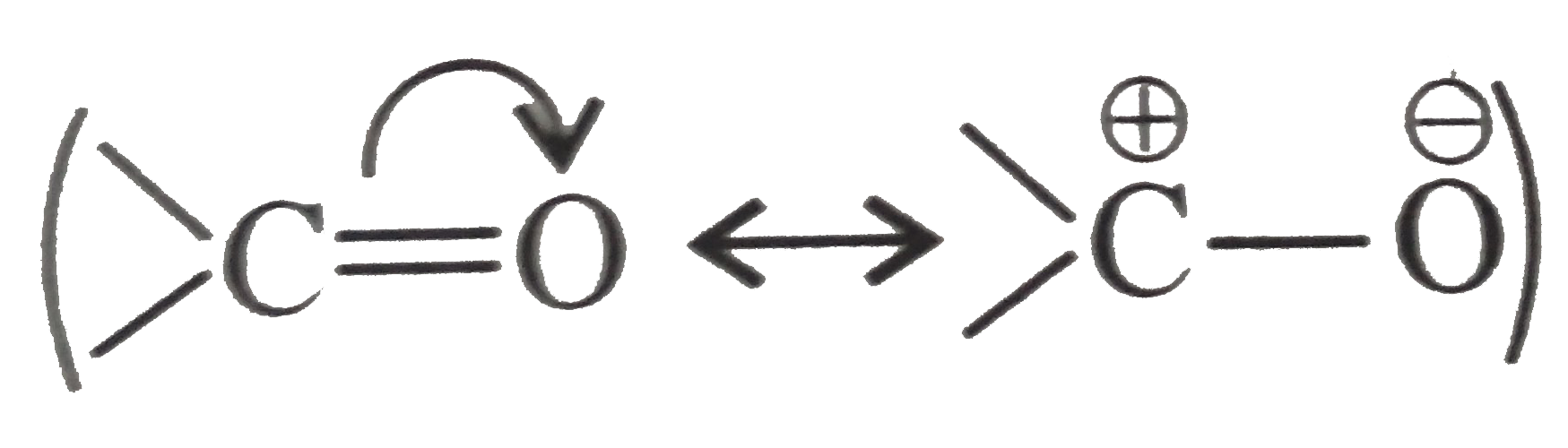
(a) `RCOCl` is more reactive than `RCl` because :
(i) The electromeric effect of `(C=O)` in `RCOCl` . `C` is more positive and more electrophilic than `C` in `(R-Cl)`.

(ii) The `T.S` (transition state) in acid derivative is tetrahedral intermediate and is less sterically hindered than the `T.S` with pentavalent `C` in the `SN^2` reaction of `RCl`.
(iii) In `RCOCl`, a weaker `pi-bond` is broken while in `RCl`, a `sigma-bond` is partically broken to form alkyl `T.S`.
(b) The test is used to detect ester an anhydride groups. Esters and anhydrides react with hydroxylamine `(NH_2 OH)` to form hydroxamic acid `(RCONHOH)`, which gives red-to-violet coloured complex with `FeCl_3`.
Promotional Banner

Topper's Solved these Questions

  • CARBOXYLIC ACIDS AND THEIR DERIVATIVES

    CENGAGE CHEMISTRY ENGLISH|Exercise Solved Examples|17 Videos
  • CARBOXYLIC ACIDS AND THEIR DERIVATIVES

    CENGAGE CHEMISTRY ENGLISH|Exercise Exercises (Subjective)|19 Videos
  • BIOMOLECULES

    CENGAGE CHEMISTRY ENGLISH|Exercise Exercises Archives (Analytical And Descriptive)|8 Videos
  • CHEMICAL KINETICS

    CENGAGE CHEMISTRY ENGLISH|Exercise Archives Subjective|23 Videos

Similar Questions

Explore conceptually related problems

Allyl chloride is hydrolysed more readily than n-propyl chloride. Why ?

Benzyl chloride undergoes nucleophilic substitution much more easily than chlorobenzene. Explain.

Why is methyl chloride hydrolysed more readily than chlorobenzene?

What is chromyl chloride test? Why is it so named?

Tertiary alkyl halide undergoes solvolysis in either acetic acid or in ethanol . (a) What is the solvolysis product in each solvent ( b) In which solvent reaction is more rapid and why ?

Explain the following: (a) More metal fluorides are ionic in nature than metal chlorides. (b) Perchloric acid is a stronger acid than sulphuric acid. (c ) Fluorine does not undergo disproportionation reactions but other halogens do.

(i) Why are haloalkanes more reactive towards nucleophilic substitution reaction than haloarenes ? (ii) Which one of the following two substance undergoes S_(N)1 reaction faster and why ?

The -NO_(2) group in an aromatic ring deactivates the ortho and para positions for an electrophilic attack. When -NO_(2) group is present at ortho or para positions of a leaving group (Nucleofuge) it activates the ring for nucleophilic attack. The reduction of -NO_(2) group by metal in acid causes its reduction to -NH_(2) group and then the ring becomes strongly activated for a electrophilic attack. The strong activation of -NH_(2) group is moderated by its acylation with CH_(3)COCl to -NHAc group. Deacylation is carried out by hydrolysis with H_(3)O^(+) or OH^(-) . The ring alkylation by using RX//AlX_(3) is not possible in presence of -NO_(2) or -NH_(2) group but is possible in presence of -NHAc group. The product (G) is :

The -NO_(2) group in an aromatic ring deactivates the ortho and para positions for an electrophilic attack. When -NO_(2) group is present at ortho or para positions of a leaving group (Nucleofuge) it activates the ring for nucleophilic attack. The reduction of -NO_(2) group by metal in acid causes its reduction to -NH_(2) group and then the ring becomes strongly activated for a electrophilic attack. The strong activation of -NH_(2) group is moderated by its acylation with CH_(3)COCl to -NHAc group. Deacylation is carried out by hydrolysis with H_(3)O^(+) or OH^(-) . The ring alkylation by using RX//AlX_(3) is not possible in presence of -NO_(2) or -NH_(2) group but is possible in presence of -NHAc group. The product (H) is :

The -NO_(2) group in an aromatic ring deactivates the ortho and para positions for an electrophilic attack. When -NO_(2) group is present at ortho or para positions of a leaving group (Nucleofuge) it activates the ring for nucleophilic attack. The reduction of -NO_(2) group by metal in acid causes its reduction to -NH_(2) group and then the ring becomes strongly activated for a electrophilic attack. The strong activation of -NH_(2) group is moderated by its acylation with CH_(3)COCl to -NHAc group. Deacylation is carried out by hydrolysis with H_(3)O^(+) or OH^(-) . The ring alkylation by using RX//AlX_(3) is not possible in presence of -NO_(2) or -NH_(2) group but is possible in presence of -NHAc group. The product (I) is :

CENGAGE CHEMISTRY ENGLISH-CARBOXYLIC ACIDS AND THEIR DERIVATIVES-Exercises Archives (Analytical And Descriptive)
  1. (a) Why do acyl chlorides undergo nucleophilic attack more readily tha...

    Text Solution

    |

  2. Write the chemical eqution to show what happens when 'Ethyl acetate is...

    Text Solution

    |

  3. State with balanced equation what happens when 'Acetic anhydride react...

    Text Solution

    |

  4. Give reasons for the following in one or two sentences. 'Acetic acid...

    Text Solution

    |

  5. Write down the reactions involved in the preparation of the following ...

    Text Solution

    |

  6. A certain hydrocarbon (A) was found to contain 85.7 % carbon and 14.3 ...

    Text Solution

    |

  7. Give reason in one or two sentences for the following : 'Formic acid i...

    Text Solution

    |

  8. Arrange the following in order of their increasing ease of hydrolysis ...

    Text Solution

    |

  9. Complete the following with appropriate structures : (CH(3) CO)(2) O...

    Text Solution

    |

  10. A liquid (X) having a molecular formula C(6) H(12) O(2) is hydrolysed ...

    Text Solution

    |

  11. Write the balanced equations for the following reaction : 'Acetamide...

    Text Solution

    |

  12. An organic compound (A) on treatment with acetic acid in the presence ...

    Text Solution

    |

  13. Give reasons for the following : 'Carbon-oxygen bond lengths in form...

    Text Solution

    |

  14. Conversion of Ethanoic acid to mixture of methanoic acid and diphenyl ...

    Text Solution

    |

  15. The sodium salt of a carboxylic acid, A, was produced by passing a gas...

    Text Solution

    |

  16. In the following, identify the compounds/reaction conditions represent...

    Text Solution

    |

  17. Arrange the following as stated : 'Increasing order of acidic streng...

    Text Solution

    |

  18. In the following identify the compounds/reaction conditions represente...

    Text Solution

    |

  19. Complete the following sequence of the reactions with approprite struc...

    Text Solution

    |

  20. Identify the major product in the following reactions : (i) (ii) ...

    Text Solution

    |

  21. In the following reactions, identify the compounds A, B, C and D. (i...

    Text Solution

    |
