Home
Class 12
CHEMISTRY
3-Phenol propanic acid (B) can be prepar...

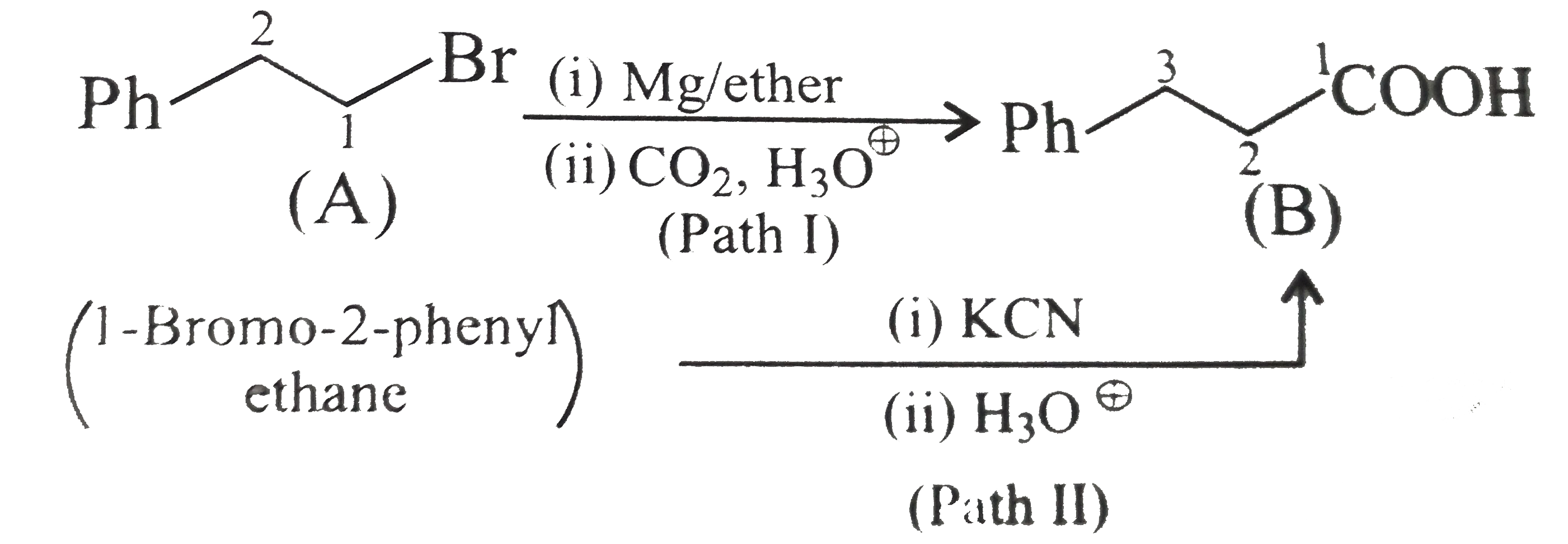
`3-Phenol` propanic acid `(B)` can be prepared by both nitrile and carbonation method as shown.

Path `I` gives a good yield of `(B)`.
`overset (Ө) C N` initiates elimination reaction.

A

If both `(A)` are `( R)` are true and `( R)` is the correct explanation of `(A)`.

B

If both `(A)` and `( R)` are true but `( R)` is not the correct explanation of `(A)`.

C

If `(A)` is true but `( R)` is false.

D

If `(A)` is false but `( R)` is true.

Text Solution

Verified by Experts

The correct Answer is:

A

Since `3-phenol` propanoic acid is `1^@ RX`, preparation by both methods can occur.
Promotional Banner

Topper's Solved these Questions

  • CARBOXYLIC ACIDS AND THEIR DERIVATIVES

    CENGAGE CHEMISTRY ENGLISH|Exercise Exercises Archives (Single Correct)|10 Videos
  • CARBOXYLIC ACIDS AND THEIR DERIVATIVES

    CENGAGE CHEMISTRY ENGLISH|Exercise Exercises Archives (Assertion-Reasoning)|2 Videos
  • CARBOXYLIC ACIDS AND THEIR DERIVATIVES

    CENGAGE CHEMISTRY ENGLISH|Exercise Exercises (Singlecorrect)|64 Videos
  • BIOMOLECULES

    CENGAGE CHEMISTRY ENGLISH|Exercise Exercises Archives (Analytical And Descriptive)|8 Videos
  • CHEMICAL KINETICS

    CENGAGE CHEMISTRY ENGLISH|Exercise Archives Subjective|23 Videos

Similar Questions

Explore conceptually related problems

Succinic acid (B) can be prepared by both nitrile and carbonation method as shown. Both paths give good yields of (B) . (A) with Mg would lead to the loss of vicinal Br atoms to give alkene and MgBr_2 .

An alkene A on ozonolysis yields acetone and an aldehyde. The aldehyde is easily oxidised to an acid B. When B is treated with bromine in presence of yields a compound C which on hydrolysis gives a hydroxyle acid D. This acid can also be obatined from acetone by the reaction with hydrogen cyanide followed by hydrolysis. Identify the compounds A, B C and D.

Explain the effect of SN^2 rates for the following reactions : (a) Increasing the polarity of solvent. (b) Show the T.S with all partial charges for each reaction type. (I) Me_2 overset (oplus) S - Me + NH_3 rarr Me overset (oplus)N H_3 + Me_2 S (II) Me I + NH_3 rarr Me overset (oplus)N H_3 + I^(Ө) (III) Me I + overset (Ө) O H rarr Me OH + I^(Ө) (IV) Me_2 S^(oplus) - Me + overset (Ө) OH rarr Me OH + Me_2 S .

Compound (A) C_(6)H_(12) gives a positive test with bromine in carbon tetrachloride. Reaction of (A) with alkaline KMnO_(4) yields only (B) which is the potassium salt of an acid. Write structure formulae and IUPAC name of (A) and (B).

Boron reacts with oxygen at 700^@C to give (A) . Compound (A) reacts with carbon and dry chloride to give (B) and carbon monoxide. (B) on reduction with LiAlH_(4) gives ( C) along with LiCl and AlCl_(3). ( C) on reaction with ammonia gives (D) . Which on heating gives (E).(C) on reaction with NaH gives (F) . Compound (A) is

(a) Write chemical equations and reaction conditions for the conversion (i) Ethene to ethanol (ii) Phenol to phenyl ethanoate (ii) Ethanol to propan-2-ol. (b) Give an example for each of the following reactions: (i) Kolbe's reaction (ii) Reimer-Tiemann reaction

Both carbonyl compounds and acid derivatives though they contain grouping yet the reactions given by them are entirely different. As Aldehydes and Ketones give addition product with a nucleophile, while carboxylic acid derivatives give nucleophilic acyl substitution through addition/elimination mechanism. Where X- = -Cl - O-overset(O)overset(||)C-R-OR, -NR(R) etc. Why aldeydes and Ketones give nucleophilic addition reaction while acid derivatives prefer nucleophilic acyl substititution reaction?
