Home
Class 11
CHEMISTRY
A compound (A) is a sodium salt of dibas...

A compound `(A)` is a sodium salt of dibasic acid and on electrolysis gives a gas `(B),` gas `CO_(2)` at anode, and `H_(2)(g)` at cathode.
Gas `(B)` does not give any test for unsaturation, `i.e.,` it does not decolourise `Br_(2)` water solution and aqueous `KMnO_(4)` solution.
Gas `(B)` on reaction with `(H_(2)+Pt)` at room temperature does not react but at `120^(@)C`, gas `(B)` gives butane. Identfy `(A)` and `(B)`

Text Solution

Verified by Experts
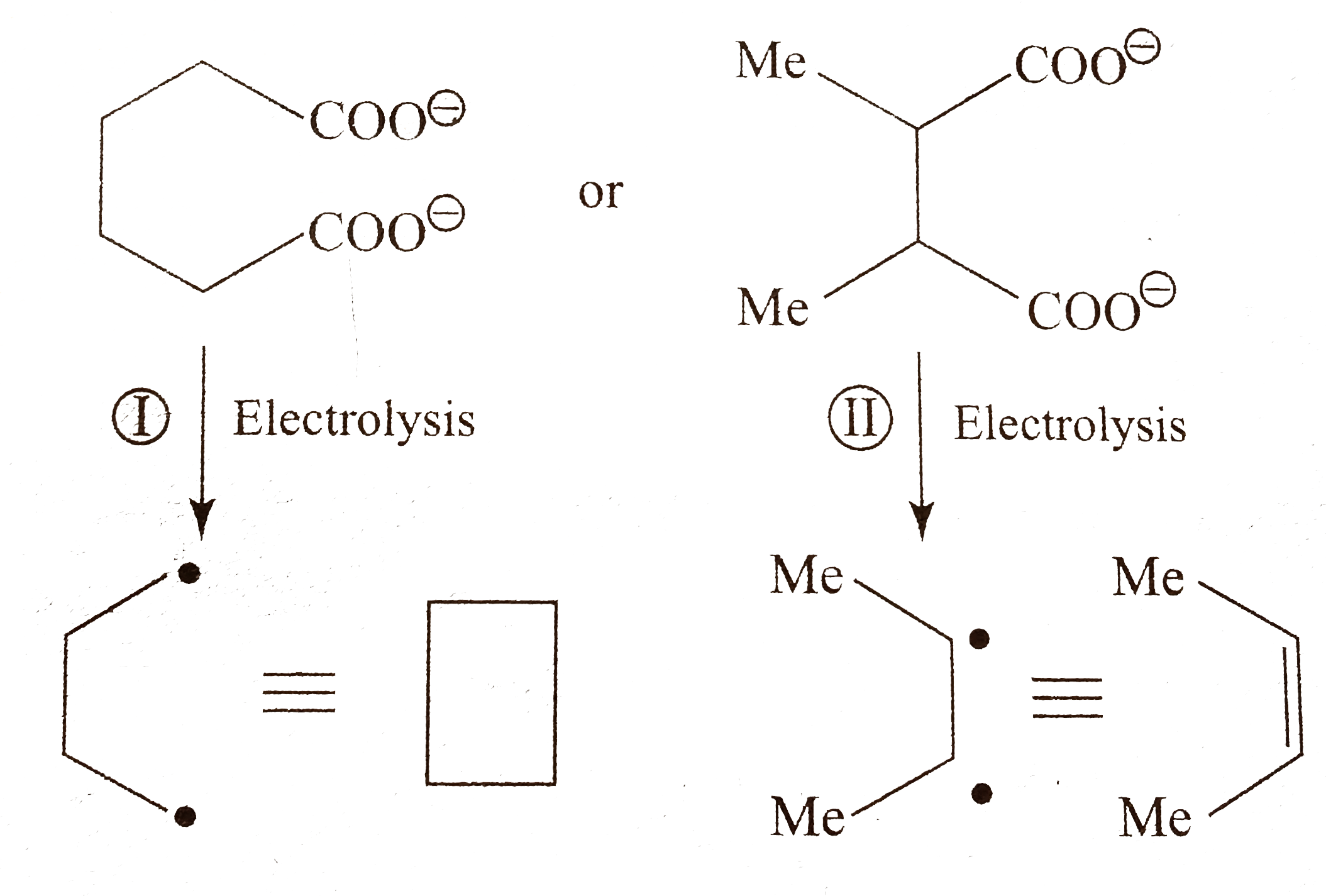
`(A)` should be a `6-C-`atom because `(B)` on reduction at `120^(@)C` gives butane `[ 4 C` atoms of butane `+2(-COOH)` group `].`
`(A)` can be `:`

`(A)` cannot be `(II)` because the product obtained by this will be alkene that gives test for unsaturation, but according to the problem, `(B)` does not give this test. So `(A)` is `(I)`

The product can be `(C)` also, due to the stabilisation of `1^(@)` radical to `2^(@)` radical, but one has to proceed according to the problem given .
Promotional Banner

Topper's Solved these Questions

  • ALKENES AND ALKADIENES

    CENGAGE CHEMISTRY ENGLISH|Exercise EXERCISES|29 Videos
  • ALKENES AND ALKADIENES

    CENGAGE CHEMISTRY ENGLISH|Exercise linked Comprehension Type|38 Videos
  • ALKENES AND ALKADIENES

    CENGAGE CHEMISTRY ENGLISH|Exercise Single correct Answer|14 Videos
  • ALKANES AND CYCLOALKANES

    CENGAGE CHEMISTRY ENGLISH|Exercise Archives|13 Videos
  • ALKYNES

    CENGAGE CHEMISTRY ENGLISH|Exercise Exercises (Archives - Analytical and Desriptive Type)|4 Videos

Similar Questions

Explore conceptually related problems

a. c. Tetrachloroethene does not give the test for unsaturation , i.e., it does not decolourise Br_(2) water solution. Explain why

Identify A and B . Gas (B) gives test for unsaturation, i.e., it decolourises Br_(2) water and aqueous KMnO_(4) solution.

Name the gas that decolourises acidified KMnO_4 solution.

Why Zn reacts with dilute H_(2)SO_(4) to give H_(2) gas but Cu does not ?

Zinc on reaction with NaOH gives a salt (A) along with a gas (B). (A) on reaction with H_(2)S gas gives a white precipitate (C ). Identify (A), (B) and (C ).

Gas (B) on passing through CaSO_(4) solution will give

Gas (B) on passing through cadmium acetate solution will give :

An inorganic iodide (A) on heating with a solution of KOH gives a gas (B) and a solution of a compound. The gas (B) on ignition in air gives a compound (C ) and water. Copper sulphate is finally reduced to the metal on passing (B) through its solution. What is true about gas (B) and compound (C ) ?

CENGAGE CHEMISTRY ENGLISH-ALKENES AND ALKADIENES-SOLVED Example
  1. Give the reaction of the following : i. ii. 2-Bromo butane + C(2...

    Text Solution

    |

  2. Give the decreasing order or reactivity for the elimination with stron...

    Text Solution

    |

  3. A compound (A) is a sodium salt of dibasic acid and on electrolysis gi...

    Text Solution

    |

  4. Give the structure of an optically active alkene (A) having the lowest...

    Text Solution

    |

  5. Give the structure of an optically active alkyne (A) having the lowest...

    Text Solution

    |

  6. Give the structure of an optically active unsaturated hydrocarbon (A) ...

    Text Solution

    |

  7. Explain the formation of (A) and (B) in the following reaction. Oct-...

    Text Solution

    |

  8. Give all the possible products from the reaction of NBS with 4-methyl ...

    Text Solution

    |

  9. Complete the following reactions : a. (F)overset (+D)larr(E)overse...

    Text Solution

    |

  10. a. c. Tetrachloroethene does not give the test for unsaturation...

    Text Solution

    |

  11. i. Z-2,3-Dideuteroeo-but-2-ene overset("Hydroboration")underset("bromi...

    Text Solution

    |

  12. Complete the following reactions: i. CH(2)=CH(2) overset(EtONa+eTOH)...

    Text Solution

    |

  13. a. Convert butan-1-ol to 3-chlorobutan -2-ol.

    Text Solution

    |

  14. Convert : a. 1-Bromobutane to 2-bromobutane

    Text Solution

    |

  15. Convert:

    Text Solution

    |

  16. Write the monomer of the following polymer : a. P.M.M.A. ,b. H.D.P....

    Text Solution

    |

  17. Give examples of some optically active polymers

    Text Solution

    |

  18. Based on the arrangement of branching of [(R)-(Ph), in case of styron ...

    Text Solution

    |

  19. Convert the following :

    Text Solution

    |

  20. Identify compound (A).

    Text Solution

    |