Home
Class 12
CHEMISTRY
Compound (A) (C(4)H(8)O(3)) reacts with ...

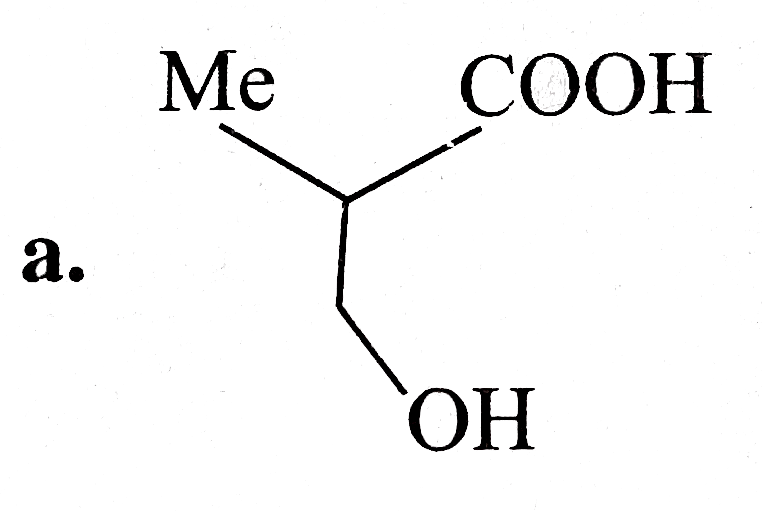
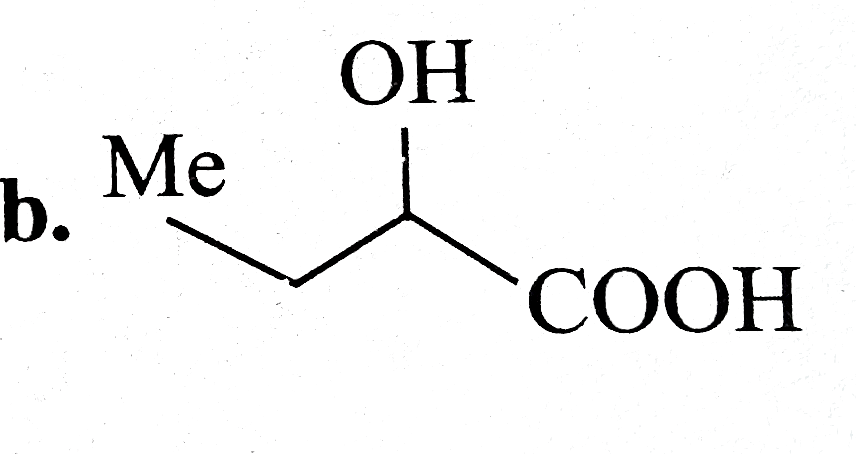
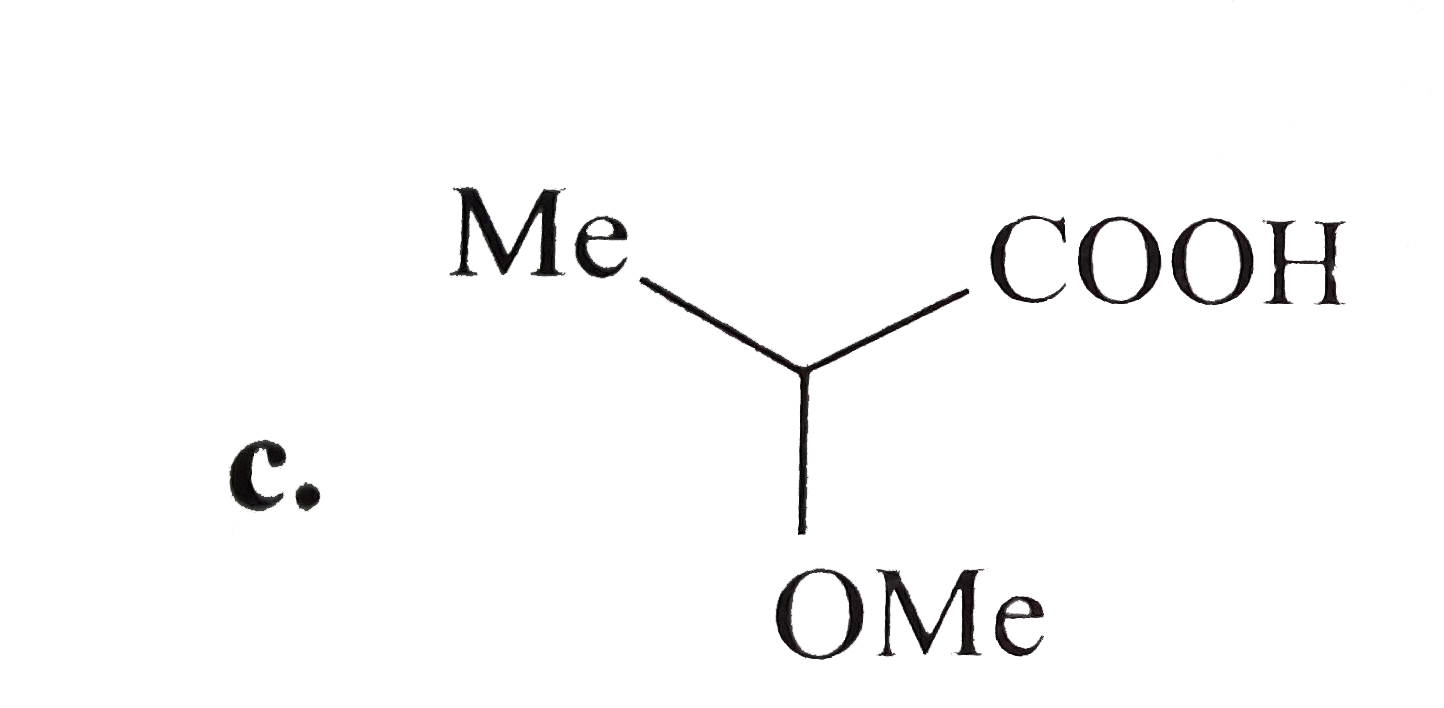
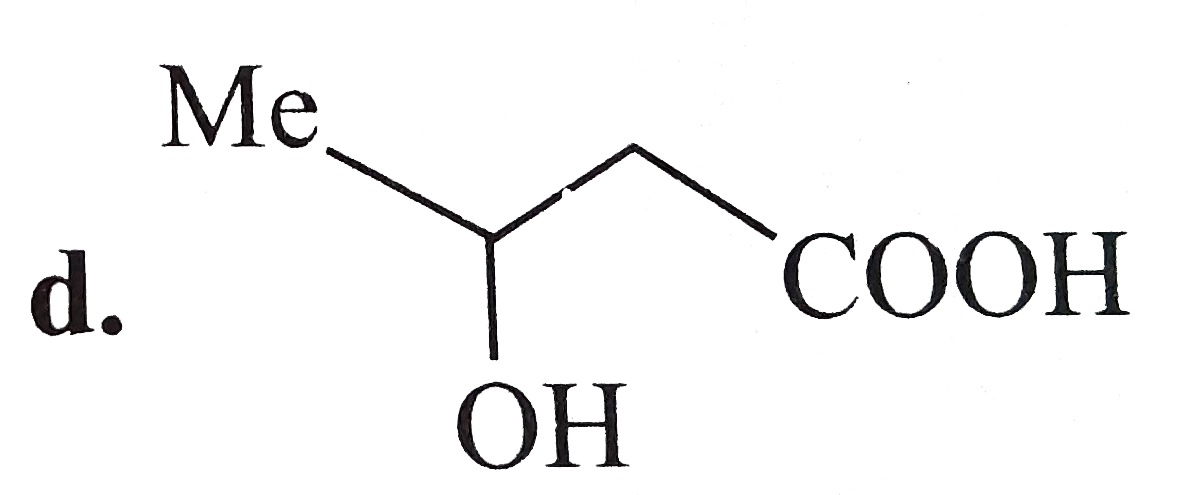
Compound `(A) (C_(4)H_(8)O_(3))` reacts with `NaHCO_(3)` and evolves `CO_(2)(g). (A)` reacts with `LAH` to give a compound `(B)` which is a chiral. The structure of `(A)` is:

A

a.

B

b.

C

c.

D

d.

Text Solution

AI Generated Solution

The correct Answer is:

To solve the problem, we need to identify the structure of compound (A) with the molecular formula \( C_4H_8O_3 \) based on the reactions it undergoes. ### Step 1: Analyze the Reaction with Sodium Bicarbonate The first piece of information we have is that compound (A) reacts with sodium bicarbonate (\( NaHCO_3 \)) and evolves carbon dioxide (\( CO_2 \)). This indicates that compound (A) contains a carboxylic acid functional group (\(-COOH\)), as carboxylic acids react with bicarbonates to produce carbon dioxide. **Hint:** Look for functional groups that can react with bicarbonates. ### Step 2: Determine the Possible Structure of Compound (A) Given that compound (A) is a carboxylic acid and has the molecular formula \( C_4H_8O_3 \), we can start constructing its structure. The presence of 3 oxygen atoms suggests a carboxylic acid and possibly an additional functional group. A reasonable structure for compound (A) could be 3-hydroxybutanoic acid, which has the following structure: - A carboxylic acid group at one end. - A hydroxyl group (-OH) on the third carbon. The structure can be represented as: \[ CH_3-CH(OH)-CH_2-COOH \] **Hint:** Consider the placement of functional groups to satisfy the molecular formula. ### Step 3: Analyze the Reaction with Lithium Aluminum Hydride Next, we know that compound (A) reacts with lithium aluminum hydride (LAH), which is a strong reducing agent. This reaction will reduce the carboxylic acid group to a primary alcohol. The reduction of 3-hydroxybutanoic acid will yield 3-hydroxybutanol, which is chiral due to the presence of a chiral carbon atom. The structure of compound (B) after reduction can be represented as: \[ CH_3-CH(OH)-CH_2-CH_2OH \] **Hint:** Identify how the functional groups change during the reduction process. ### Step 4: Confirm the Chirality of Compound (B) The resulting compound (B) is chiral because it has one carbon atom bonded to four different groups (the carbon with the hydroxyl group and the ethyl and methyl groups). ### Conclusion Thus, the structure of compound (A) is confirmed to be 3-hydroxybutanoic acid, which can be drawn as: \[ \text{HOOC-CH(OH)-CH_2-CH_3} \] ### Final Answer The structure of compound (A) is: \[ \text{3-Hydroxybutanoic acid} \] ---

To solve the problem, we need to identify the structure of compound (A) with the molecular formula \( C_4H_8O_3 \) based on the reactions it undergoes. ### Step 1: Analyze the Reaction with Sodium Bicarbonate The first piece of information we have is that compound (A) reacts with sodium bicarbonate (\( NaHCO_3 \)) and evolves carbon dioxide (\( CO_2 \)). This indicates that compound (A) contains a carboxylic acid functional group (\(-COOH\)), as carboxylic acids react with bicarbonates to produce carbon dioxide. **Hint:** Look for functional groups that can react with bicarbonates. ### Step 2: Determine the Possible Structure of Compound (A) ...
Promotional Banner

Topper's Solved these Questions

  • REDUCTION AND OXIDATION REACTION OF ORGANIC COMPOUNDS

    CENGAGE CHEMISTRY ENGLISH|Exercise Exercise (Assertion And Reasoning)|10 Videos
  • REDUCTION AND OXIDATION REACTION OF ORGANIC COMPOUNDS

    CENGAGE CHEMISTRY ENGLISH|Exercise Exercise Archives (Subjective)|26 Videos
  • REDUCTION AND OXIDATION REACTION OF ORGANIC COMPOUNDS

    CENGAGE CHEMISTRY ENGLISH|Exercise Exercise (Multiple Correct)|35 Videos
  • QUALITATIVE INORGANIC SALT ANALYSIS

    CENGAGE CHEMISTRY ENGLISH|Exercise Viva Voce Questions And Part-C (Analysis Of Cations)|42 Videos
  • SOLID STATE

    CENGAGE CHEMISTRY ENGLISH|Exercise Ex 1.2 (Objective)|9 Videos

Similar Questions

Explore conceptually related problems

An organic compound (A) (C_5 H_8 O_3) on heating with soda lime gives (B) which reacts with HCN to give ( C) . The compound ( C) reacts with thionyl chloride to produce (D) which on reaction with KCN gives a compound ( E) . Alkaline hydrolysis of ( E) gives a salt (F) which on heating with soda lime produces n-butane . Careful oxidation of (A) with dichromate give acetic acid and malonic acid. Give the structures to (A) to (F) with proper reasoning.

C_(7)H_(10)O reacts with CH_(3)MgBr r to give a compound C_(8)H_(10)O which gives the test with iodoform, than fine out structure of A

An organic compound (A) (C_(5)H_(7)OCl) reacts rapidly with ethanol to give (B) (C_(7)H_(12)O_(2)) . (A) also reacts with water to produce an acid which reacts with bromine to give (C ) (C_(5)H_(8)Br_(2)O_(2)) . (B) on boiling with H_(2)SO_(4) forms an acid (D). When (D) is oxidised with KMnO_(4) an acid (E ) (C_(4)H_(6)O_(3)) is produced. On mild heating, (E ) gives (F) (C_(3)H_(6)O) which cannot be oxidised by ammoniacal AgNO_(3) . Identify the compounds (A) to (F).

An organic compound A, C_(5)H_(8)O reacts with H_(2)O, NH_(3) and CH_(3)COOH as described below A is

When an inorganic compound reacts with SO_2 in aqueous medium produces (A). (A) on reaction with Na_2 CO_3 gives the compound (B) which with sulphur gives a substance (C) used in photography. The compound (C) is.

Acetophenone when reacted with a base C_(2)H_(5)ONa yields a stable compound which has the structure

Compound (X ) C_(7)H_(8)O dissolves in NaOH but not in NaHCO_(3) ( X) reacts rapidly with Br_(2) to give (Y) C_(7) H_(5) O Br_(3) Product structure of X would be

A compound A (C_8H_8O_2) react with Br_2//FeBr_3 and gives only one kind of product when A react with sodalime gives toulene find A?

Which of the following acids (given below) react with NaHCO_(3) and liberate CO_(2)(g) ?
