


Home
Class 12
CHEMISTRY
an Organic compound (A) (C(4)H(6)) forms...

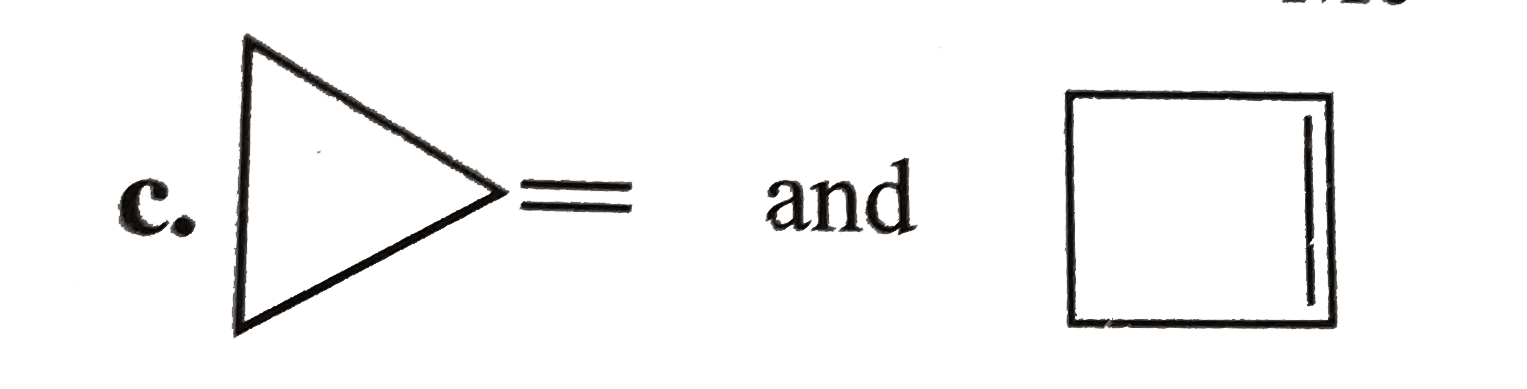
an Organic compound `(A) (C_(4)H_(6))` forms a precipitate with Tollens and Fehling's reagents. `(A)` has an isomer `(B)`. `(B)` reacts with `1 mol` of `Br_(2)` to form `1,4`-dibromo-2-butene. `(A)` and `(B)` are:

A

a.

B

b.

C

c.

D

d.

Text Solution

AI Generated Solution

The correct Answer is:

To solve the problem, we need to identify the organic compounds (A) and (B) based on the given information. Let's break down the solution step by step. ### Step 1: Determine the Degree of Unsaturation The molecular formula of compound (A) is C₄H₆. We can calculate the degree of unsaturation (DU) using the formula: \[ \text{Degree of Unsaturation} = \frac{2C + 2 - H}{2} \] Where C is the number of carbon atoms and H is the number of hydrogen atoms. Substituting the values: \[ \text{DU} = \frac{2(4) + 2 - 6}{2} = \frac{8 + 2 - 6}{2} = \frac{4}{2} = 2 \] ### Step 2: Analyze the Degree of Unsaturation A degree of unsaturation of 2 indicates that the compound could have either: - One triple bond (alkyne) or - Two double bonds (alkenes). ### Step 3: Identify Compound (A) Since compound (A) forms a precipitate with Tollens' and Fehling's reagents, it suggests that (A) is likely a terminal alkyne. Terminal alkynes can reduce these reagents. A suitable structure for compound (A) is 1-butyne (or methylacetylene), represented as: \[ \text{CH}_3\text{C} \equiv \text{C}\text{H} \] ### Step 4: Confirm the Reaction with Tollens' and Fehling's Reagents When 1-butyne reacts with Tollens' reagent (ammonical silver nitrate), it forms a white precipitate of silver butylenide (AgC≡C-CH₃). Similarly, it will react with Fehling's solution to produce a red precipitate of copper(I) oxide. ### Step 5: Identify Compound (B) Compound (B) is an isomer of (A) and has the same molecular formula (C₄H₆). It reacts with 1 mole of Br₂ to form 1,4-dibromo-2-butene. The structure of compound (B) can be deduced as follows: \[ \text{C} \text{C} \text{C} \text{C} \] with two double bonds, specifically 1,3-butadiene: \[ \text{CH}_2=\text{CH}-\text{CH}=\text{CH}_2 \] ### Step 6: Confirm the Reaction with Bromine When 1,3-butadiene reacts with bromine (Br₂), it can add across the double bonds to yield 1,4-dibromo-2-butene: \[ \text{Br}-\text{CH}_2-\text{C}=\text{C}-\text{Br}-\text{CH}_2 \] ### Conclusion Thus, the compounds are: - Compound (A): 1-butyne (C₄H₆) - Compound (B): 1,3-butadiene (C₄H₆)

To solve the problem, we need to identify the organic compounds (A) and (B) based on the given information. Let's break down the solution step by step. ### Step 1: Determine the Degree of Unsaturation The molecular formula of compound (A) is C₄H₆. We can calculate the degree of unsaturation (DU) using the formula: \[ \text{Degree of Unsaturation} = \frac{2C + 2 - H}{2} \] ...
Promotional Banner

Topper's Solved these Questions

  • REDUCTION AND OXIDATION REACTION OF ORGANIC COMPOUNDS

    CENGAGE CHEMISTRY ENGLISH|Exercise Exercise (Assertion And Reasoning)|10 Videos
  • REDUCTION AND OXIDATION REACTION OF ORGANIC COMPOUNDS

    CENGAGE CHEMISTRY ENGLISH|Exercise Exercise Archives (Subjective)|26 Videos
  • REDUCTION AND OXIDATION REACTION OF ORGANIC COMPOUNDS

    CENGAGE CHEMISTRY ENGLISH|Exercise Exercise (Multiple Correct)|35 Videos
  • QUALITATIVE INORGANIC SALT ANALYSIS

    CENGAGE CHEMISTRY ENGLISH|Exercise Viva Voce Questions And Part-C (Analysis Of Cations)|42 Videos
  • SOLID STATE

    CENGAGE CHEMISTRY ENGLISH|Exercise Ex 1.2 (Objective)|9 Videos

Similar Questions

Explore conceptually related problems

B_(2)H_(6) reacts with NH_(3) to form

B_(2)H_(6) reacts with NH_(3) to form

Compound A(C_(3)H_(5)N) gives precipitate with Tollen's reagent and H_(2) gas is also evolved on addition of Li metal. Compound A can be :

B_(2)H_(6) reacts with O_(2) and H_(2)O respectively to form

B_(2)H_(6) reacts with O_(2) and H_(2)O respectively to form?

Phenol reacts with methyl chloroformate in the presence of NaOH to form product A. A reacts with Br_(2) to form product B. A and B are respectively

Unknown compound (A) C_(5)H_(10)O give positive test with 2,4 - DNP but negative test with Tollen's reagent. It also give yellow precipitate with I_(2)//NaOH . (A) is :

CENGAGE CHEMISTRY ENGLISH-REDUCTION AND OXIDATION REACTION OF ORGANIC COMPOUNDS-Exercise (Single Correct)
  1. The product (A) is:

    Text Solution

    |

  2. The product (A) and (B) are:

    Text Solution

    |

  3. an Organic compound (A) (C(4)H(6)) forms a precipitate with Tollens an...

    Text Solution

    |

  4. An alkene on ozonolysis yields only ethanal. There is an isomer of the...

    Text Solution

    |

  5. (A) can be:

    Text Solution

    |

  6. Which of the following is an incorrect statement?

    Text Solution

    |

  7. (A) and (B) are:

    Text Solution

    |

  8. The oxidation product of 1,2-cyclopentane diol with HIO(4) or (CH(3)CO...

    Text Solution

    |

  9. Chromic anhydride in H(2)SO(4) is not blue by:

    Text Solution

    |

  10. Which of the following reactions is correct?

    Text Solution

    |

  11. Fehling's solution can make distinction between:

    Text Solution

    |

  12. C(6)H(10)O(3) (Keto ester)(A)underset(Delta)overset(NaOH+I(2))(rarr) Y...

    Text Solution

    |

  13. Suggest a suitable oxidising reagent for the following conversions:

    Text Solution

    |

  14. C(2)H(5)O-overset(O)overset(||)(C )-OC(2)H(5) overset(2MeMgBr)(rarr) (...

    Text Solution

    |

  15. Which of the following compounds will not give haloform reaction?

    Text Solution

    |

  16. Identify the set from the following which connot form acetone in a sin...

    Text Solution

    |

  17. (A) will not

    Text Solution

    |

  18. CH(3)CH(2)NO(2) underset(at 0^(@)C)overset(NaNO(2)+HBr)(rarr) (A). (A)...

    Text Solution

    |

  19. Which of the following does not give Liebermann's nitroso reaction?

    Text Solution

    |

  20. Of the following compounds, whose ozonolysis proves the Kekule structu...

    Text Solution

    |
