Home
Class 12
CHEMISTRY
The oxidation product of 1,2-cyclopentan...

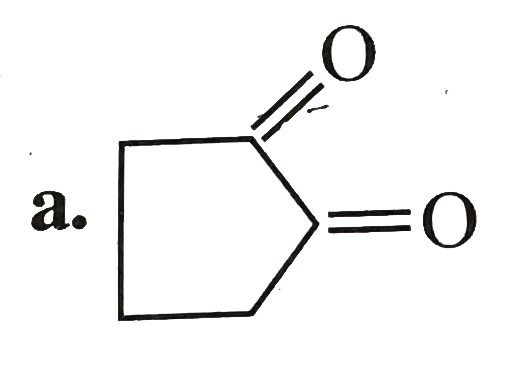
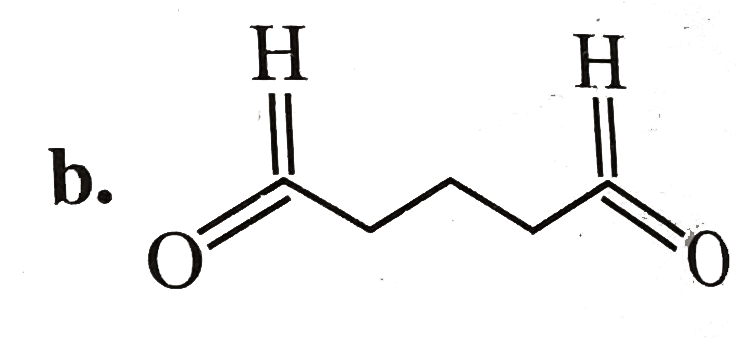
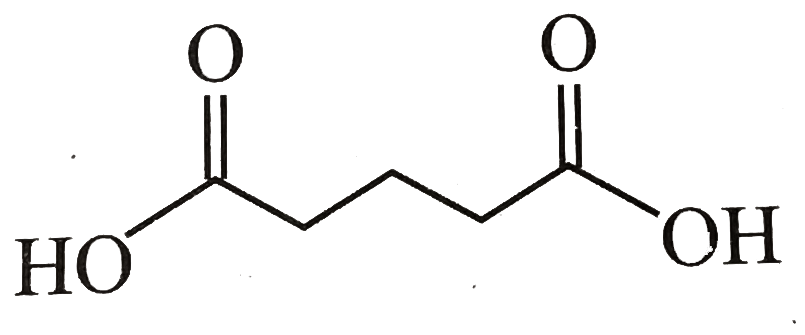
The oxidation product of `1,2`-cyclopentane diol with `HIO_(4)` or `(CH_(3)COO)_(4) Pb` is:

A

a.

B

b.

C

c.

D

d. None

Text Solution

AI Generated Solution

The correct Answer is:

To solve the question regarding the oxidation product of 1,2-cyclopentane diol with HIO₄ or (CH₃COO)₄Pb, we can follow these steps: ### Step-by-Step Solution: 1. **Identify the Reactant:** The reactant is 1,2-cyclopentane diol, which has two hydroxyl (-OH) groups attached to the first and second carbon atoms of a cyclopentane ring. 2. **Understand the Oxidizing Agents:** The oxidizing agents mentioned are periodic acid (HIO₄) and lead tetraacetate [(CH₃COO)₄Pb]. Both of these reagents are known to cleave vicinal diols (diols with hydroxyl groups on adjacent carbons) and convert them into carbonyl compounds. 3. **Reaction Mechanism:** - When 1,2-cyclopentane diol reacts with periodic acid, the hydroxyl groups (-OH) will react with the oxidizing agent. - The reaction leads to the formation of a cyclic intermediate where the -OH groups are replaced by two carbonyl (C=O) groups. - Specifically, the -OH groups are oxidized, and water is eliminated, resulting in the formation of carbonyl groups. 4. **Formation of Carbonyl Compounds:** - The cleavage of the C-O bonds occurs, leading to the formation of two carbonyl groups (C=O) at the 1 and 2 positions of the cyclopentane ring. - This results in the formation of a diketone, specifically 1,2-cyclopentanedione. 5. **Final Product:** The final product of the oxidation of 1,2-cyclopentane diol with HIO₄ or (CH₃COO)₄Pb is **1,2-cyclopentanedione**. ### Conclusion: Thus, the oxidation product of 1,2-cyclopentane diol with HIO₄ or (CH₃COO)₄Pb is **1,2-cyclopentanedione**.

To solve the question regarding the oxidation product of 1,2-cyclopentane diol with HIO₄ or (CH₃COO)₄Pb, we can follow these steps: ### Step-by-Step Solution: 1. **Identify the Reactant:** The reactant is 1,2-cyclopentane diol, which has two hydroxyl (-OH) groups attached to the first and second carbon atoms of a cyclopentane ring. 2. **Understand the Oxidizing Agents:** ...
Promotional Banner

Topper's Solved these Questions

  • REDUCTION AND OXIDATION REACTION OF ORGANIC COMPOUNDS

    CENGAGE CHEMISTRY ENGLISH|Exercise Exercise (Assertion And Reasoning)|10 Videos
  • REDUCTION AND OXIDATION REACTION OF ORGANIC COMPOUNDS

    CENGAGE CHEMISTRY ENGLISH|Exercise Exercise Archives (Subjective)|26 Videos
  • REDUCTION AND OXIDATION REACTION OF ORGANIC COMPOUNDS

    CENGAGE CHEMISTRY ENGLISH|Exercise Exercise (Multiple Correct)|35 Videos
  • QUALITATIVE INORGANIC SALT ANALYSIS

    CENGAGE CHEMISTRY ENGLISH|Exercise Viva Voce Questions And Part-C (Analysis Of Cations)|42 Videos
  • SOLID STATE

    CENGAGE CHEMISTRY ENGLISH|Exercise Ex 1.2 (Objective)|9 Videos

Similar Questions

Explore conceptually related problems

Oxidaton product 1,2-cyclopentanediol with HIO_4 gives

A colourless inorganic compound (A) imparts a green colour to the flame. Its solution gives a white ppt. (B) with H_(2)SO_(4) . When heated with K_(2)Cr_(2)O_(7) and conc. H_(2)SO_(4) , a brown red vapour/gas (C) is formed. The gas/ vapour when passed through aqueous NaOH solution, it turns into a yellow solution (D) which forms yellow precipitate (E) with CH_(3)COOH and (CH_(3)COO)_(2)Pb . with reference to above information, answe the following questions. Q. The yellow ppt. formed when (D) reacts with CH_(3)COOH and (CH_(2)COO)_(2)Pb is:

The oxidation number of carbon in CH_(4) is

The oxidation sates of iodine in HIO_(4), H_(3)IO_(5) and H_(5)IO_(6) are respectively :

Oxidation of 2-methyl propane-1,2-diol with periodic acid gives:-

The open - chain glucose on oxidation with HIO_(4) gives

Write the chemical name of the (CH_3COO)_2 Pb ?

Calculate the oxidation number of carbon in the following compounds. CH_(4),CH_(3)Cl,CH_(2)Cl_(2),CHCl_(3),C Cl_(4)

Pb(CH_3COO)_2+H_2S to Product is:

The oxidation number, of C in CH_(4). CH_(3)CI, CH_(2)CI_(2), CHCl_(3) and C Cl_(4) are respectively:

CENGAGE CHEMISTRY ENGLISH-REDUCTION AND OXIDATION REACTION OF ORGANIC COMPOUNDS-Exercise (Single Correct)
  1. Which of the following is an incorrect statement?

    Text Solution

    |

  2. (A) and (B) are:

    Text Solution

    |

  3. The oxidation product of 1,2-cyclopentane diol with HIO(4) or (CH(3)CO...

    Text Solution

    |

  4. Chromic anhydride in H(2)SO(4) is not blue by:

    Text Solution

    |

  5. Which of the following reactions is correct?

    Text Solution

    |

  6. Fehling's solution can make distinction between:

    Text Solution

    |

  7. C(6)H(10)O(3) (Keto ester)(A)underset(Delta)overset(NaOH+I(2))(rarr) Y...

    Text Solution

    |

  8. Suggest a suitable oxidising reagent for the following conversions:

    Text Solution

    |

  9. C(2)H(5)O-overset(O)overset(||)(C )-OC(2)H(5) overset(2MeMgBr)(rarr) (...

    Text Solution

    |

  10. Which of the following compounds will not give haloform reaction?

    Text Solution

    |

  11. Identify the set from the following which connot form acetone in a sin...

    Text Solution

    |

  12. (A) will not

    Text Solution

    |

  13. CH(3)CH(2)NO(2) underset(at 0^(@)C)overset(NaNO(2)+HBr)(rarr) (A). (A)...

    Text Solution

    |

  14. Which of the following does not give Liebermann's nitroso reaction?

    Text Solution

    |

  15. Of the following compounds, whose ozonolysis proves the Kekule structu...

    Text Solution

    |

  16. CH(3)-overset(CH(3))overset(|)(CH)-NO(2) underset(at 0^(@)C)overset(Na...

    Text Solution

    |

  17. Which of the following compounds are (A), (B), (C ), and (D)? Ph-ove...

    Text Solution

    |

  18. The compound (A)

    Text Solution

    |

  19. Fenton's regent (Fe^(2+)+H(2)O(2)) with benzene gives:

    Text Solution

    |

  20. Lactic acid on oxidation with Fenton's reagent gives:

    Text Solution

    |
