Home
Class 12
CHEMISTRY
Identify the set from the following whic...

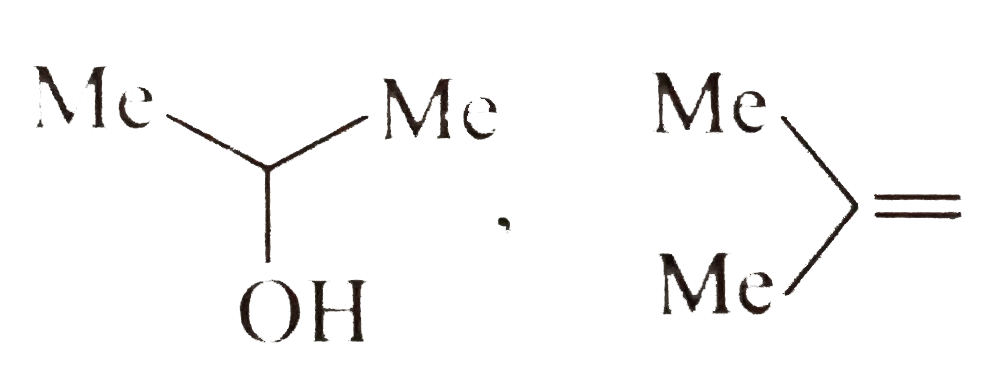
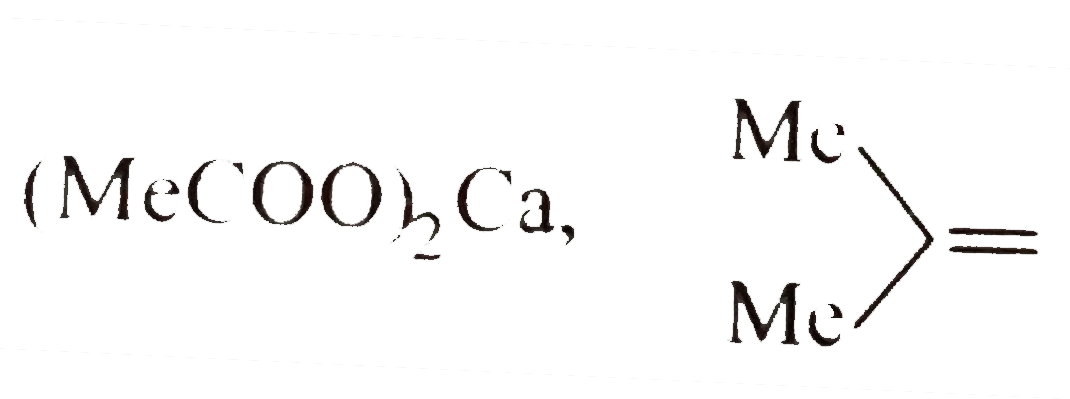
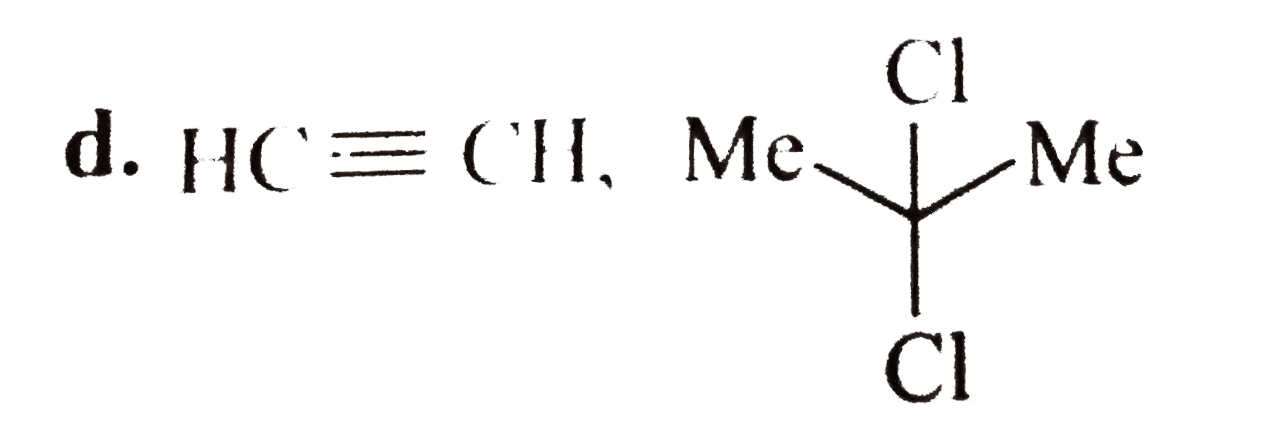
Identify the set from the following which connot form acetone in a single-step reaction.

A

a.

B

b.

C

c.`(MeCOO)_(2)Ca, Me- -= -H`

D

d.

Text Solution

AI Generated Solution

The correct Answer is:

To solve the question of which set cannot form acetone in a single-step reaction, we need to analyze each option provided. Acetone (C3H6O) is a simple ketone, and we will determine if the compounds in each option can be converted to acetone through a single-step reaction. ### Step-by-Step Solution: 1. **Understanding Acetone Formation**: - Acetone is a three-carbon ketone. To form acetone, we need to identify reactions that can yield this compound directly from the given starting materials. 2. **Analyzing Each Option**: - **Option A**: A secondary alcohol. - Secondary alcohols can be oxidized to ketones using oxidizing agents (e.g., CrO3). Therefore, this option can form acetone in a single step. - **Option B**: An alkene (specifically, methylene). - Alkenes can undergo ozonolysis, which can break the double bond and form carbonyl compounds, including acetone. Thus, this option can also form acetone in a single step. - **Option C**: Calcium acetate. - When calcium acetate is heated, it can decompose to form acetone. Therefore, this option can also yield acetone in a single step. - **Option D**: A terminal alkyne. - Terminal alkynes can react with dilute H2SO4 in the presence of mercuric ions (Hg2+) to form an enol intermediate, which can tautomerize to yield a ketone. In this case, it can form acetone. Thus, this option can also yield acetone in a single step. 3. **Identifying the Correct Answer**: - After analyzing all options, we find that all the options (A, B, C, and D) can form acetone in a single-step reaction. However, if we consider the possibility of an ethynyl compound (ethyne) instead of a terminal alkyne, it would not yield acetone in a single step. - Therefore, if we assume that option D refers to a compound that cannot form acetone directly, we conclude that it is the only option that does not directly yield acetone. ### Conclusion: - The answer to the question is **Option D**. This compound cannot form acetone in a single-step reaction.

To solve the question of which set cannot form acetone in a single-step reaction, we need to analyze each option provided. Acetone (C3H6O) is a simple ketone, and we will determine if the compounds in each option can be converted to acetone through a single-step reaction. ### Step-by-Step Solution: 1. **Understanding Acetone Formation**: - Acetone is a three-carbon ketone. To form acetone, we need to identify reactions that can yield this compound directly from the given starting materials. 2. **Analyzing Each Option**: ...
Promotional Banner

Topper's Solved these Questions

  • REDUCTION AND OXIDATION REACTION OF ORGANIC COMPOUNDS

    CENGAGE CHEMISTRY ENGLISH|Exercise Exercise (Assertion And Reasoning)|10 Videos
  • REDUCTION AND OXIDATION REACTION OF ORGANIC COMPOUNDS

    CENGAGE CHEMISTRY ENGLISH|Exercise Exercise Archives (Subjective)|26 Videos
  • REDUCTION AND OXIDATION REACTION OF ORGANIC COMPOUNDS

    CENGAGE CHEMISTRY ENGLISH|Exercise Exercise (Multiple Correct)|35 Videos
  • QUALITATIVE INORGANIC SALT ANALYSIS

    CENGAGE CHEMISTRY ENGLISH|Exercise Viva Voce Questions And Part-C (Analysis Of Cations)|42 Videos
  • SOLID STATE

    CENGAGE CHEMISTRY ENGLISH|Exercise Ex 1.2 (Objective)|9 Videos

Similar Questions

Explore conceptually related problems

Identify the product in the following reaction

Identify the major formed in the following reaction

Identify the product in the following reaction :

Identify (A) in the following reaction

Identify the product of following reaction ?

Identify the set of fibrous joints from the following.

Identify set of polysaccharides from the following

CENGAGE CHEMISTRY ENGLISH-REDUCTION AND OXIDATION REACTION OF ORGANIC COMPOUNDS-Exercise (Single Correct)
  1. C(2)H(5)O-overset(O)overset(||)(C )-OC(2)H(5) overset(2MeMgBr)(rarr) (...

    Text Solution

    |

  2. Which of the following compounds will not give haloform reaction?

    Text Solution

    |

  3. Identify the set from the following which connot form acetone in a sin...

    Text Solution

    |

  4. (A) will not

    Text Solution

    |

  5. CH(3)CH(2)NO(2) underset(at 0^(@)C)overset(NaNO(2)+HBr)(rarr) (A). (A)...

    Text Solution

    |

  6. Which of the following does not give Liebermann's nitroso reaction?

    Text Solution

    |

  7. Of the following compounds, whose ozonolysis proves the Kekule structu...

    Text Solution

    |

  8. CH(3)-overset(CH(3))overset(|)(CH)-NO(2) underset(at 0^(@)C)overset(Na...

    Text Solution

    |

  9. Which of the following compounds are (A), (B), (C ), and (D)? Ph-ove...

    Text Solution

    |

  10. The compound (A)

    Text Solution

    |

  11. Fenton's regent (Fe^(2+)+H(2)O(2)) with benzene gives:

    Text Solution

    |

  12. Lactic acid on oxidation with Fenton's reagent gives:

    Text Solution

    |

  13. The compounds (A) and (B) are:

    Text Solution

    |

  14. (A) is:

    Text Solution

    |

  15. The compound (A) is:

    Text Solution

    |

  16. The compound (A) is:

    Text Solution

    |

  17. Which single reagent can be used in the following conversions?

    Text Solution

    |

  18. Et-N^(o+)-=C^(ɵ) underset(or HgO or O(3))overset(Cl(2)+DMSO)(rarr). Th...

    Text Solution

    |

  19. Imines or enamines are selectively reduced to 1^(@) or 2^(@) amines wi...

    Text Solution

    |

  20. Caprolactam on reduction with LAH or H(2)+Pt or Pd gives:

    Text Solution

    |
