Home
Class 12
CHEMISTRY
A ketone [A] which undergoes haloform re...

A ketone [A] which undergoes haloform reactions gives compound [B] on reduction. [B] on heating with sulphuric acid gives compound [C] which forms monozonide [D}. On hydrolysis in the presence on zinc dust gives acetaldehyde. Identify [A], [B] , [C] and [D]. Write the down the reactions. Involved.

Text Solution

Verified by Experts
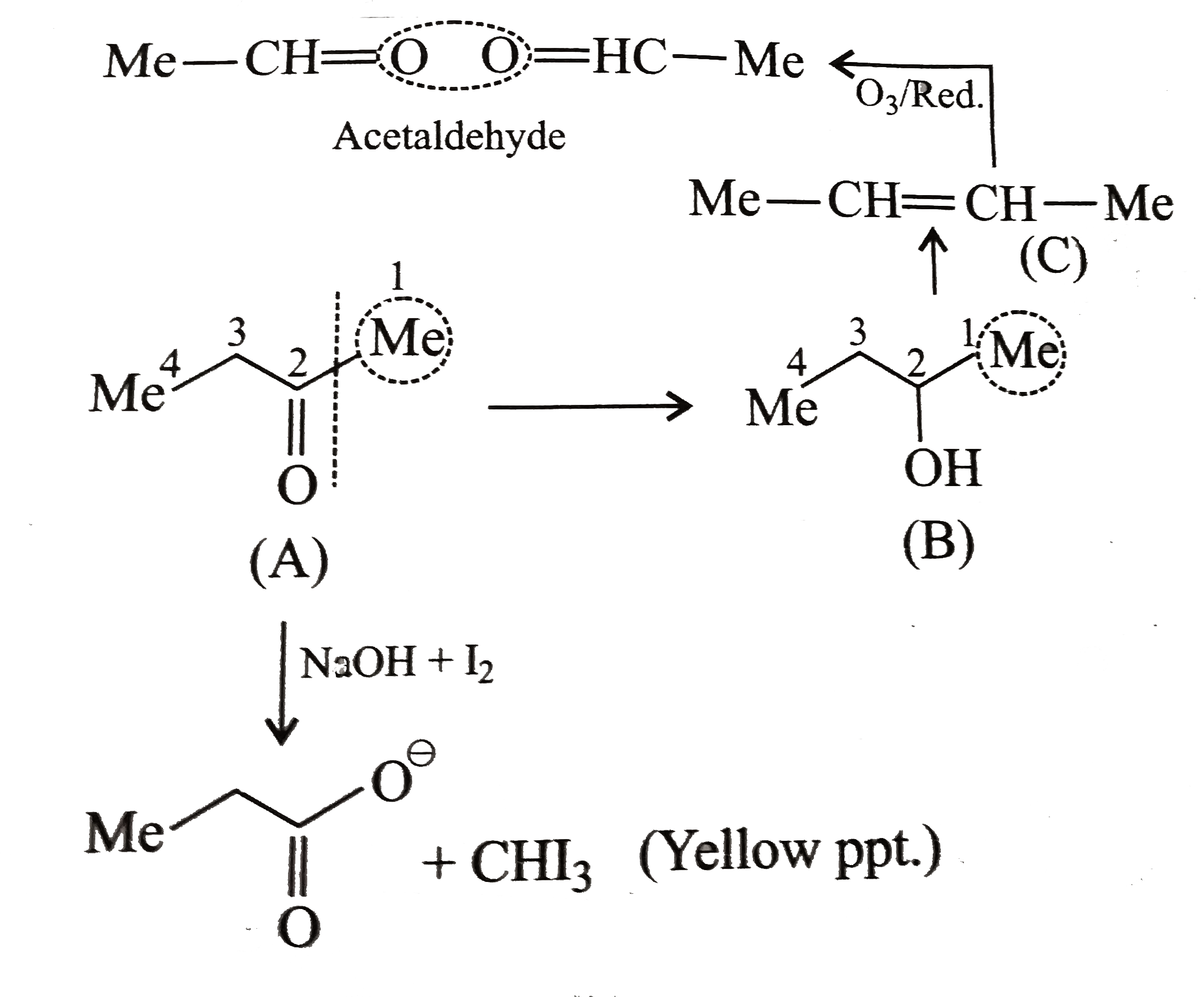
Ketone `(A)` gives haloform reaction, so it must contain `(Me-CO-)` group. Ketone on reduction gives `2^(@)` alcohol. (B), which gives alkene `(C )` with `H_(2)SO_(4)`. Alkene on ozonolysis followed by reduction with `Zn` dust gives `MeCHO`. So, the structure of alkene `(C )` is:

So `(A)` is: Butan-`2`-one, `(B)` is: Butan-`2`-ol, `(C )` is: Butan-`2`-one.
Promotional Banner

Topper's Solved these Questions

  • REDUCTION AND OXIDATION REACTION OF ORGANIC COMPOUNDS

    CENGAGE CHEMISTRY ENGLISH|Exercise SUBJECTIVE TYPE|4 Videos
  • REDUCTION AND OXIDATION REACTION OF ORGANIC COMPOUNDS

    CENGAGE CHEMISTRY ENGLISH|Exercise Exercise (Assertion And Reasoning)|10 Videos
  • QUALITATIVE INORGANIC SALT ANALYSIS

    CENGAGE CHEMISTRY ENGLISH|Exercise Viva Voce Questions And Part-C (Analysis Of Cations)|42 Videos
  • SOLID STATE

    CENGAGE CHEMISTRY ENGLISH|Exercise Ex 1.2 (Objective)|9 Videos

Similar Questions

Explore conceptually related problems

A ketone A, which undergoes halform reaction, gives compound B on reduction B on heating with sulphuric acid gives compounds C, which forms mono-ozonide D.D on hydrolysis in the presence of zinc dust gives only acetaldehyde. Identify A, B and C. Write down the reaction involved.

Identify [A][B] and [C] and gives the complete chemical reactions involved.

A ketone A (C_(4)H_(8)O) which undergoes lodoform reaction gives compound Bon reduction. B on heating with conc. H_(2)SO_(4) at 443 K gives a compound C which forms ozonide D. Don hydrolysis with Zn dust gives only E. Identify the compounds A to E. Write the lodoform reaction with compound A.

An element A reacts with water to form a compound B which is used in white washing. The compound B on heating forms an oxide C which on treatment with water gives back B. Identify A, B and C and give the reactions involved.

An organic compound A with molecular formula C_2 H_7 N on reaction with nitrous acid gives a compound B.B on controlled oxidation gives a compound C. C reduces Tollens' reagent to give silver mirror and D. B reacts with D in the presence of concentrated sulfuric acid to give a sweet smelling compound E. Identify A, B, C, D and E. Give the reaction of C with ammonia and name the product.

An alkali metal A gives a compound B (molecular mass = 40) on reacting with water. The compound B gives a soluble compound C on treatment with aluminium oxide. Identify A, B and C and give the reactions involved.

Give the stereochemical forculae for (A),(B)(C), and (D) and also give the reactions involved.

An element A burns with golden flame in air. It reacts with another element B, atomic number 17 to give a product C. An aqueous solution of product C on electrolysis gives a compound D and liberates hydrogen. Identify A, B, C and D. Also write down the equations for the reactions involved.

An organic compound A (C_(2)H_(6)O) reacts with sodium to form a compound B with the evolution of H_(2) and gives a yellow compound C on reacting with iodine and NaOH. When heated with conc. H_(2)SO_(4) at 413 K, it gives a compound D (C_(4)H_(10)O) which on reaction wiht conc. HI at 373 K gives compound E. The compound D is also obtained when B is heated with E. Idntify the compounds A,B,C,D and E write the equations for the reaction involved.

An organic compound [A], whose molecular formula is C_(3)H_(6)O , gives iodoform reaction and forms compound [B]. Compound [B], when heated with silver powder, converts into compound [C}. Compound [C] reacts with dil. Sulphuric acid and mercuric sulphate to obtain compound [D], which gives Aldol condensation reaction. Write down the names of all compounds from [A] to [D] and also write the chemical equations for each step.

CENGAGE CHEMISTRY ENGLISH-REDUCTION AND OXIDATION REACTION OF ORGANIC COMPOUNDS-Exercise Archives (Subjective)
  1. The appropriate reagent for the following transformation is

    Text Solution

    |

  2. Which one of the following will most readily be dehydrated in acidic c...

    Text Solution

    |

  3. 1-Propanol and 2- propanol can be distinguished by:

    Text Solution

    |

  4. Compound (X) with molecular formula C(3)H(8)O is treated with acidifie...

    Text Solution

    |

  5. PhC-=CMeoverset(Hg^(2+)+H^(o+))to(A). The compound (A) is:

    Text Solution

    |

  6. The products of acid hydrolysis of P and Q can be distinguished by

    Text Solution

    |

  7. How will you convert butan -2-one to propanoic acid ?

    Text Solution

    |

  8. Which of the following compound will give a yellow precipitate with io...

    Text Solution

    |

  9. Under Wolff-Kishner reduction conditions, the conversion which may be ...

    Text Solution

    |

  10. Fehling's solution 'A' consists of an aqueous solution of copper sulph...

    Text Solution

    |

  11. The yield of ketone is oxidised is more than the yield of aldeyde whe...

    Text Solution

    |

  12. Statement-1: Acetic acid does not undergo haloform test. and State...

    Text Solution

    |

  13. Give a chemical test to distinguish between methanol and ethanol.

    Text Solution

    |

  14. Answer the following with suitable equation wherever necessary : Sug...

    Text Solution

    |

  15. A ketone [A] which undergoes haloform reactions gives compound [B] on ...

    Text Solution

    |

  16. Give reasons: iodoform is obtained by the reaction of acetone with h...

    Text Solution

    |

  17. When t-butanol and n-butanol are separately treated with a few drops o...

    Text Solution

    |

  18. A compund X(C8H10O) upon treatment with alkaline solution of iodine gi...

    Text Solution

    |

  19. Identify (A), (B), and (C ) and give their strucyures.

    Text Solution

    |

  20. An alkene (A) C(16)H(16) on ozonolysis gives only one product (B) (C(8...

    Text Solution

    |

