Home
Class 12
CHEMISTRY
a. Why are overline(e) donating groups, ...

a. Why are `overline(e)` donating groups, such as `(-NH_(2))` (`-`OR), `(-R) o-` and `p-` directing towards `SE` reaction? Explain by an example.
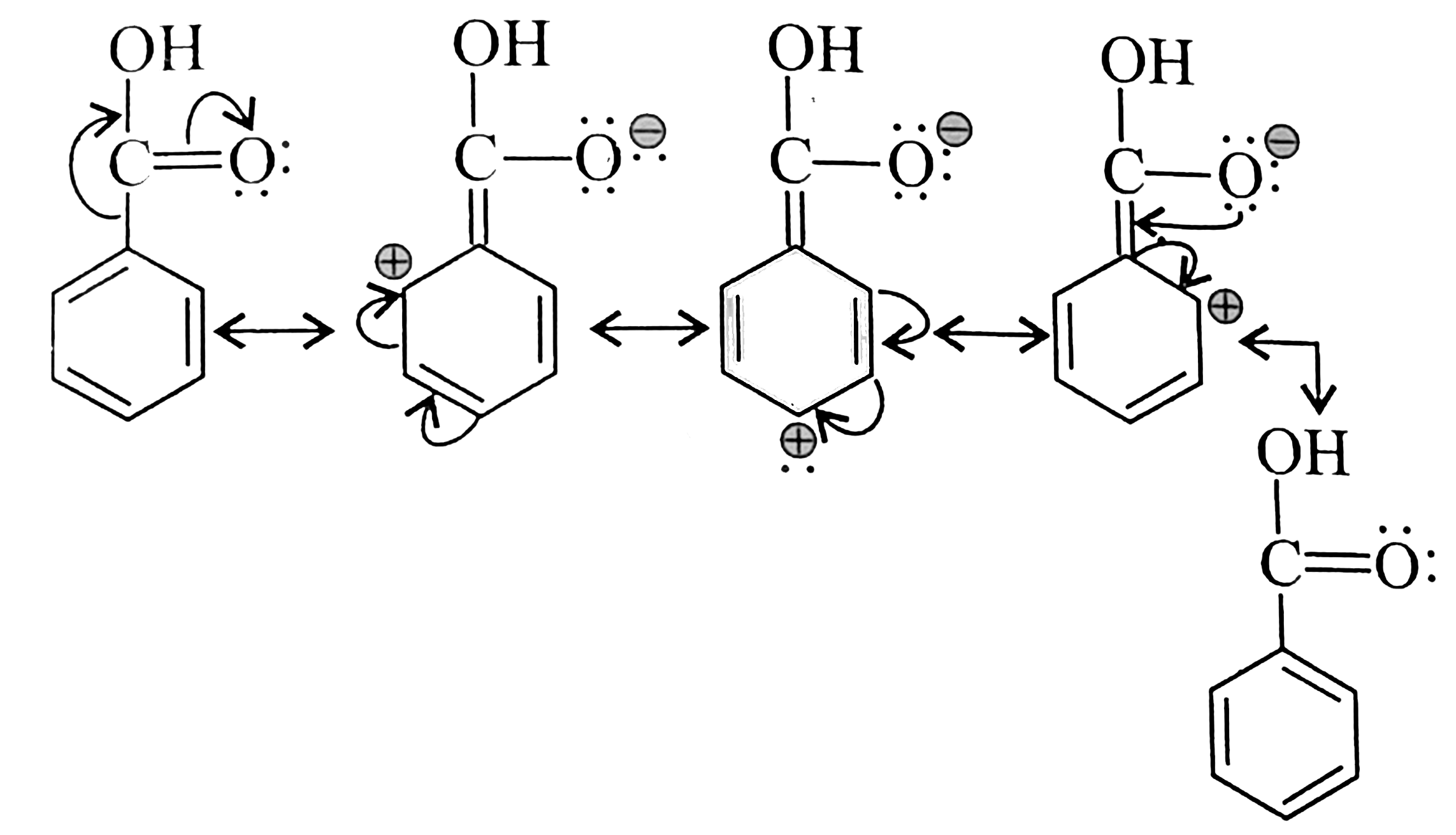
b. Why are `overline(e)` withdrawing groups, [such as `(-NO_(2), (-SO_(3)H),(-CN),(-COOH)`, etc].`m-` direection towards `SE` reaction? explain by example.
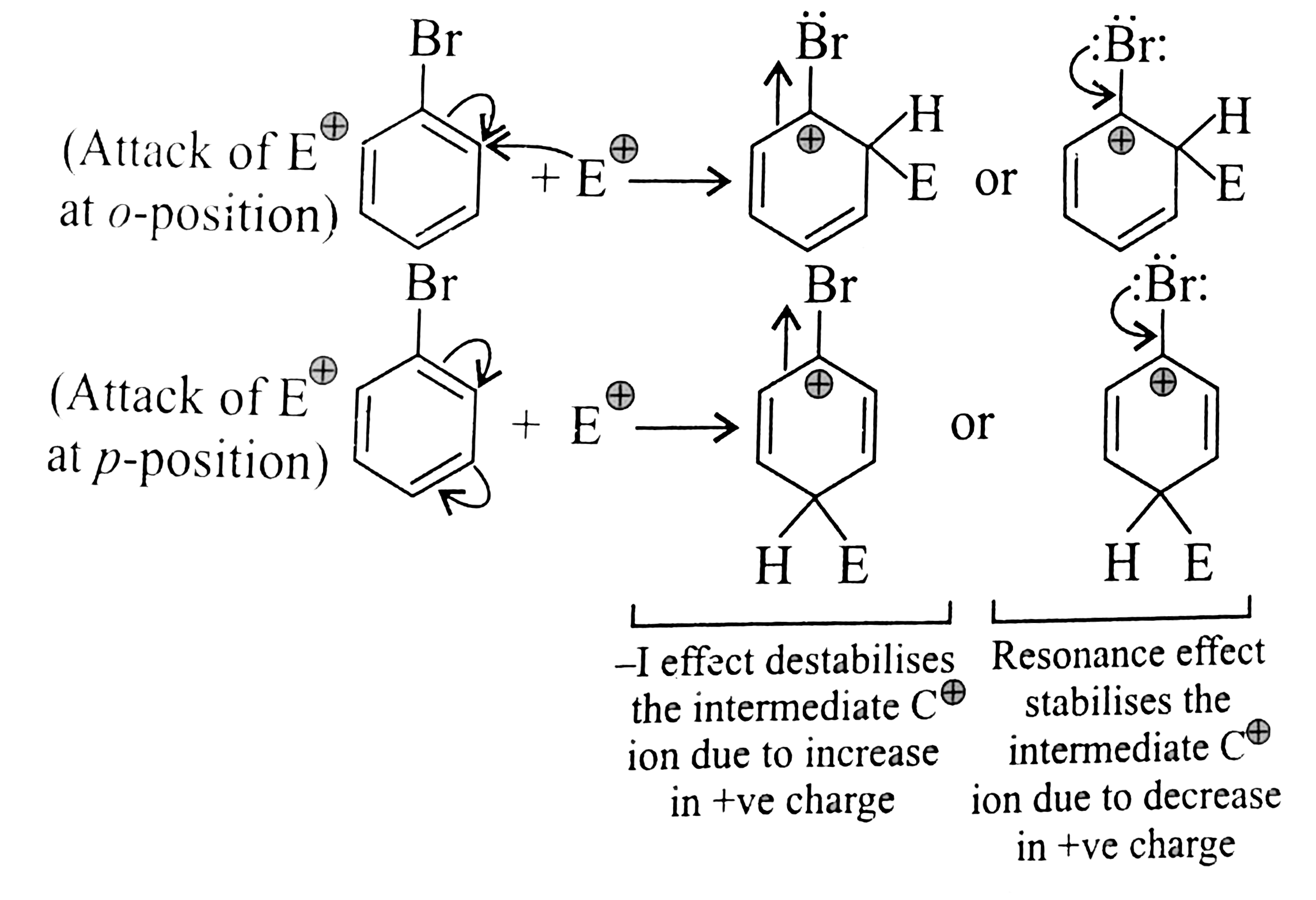
c. Although halogens are `overline(e)` withdrawing yet they are `o-` and `p-` directing towards `SE` reaction. Why?

Text Solution

Verified by Experts
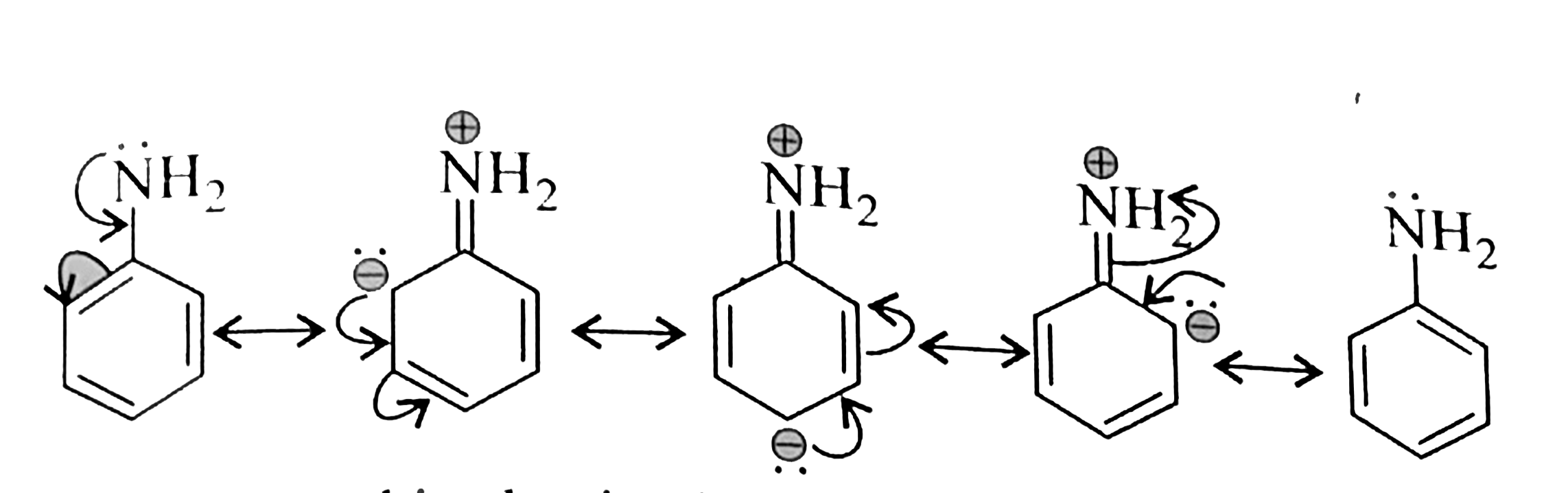
a. Due to `+M` effect (or `oveline(e)` donating effect) of `(-NH_(2))` group, aniline is resonance stablised as shown:

Due to this, the ring is activated at `o-` and `p-` positions. Thus, `overline(e)` density is increased at these positions. Hence, the incoming electrophile attacks at these positions giving `o-` and `p-` products. b. Due to `overline(e-)` withdrawing effect of the `(-COOH)` group, benozoic acid is resonance stablised as shown:

due to this, the benzene ring is deactived at `o-` and `p-` positons, thus `overline(e)` density is decreased at these positon. So, comparatively `overline(e)` density at `m-` position is increased, and hence the incoming electrophile attacks at `m`-postion giving `m-` products,
C. Halogens are said to be `pi` donating but `sigma` with-drawing, i.e., they withdraw `overline(e)s` thorugh resonance. The intermediate carbocation formed during `SE` reaction is destablised by the `-1` effect of the halogens.

Resonane stablises the intermediate carbocation and this effect is more prominent at `o-` and `p-` positons, `-I` effect is stronger (due to high `EN` of halogens ) than resonance and causes net `overline(e)` withdrawal, and thus causing net deactivation. The resonance effect for the attack at `o-` and `p-` positons and hence makes the deactivation lesss for `o-` and `p-` subsitution.
Promotional Banner

Topper's Solved these Questions

  • AROMATIC COMPOUNDS AND ALKYL AND ARYL HALIDES

    CENGAGE CHEMISTRY ENGLISH|Exercise Solved Examples|21 Videos
  • AROMATIC COMPOUNDS AND ALKYL AND ARYL HALIDES

    CENGAGE CHEMISTRY ENGLISH|Exercise Solved Problems|37 Videos
  • APPENDIX INORGANIC VOLUME 2

    CENGAGE CHEMISTRY ENGLISH|Exercise Short Answer Type|179 Videos
  • BIOMOLECULES

    CENGAGE CHEMISTRY ENGLISH|Exercise Exercises Archives (Analytical And Descriptive)|8 Videos

Similar Questions

Explore conceptually related problems

Althrough chlorine is an electron withdrawing group, yet it is ortho-para-directing in electrophilic aromatic substitution reactions. Explain why it is so ?

The typical reaction of benzene and other aromatic compounds are electrophilic substitution. Presence of electron donating group activates the ring towards electrophilic substitution, while presence of electron withdrawing group deactivates the ring towards electrophilic substituion but at the same time activates the ring towards nucleophilic subsituion. Some groups are predominantly meta-directing and all of these are deactivating. Except halogen, most of the o- and p- directing groups are activating groups. Which of the following compound is not formed. X represents mixture of organic compounds. The mixture does not contain

The typical reaction of benzene and other aromatic compounds are electrophilic substitution. Presence of electron donating group activates the ring towards electrophilic substitution, while presence of electron withdrawing group deactivates the ring towards electrophilic substituion but at the same time activates the ring towards nucleophilic subsituion. Some groups are predominantly meta-directing and all of these are deactivating. Except halogen, most of the o- and p- directing groups are activating groups. underset(Delta)overset(C_(2)H_(5)Cl.AlCl_(3))rarr(A) major. A is trisubstituted benzene. The structure of A is :

The typical reaction of benzene and other aromatic compounds are electrophilic substitution. Presence of electron donating group activates the ring towards electrophilic substitution, while presence of electron withdrawing group deactivates the ring towards electrophilic substituion but at the same time activates the ring towards nucleophilic subsituion. Some groups are predominantly meta-directing and all of these are deactivating. Except halogen, most of the o- and p- directing groups are activating groups. underset(Delta)overset(C_(2)H_(5)Cl.AlCl_(3))rarr(A) major. A is trisubstituted benzene. The structure of A is :

Assertion (A) : Gabriel phthalimide reaction is used for the prepartion fo C_2H_5NH_2 and p-nitro aniline . Reason (R ): SN^2 reaction takes place with 1^@ RX and 1^@ ArX containing overline e - withdrawing group at o-and p-positions

Why are (o + p) in ratious for the SE reaction (e.g. nitraction) of toluene and PhCF, 32.3 and 0.14 , respectively ?

(a) Explain why H_(2)and O_(2) do not react at room temperature. (b) Writen the rate equation for the reaction A_(2)+3B_(2)to 2C, if the overall order of the reaction is zero.

How many of the following groups if substituted at o- and /or p-postions of chlorobenzene, increase its reactivity towards nucleophic substitution? -CN, -CH_3, - NH(CH_3), -COOH, -NO_(2), -OCH_(3) .

Redox reactions play a pivotal role in chemistry and biology. The values standard redox potential (E^(o)) of two half cell reactions decided which way the reaction is expected to preceed. A simple example is a Daniell cell in which zinc goes into solution and copper sets deposited. Given below are a set of half cell reactions ( acidic medium ) along with their E^(c-)(V with respect to normal hydrogen electrode ) values. Using this data, obtain correct explanations for Question. I_(2)+2e^(-) rarr 2I^(c-)," "E^(c-)=0.54 Cl_(2)+2e^(-) rarr 2Cl^(c-), " "E^(c-)=1.36 Mn^(3+)+e^(-) rarr Mn^(2+), " "E^(c-)=1.50 Fe^(3+)+e^(-) rarr Fe^(2+)," "E^(c-)=0.77 O_(2)+4H^(o+)+4e^(-) rarr 2H_(2)O, " "E^(c-)=1.23 Sodium fusion extract obtained from aniline on treatment with iron (II) sulphate and H_(2)SO_(4) in the presence of air gives a Prussion blue precipitate. The blue colour is due to the formation of

Redox reactions play a pivotal role in chemistry and biology. The values standard redox potential (E^(c-)) of two half cell reactions decided which way the reaction is expected to preceed. A simple example is a Daniell cell in which zinc goes into solution and copper sets deposited. Given below are a set of half cell reactions ( acidic medium ) along with their E^(c-)(V with respect to normal hydrogen electrode ) values. Using this data, obtain correct explanations for Question. I_(2)+2e^(-) rarr 2I^(c-)," "E^(c-)=0.54 Cl_(2)+2e^(-) rarr 2Cl^(c-), " "E^(c-)=1.36 Mn^(3+)+e^(-) rarr Mn^(2+), " "E^(c-)=1.50 Fe^(3+)+e^(-) rarr Fe^(2+)," "E^(c-)=0.77 O_(2)+4H^(o+)+4e^(-) rarr 2H_(2)O, " "E^(c-)=1.23 Among the following, identify the correct statement. (a)Chloride ion is oxidized by O_(2) . (b) Fe^(2+) is oxidized by iodine. (c)Iodide ion is oxidized by chlorine (d) Mn^(2+) is oxidized by chlorine.