Home
Class 12
CHEMISTRY
Explain : a. Vinyl chloride is unreact...

Explain :
a. Vinyl chloride is unreactive in nucliphillic `4-` subsitution reactions.
b. Neopenthyl bromide undergoes nucliphillic substituion reactions very slowly.
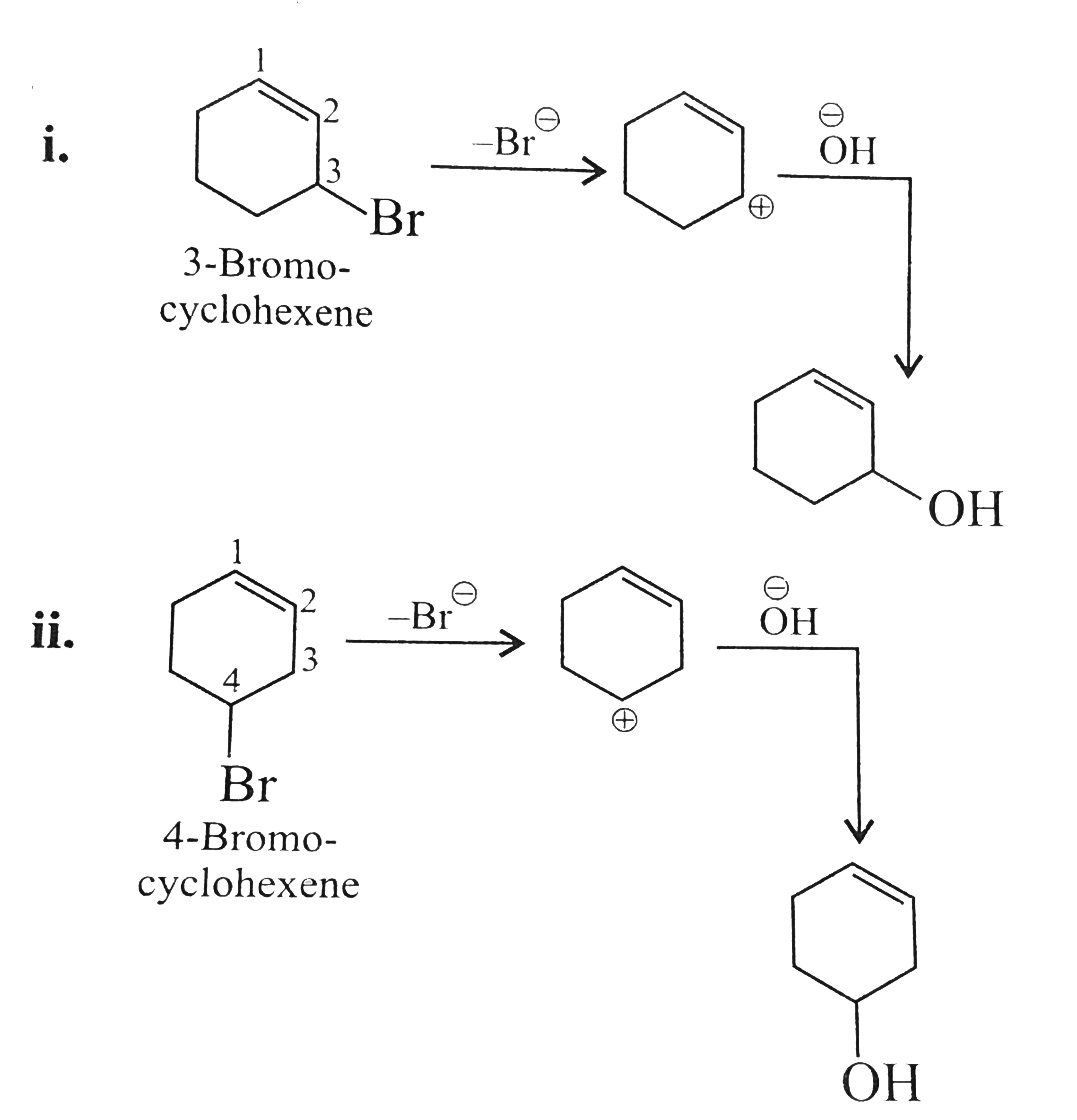
c. `3-` Bromocyclohexane is more reactive than `4-` bromovyclohexane in hydrolysis with aqueous `NaOH`.
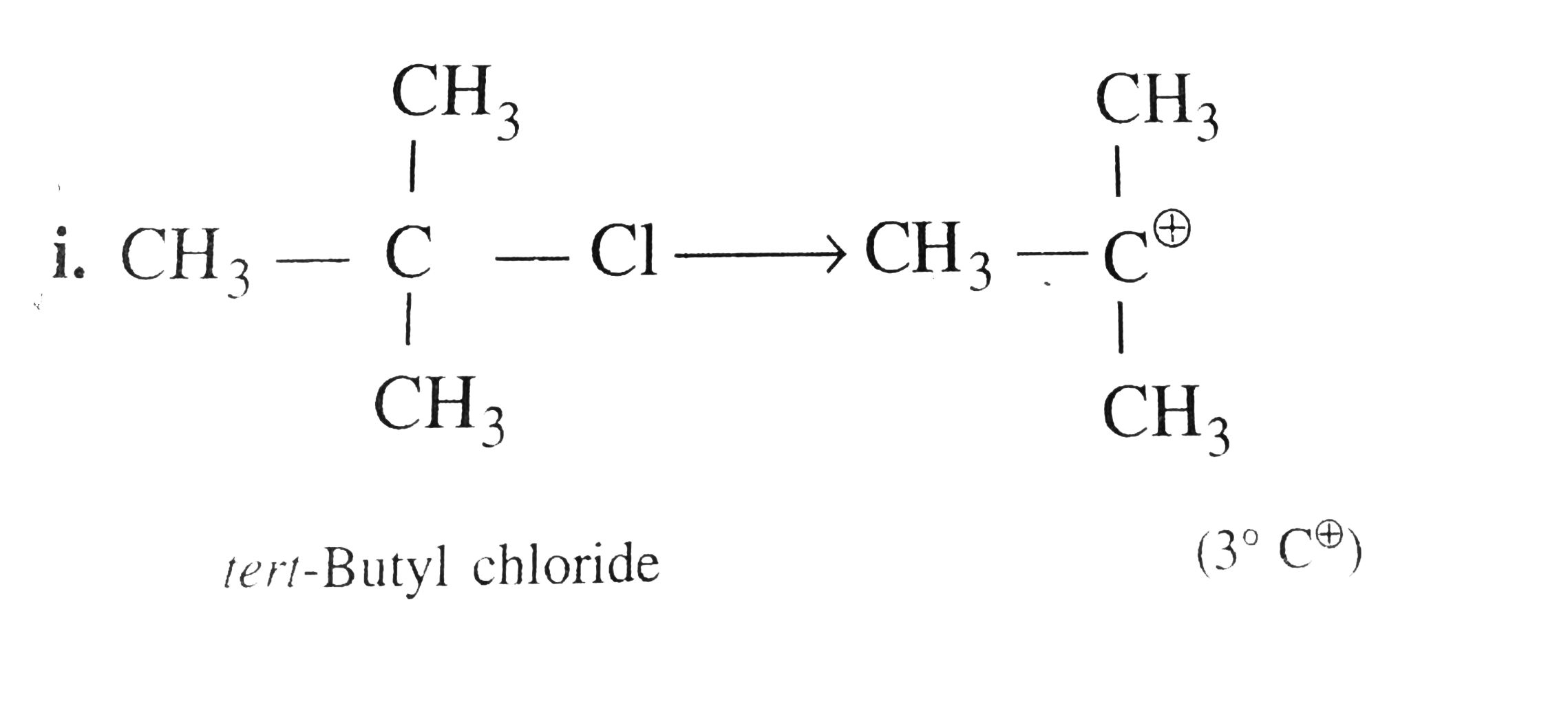
d. `ter-` Butyl chloride reacts with aqueous sodium hydroxide by `SN^(1)` mechanishm while `n-` butuyl chloride reacts by `SN^(2)` medchanism.

Text Solution

Verified by Experts
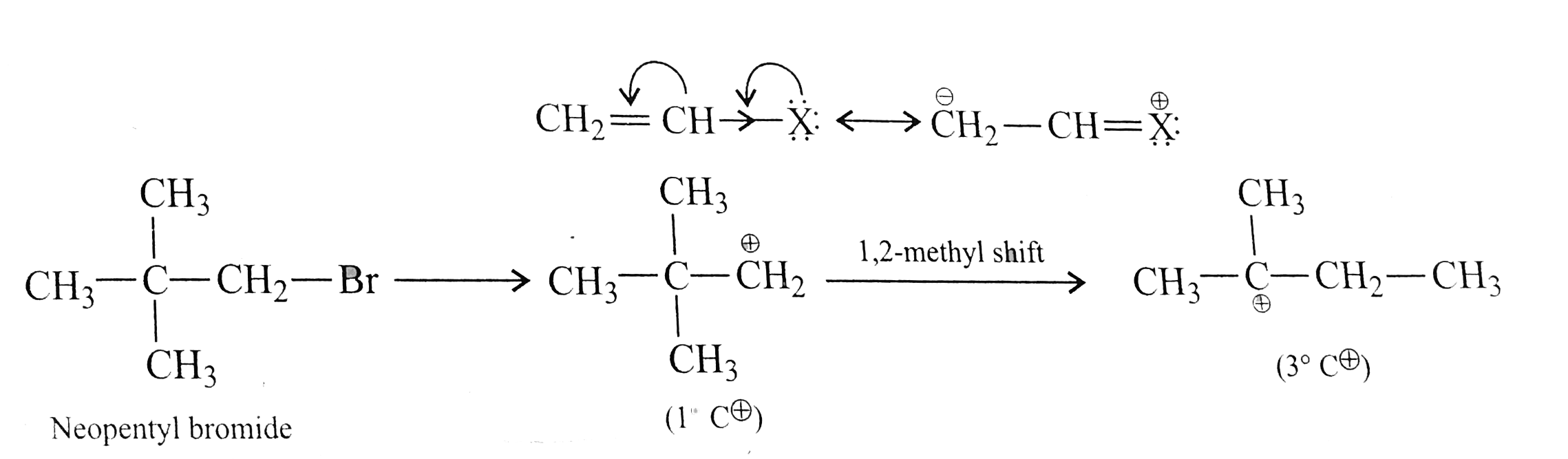
a. Vinylic and aryl halides are unreactive towards `SN` reactions due to the resonance effects. Resonanace gives rise to partial double bond character to the `(C-X)` bond, making stonger and, therefore more diffcult to cleave than the `(c-X)` bond in `RX (R_(sp^(3)) - X)` bond. It also reduces te polarity of the `(c_X)` bond and, therefore, the heterolytic cleavage of `(C-X)` bond is difficult.

Neopentyl bromide gies `(1^(@) C^(o+))` which can rearrange to `3^(@) C^(o+)` by `1.2`, methyl shift, but is sterically hindered and so `SN` reaction takes place slowly.
C.
(i) gives allylic carbocation, while (ii) gives `2^(@)C^(o+)` and allylic `C^(o+)` is more stable than `2^(@) C^(o+)`. So (i) more reactive than (ii) in hydrolysis with aq. `NAOH`.

ii. `CH_(3) CH_(2) CH_(2) CH_(2) Cl rarr CH_(3) underset((1^(@) C^(o+)))(CH_(2) CH_(2)) overset(o+)(CH_(2))`
Reactivity of `SN^(1)` reaction is `3^(@)C^(o+) gt 2^(@) C^(o+) gt 1^(@) C^(o+)` and reactivity of `SN^(2)` reaction is `1^(@)C^(o+) gt 2^(@)C^(o+) gt 3^(@)C^(o+)` . So (i) reacts with aq. `NaOH` by `SN^(1)` mechanism because it gives `3^(@) C^(o+)`, while (ii) undergoes by `SN^(2)` reaction becuase it gives `1^(@)C^(o+)`, ions.
Promotional Banner

Topper's Solved these Questions

  • AROMATIC COMPOUNDS AND ALKYL AND ARYL HALIDES

    CENGAGE CHEMISTRY ENGLISH|Exercise Exercises Subjective Type|5 Videos
  • AROMATIC COMPOUNDS AND ALKYL AND ARYL HALIDES

    CENGAGE CHEMISTRY ENGLISH|Exercise Exercises Subjective|17 Videos
  • AROMATIC COMPOUNDS AND ALKYL AND ARYL HALIDES

    CENGAGE CHEMISTRY ENGLISH|Exercise Solved Examples|21 Videos
  • APPENDIX INORGANIC VOLUME 2

    CENGAGE CHEMISTRY ENGLISH|Exercise Short Answer Type|179 Videos
  • BIOMOLECULES

    CENGAGE CHEMISTRY ENGLISH|Exercise Exercises Archives (Analytical And Descriptive)|8 Videos

Similar Questions

Explore conceptually related problems

What happens when : (write only chemical reactions) (a) Hydrogen Sulphide is treated with Sulphur dioxide. (b) carbondioxide is passed through a concertrated aqueous solution of sodium chloride saturated with ammonia. ( c) red lead is treated with nitric acid. (d) dilute nitric acid is slowly reacted with tin.

Compound (A), C_(8)H_(6)NOBr , is optically active. Reduction of (A) gives (B) which reacts with nitrouos acid to form (C), dihydric alcohol. Benzene sulphonyl chloride reacts with (B) to give a product soluble in NaOH. Hydrolysis of (A) gives (D) which is an optically active acid. (A) does not give any precipitate with aqueous AgNO_(3) . Controlled oxidation of (A) gives monobromo benzoic acid. Compound (A) on reaction with Br_(2)//Fe gives only one compound. Identify (A), (B), (C), and (D).

Explain: a. alpha -Halocarbonyl compounds, even the 3^(@) types like , do not undergo SN^(1) reaction. b. Which is more reactive: (i) PrCI or (ii) MeCOCH_(2)CI with NaI/acetone ? c. Acetals and ketals are regenerated back to carbonyl. compounds with H_(3)O^(o+) but not with overset(Θ)(OH) . d. Cyclohexane is more reactive than cyclopenatone with HCN.

Explain the following observations: (a) Azide ion (N_(3)) react with 2- bromopentane thousand times faster than with neopentyl bromide in a S_(N)2 reaction through former is a secondary halide while latter is primary. (b) What will happen to the stereochemistry of product of the following reaction: (c) What will happens to the rate if the concentration of alkyl bromide in (b) is doubled? (d) Wha will happen to the rate if the concentration of azide ion in (b) is doubled? (e) How the sign of optical rotation of reactant and product are related in (b) (f) When allowed to stand in dilute H_(2)SO_(4) laevo-rotatory 2-butanol slowly loss optical activity.

A white substance A reacts with dilute H_(2)SO_(4) is produce a colourless B and acidified K_(2)Cr_(2)O_(7) solution produces a green solution and a slighly coloured precipitate D .The substance B to burns in air to produce a gas E which reacts with B ito yied D and a colouless liquid .Anhyhdrous copper sulphate is turned blue on addition of this colourless liquid addition od aqueous NH_(3) or NaOH to C produce first a precipitate which dissolve in the excess of the respective reagent to produce a clear solution in each case identify A,B,C, and E. Write the equation of the reaction involved.

Write balanced redox reactions for each of the following reactions: (a) Potassium dichromate (K_(2)Cr_(2)O_(7)) reacts with hydroiodic acid (HI) to produce potassium iodide, chromium (III) iodide, and solid iodine, I_(2)(s) . (b) A purple solution of aqueous potassium permanganate (KMnO_(4)) reacts with aqueous sodium sulphite (Na_(2)SO_(3)) in basic solution to yield the green magnanate ion (MnO_(4)^(2-)) and sulphate ion (SO_(4)^(2-)) . (c ) Sn^(2+) (aq) reduce I_(4)^(Ө)(aq) to I^(Ө)(aq) and is oxidised to Sn^(4+) . (d) H_(2)O_(2)(aq) oxidises Mn^(2+)(aq) to MnO_(2) in basic medium. (e) H_(2)O_(2)(aq) reduces Cr_(2)O_(7)^(2-) (aq) to green coloured Cr^(3+)(aq) in acidic medium.

An organic compound A, C_(8)H_(6) on reacting with dil. H_(2)SO_(4) and HgSO_(4) gives a compound 'B'-which can also be obtained from reaction of benzene with acid chloride in the presents of anh. AlCl_(3) Compound B when reacted with iodine and aq. NaOH yields C and a yellow compound D. Identify A to D with proper justification.

A white substance (A) reacts with dilute H_(2)SO_(4) to produce a colourless suffocating gas (B) and a colourless solution (C )/ The reaction of gas (B) with potassium iodate and starch solution produce a blue colour solution. Aqueous Solution of (A) gives a white precipitate with BaCl_(2) solution which is soluble in dilute HCl . Addition of aqueous NH_(3) or NaOH to (C ) produced first a precipitate which dissolves in excess of the respective reagent to poduced a clear solution. Similarly addition of excess of potassium ferrocyanide to (C ) produced a precipitate (D) which also dissolves in aqeous NaOH giving a clear solution. Identify (A),(B),(C ) and (D ). Write the equation of the reactions involved.

Identify A, B, C, D and E. A while substance A reacts with dilute H_2SO_4 to produce a colourless gas B and a colourless solution C. The reaction between B and acidified K_2Cr_2O_7 solution produces a green solution and slightly coloured precipitate D. The substance D burns in air to produce a gas E which reacts with B to yield D and a colourless liquid. Anhydrous copper sulphate is turned blue on adiition of this colourless liquid. Addition of aqueous NH_3 or NaOH to C produces first a precipitate

Select from the letters A to G the correct answer corresponding to the statements from 1 to 5: A: Ammoniacal CuCl_2 , B: Trichloromethane, C: Trichloroethane, D: Bromine soln., E: Aqueous KOH F: Ethene, G: Sodalime, H: Ethanol, I: Ethyne. 1. The organic compound which forms carbon tetrachloride on reaction with chlorine. 2. The reagent which can distinguish between ethene and ethyne. 3. The substance which reacts with bromoethane to give ethanol. 4. The substance which gives bromoethane on reaction with hydrogen bromide. 5. The substance which reacts with acetic acid to give CH_3COOC_2H_5 .

CENGAGE CHEMISTRY ENGLISH-AROMATIC COMPOUNDS AND ALKYL AND ARYL HALIDES -Solved Problems
  1. Give the order of reactivity towards SN^(2) reaction of the followig: ...

    Text Solution

    |

  2. Give the order of reactivity towards SN^(1) reaction of the followig: ...

    Text Solution

    |

  3. Give the order of SN^(-1) of SN^(-1) and SN^(2) displacement of haloge...

    Text Solution

    |

  4. Give the order of reactivity towards E2 dehydrohalo-genation of the fo...

    Text Solution

    |

  5. Give the order of reactivity towards SN^(-1) solvoloysis of the follow...

    Text Solution

    |

  6. Give the order of reactivityh towards SN^(1) reaction of the following...

    Text Solution

    |

  7. Text Solution

    |

  8. Text Solution

    |

  9. Outline the preparationof the following compounds using a nucliphileic...

    Text Solution

    |

  10. Which compound in each of the following paris will react faster in SN^...

    Text Solution

    |

  11. Arrange the folliwing compounds in increasing order of SN^(-1) reactiv...

    Text Solution

    |

  12. Predict all the alkenes that would be formed by dehydrohalogenation of...

    Text Solution

    |

  13. Predict all order of reactivity of the following compounds in dehydroh...

    Text Solution

    |

  14. Explain : a. Vinyl chloride is unreactive in nucliphillic 4- subsitu...

    Text Solution

    |

  15. The nucliphilic substituation of primary alkyl chlorides wityh sodium ...

    Text Solution

    |

  16. Arrange the folliwing halides in order of increasing SN^(2) and SN^(1...

    Text Solution

    |

  17. Predicrt the order of reactivity of the following compounds in SN^(1) ...

    Text Solution

    |

  18. Predict the order of reactivity of the following compounds in S(n^(1))...

    Text Solution

    |

  19. Identify all the possible alkenes that would be formed on the dehydroh...

    Text Solution

    |

  20. Text Solution

    |