Home
Class 12
CHEMISTRY
IsoprophI bromide was treated separately...

IsoprophI bromide was treated separately with sodium ethoxide under two different conditions.
Reaction I:
Treatment of isopropyI bromide with `(Me_(3)CONa)` at `40^(@)C` gave almost exclusively compound `(A) (C_(3)H_(6))`.
Reaction II:
Treatment of `(i-PrBr)` with `NaOC_(2)H_(5)` at `30^(@)C` yileled compound `(A) (C_(3)H_(6))` along with a small amount of an ether `(B) (C_(5)H_(12)O)`.
Compound `(A)` was readily oxidised by a neutral solution of cold dil. `KMnO_(4)` to give a brown preciptate.
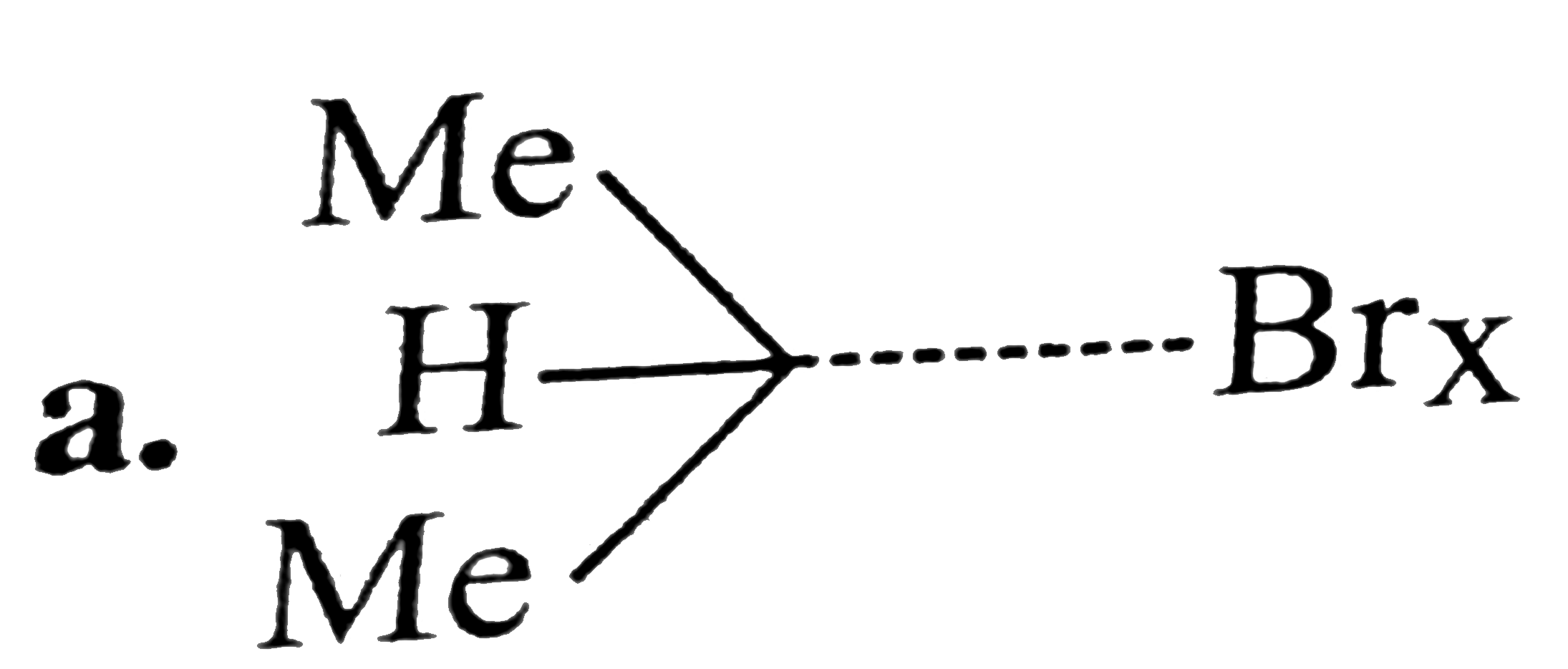
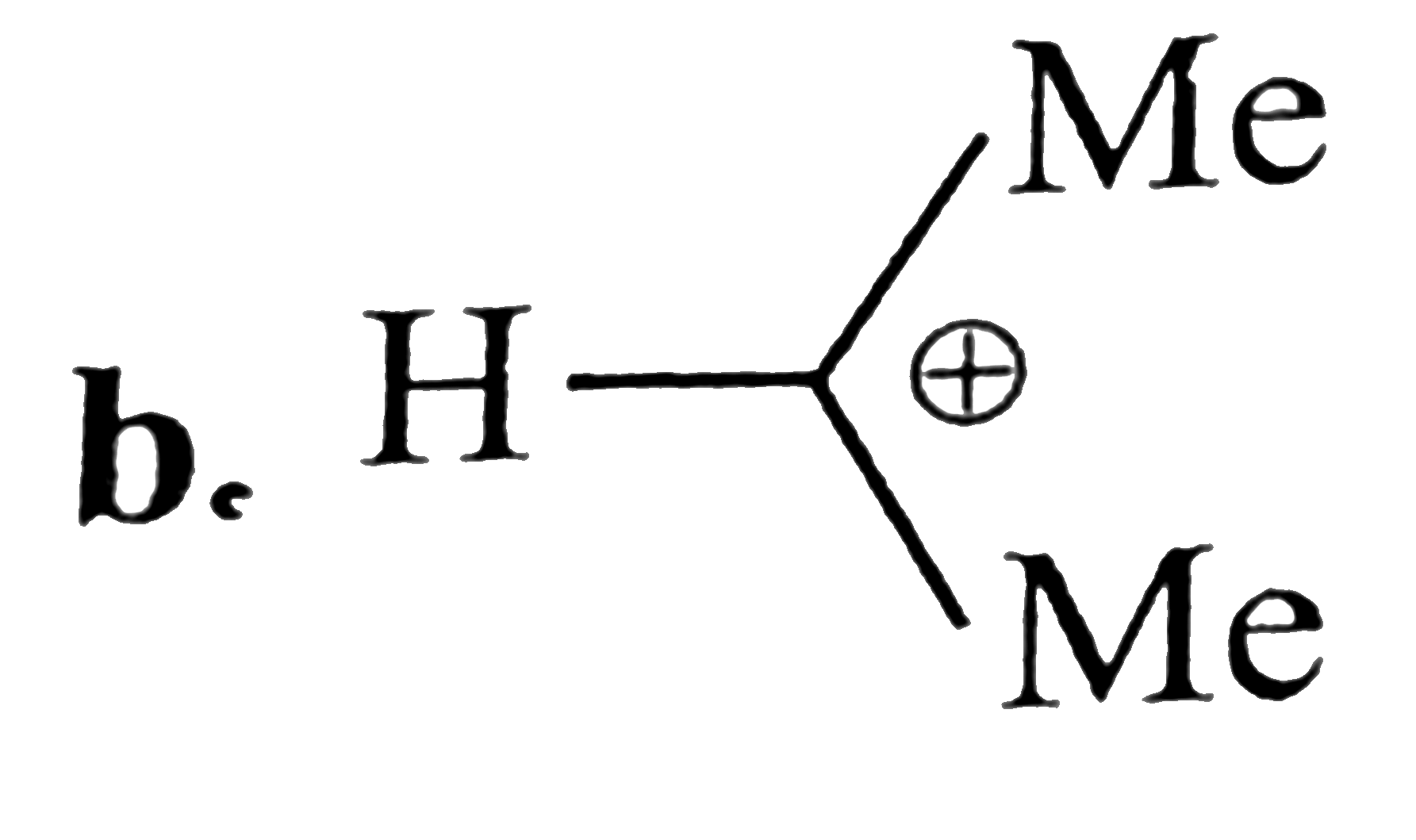
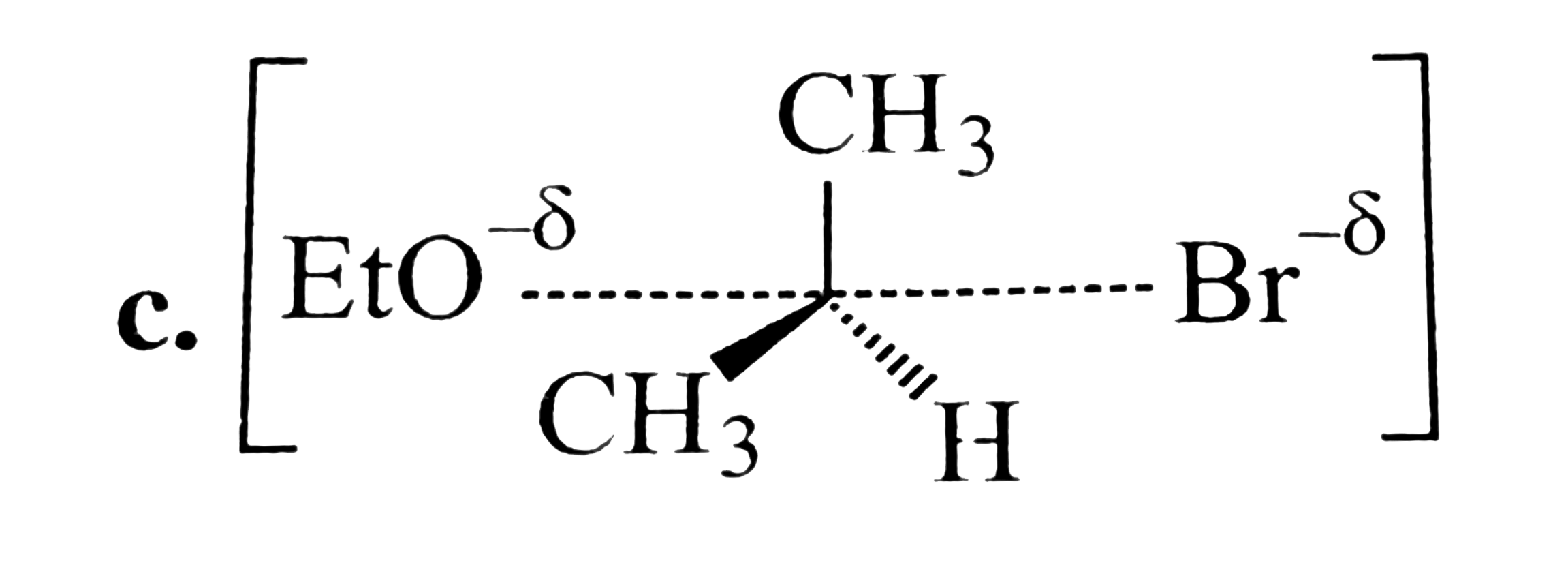
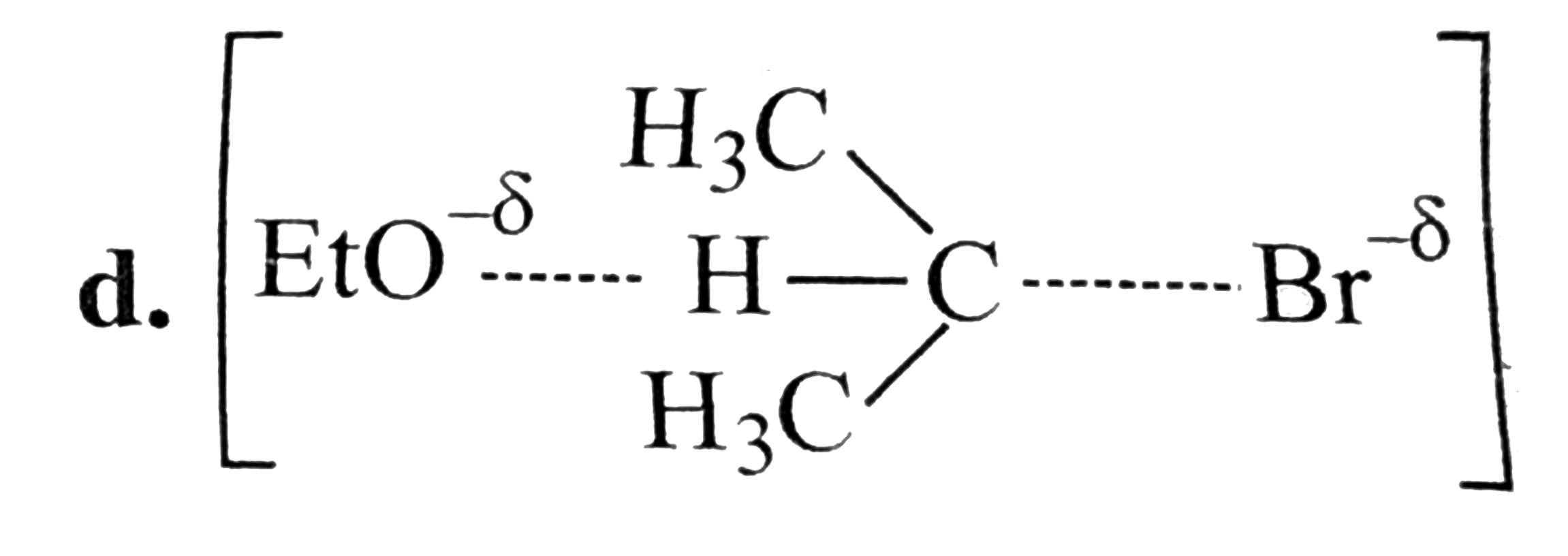
Referring to Q. No. 67 which of the following represents the intermediate `T.S` for the formation of compound `(B)` ?

A

B

C

D

Text Solution

AI Generated Solution

The correct Answer is:

To solve the problem, we need to analyze the reactions of isopropyl bromide with sodium ethoxide under two different conditions and identify the transition state for the formation of compound B. ### Step-by-Step Solution: **Step 1: Understand the Reactants and Products** - Isopropyl bromide (i-PrBr) has the structure: \[ \text{(CH}_3)_2\text{CHOBr} \] - When treated with sodium ethoxide (NaOC₂H₅), it can yield compound A (C₃H₆) and compound B (C₅H₁₂O). **Step 2: Analyze Reaction I** - In Reaction I, isopropyl bromide is treated with (Me₃CONa) at 40°C, leading to the formation of compound A. This suggests a straightforward substitution reaction, likely an SN2 mechanism, where the bromine leaves and a nucleophile replaces it. **Step 3: Analyze Reaction II** - In Reaction II, isopropyl bromide is treated with NaOC₂H₅ at 30°C. This reaction yields compound A along with a small amount of ether (compound B). The ether formation indicates that there is an additional step occurring here. **Step 4: Identify the Mechanism** - The formation of compound B (an ether) suggests that the reaction involves an SN2 mechanism where the ethoxide ion (C₂H₅O⁻) attacks the isopropyl bromide. The bromine atom acts as a leaving group. **Step 5: Draw the Transition State** - In the transition state, the nucleophile (C₂H₅O⁻) is attacking the carbon atom that is bonded to the bromine. The bromine is partially leaving, resulting in a high-energy state. - The structure of the transition state can be represented as: \[ \text{C} \text{(CH}_3)_2\text{C} \text{(O}^- \text{C}_2\text{H}_5) \text{(Br)} \text{(partial bond)} \] - In this state, the carbon is bonded to both the ethoxide and the bromine, which is about to leave. **Step 6: Identify the Correct Option** - Based on the structure of the transition state, we can conclude that option C represents the correct transition state for the formation of compound B. ### Final Answer: The transition state for the formation of compound B is represented by option C. ---

To solve the problem, we need to analyze the reactions of isopropyl bromide with sodium ethoxide under two different conditions and identify the transition state for the formation of compound B. ### Step-by-Step Solution: **Step 1: Understand the Reactants and Products** - Isopropyl bromide (i-PrBr) has the structure: \[ \text{(CH}_3)_2\text{CHOBr} ...
Promotional Banner

Topper's Solved these Questions

  • AROMATIC COMPOUNDS AND ALKYL AND ARYL HALIDES

    CENGAGE CHEMISTRY ENGLISH|Exercise Exercises Linked Compreshension Type|11 Videos
  • AROMATIC COMPOUNDS AND ALKYL AND ARYL HALIDES

    CENGAGE CHEMISTRY ENGLISH|Exercise Exercises Multiple Correct|32 Videos
  • AROMATIC COMPOUNDS AND ALKYL AND ARYL HALIDES

    CENGAGE CHEMISTRY ENGLISH|Exercise Exercises Concept Application|4 Videos
  • APPENDIX INORGANIC VOLUME 2

    CENGAGE CHEMISTRY ENGLISH|Exercise Short Answer Type|179 Videos
  • BIOMOLECULES

    CENGAGE CHEMISTRY ENGLISH|Exercise Exercises Archives (Analytical And Descriptive)|8 Videos

Similar Questions

Explore conceptually related problems

IsoprophI bromide was treated separately with sodium ethoxide under two different conditions. Reaction I: Treatment of isopropyI bromide with (Me_(3)CONa) at 40^(@)C gave almost exclusively compound (A) (C_(3)H_(6)) . Reaction II: Treatment of (i-PrBr) with NaOC_(2)H_(5) at 30^(@)C yileled compound (A) (C_(3)H_(6)) along with a small amount of an ether (B) (C_(5)H_(12)O) . Compound (A) was readily oxidised by a neutral solution of cold dil. KMnO_(4) to give a brown preciptate. The formations of (A) and (B) are best explained by:

IsoprophI bromide was treated separately with sodium ethoxide under two different conditions. Reaction I: Treatment of isopropyI bromide with (Me_(3)CONa) at 40^(@)C gave almost exclusively compound (A) (C_(3)H_(6)) . Reaction II: Treatment of (i-PrBr) with NaOC_(2)H_(5) at 30^(@)C yileled compound (A) (C_(3)H_(6)) along with a small amount of an ether (B) (C_(5)H_(12)O) . Compound (A) was readily oxidised by a neutral solution of cold dil. KMnO_(4) to give a brown preciptate. Which of the following is an accurate representations of compound (B) ?

IsoprophI bromide was treated separately with sodium ethoxide under two different conditions. Reaction I: Treatment of isopropyI bromide with (Me_(3)CONa) at 40^(@)C gave almost exclusively compound (A) (C_(3)H_(6)) . Reaction II: Treatment of (i-PrBr) with NaOC_(2)H_(5) at 30^(@)C yileled compound (A) (C_(3)H_(6)) along with a small amount of an ether (B) (C_(5)H_(12)O) . Compound (A) was readily oxidised by a neutral solution of cold dil. KMnO_(4) to give a brown preciptate. Which of the following most accureately repreasents the activated complex formed in reaction (II) that leads to compound (A) ?

An optically active compound H(C_(5)H_(6)O) on treatment with H_(2) in the presence of Lindlar's catalyst gave a compound I (C_(5)H_(8)O) . Upon hydrogenation with H_(2) and Pd/C, Compound H gave J (C_(5)H_(12)O) . Both I and J were found to b optically inactive. Select the correct statements.

Optically active isomer (A) of (C_(5)H_(9)Cl) on treatment with one mole of H_(2) gives an optically inactive compound (B) compound (A) will be :

Compound 'A' with the formula C_(3)H_(8)O on vigorous oxidation produces an acid C_(3)H_(6)O_(2) . 'A' is

Compound (A) C_(5)H_(8)O_(2) liberated CO_(2) on reaction with sodium bicarbonate. It exists in two forms neither of which is optically active. It yielded compound (B) C_(5)H_(10)O_(2) on hydrogenation. Compound (B) can be separated into enantiomorphs. Write structures of (A) and (B).

A compound X of formula C_(3)H_(8)O yields a compound C_(3)H_(6)O , on oxidation. To which of the following classes of compounds could X being

CENGAGE CHEMISTRY ENGLISH-AROMATIC COMPOUNDS AND ALKYL AND ARYL HALIDES -Exercises Linked Compreshension
  1. In the conversion of (C) to (E) , (E) is Bu - NH(2). This reaction is ...

    Text Solution

    |

  2. Compound (G) is:

    Text Solution

    |

  3. Compound (H) is:

    Text Solution

    |

  4. The compounds (I) and (J) are respectively:

    Text Solution

    |

  5. Which statement is wrong about the hydrolysis of R - overset(o+)(N) -...

    Text Solution

    |

  6. Compound (B) is:

    Text Solution

    |

  7. Compound (C) is:

    Text Solution

    |

  8. Compound (E) is:

    Text Solution

    |

  9. Compound (F) is:

    Text Solution

    |

  10. SN reaction is given by these compounds, which have a nuclophilic gr...

    Text Solution

    |

  11. SN reaction is given by these compounds, which have a nuclophilic gr...

    Text Solution

    |

  12. SN reaction is given by these compounds, which have a nuclophilic gr...

    Text Solution

    |

  13. SN^(2) reaction is a bimolecular reaction which takes places by the fo...

    Text Solution

    |

  14. SN^(2) reaction is a bimolecular reaction which takes places by the fo...

    Text Solution

    |

  15. SN^(2) reaction is a bimolecular reaction which takes places by the fo...

    Text Solution

    |

  16. SN^(2) reaction is a bimolecular reaction which takes places by the fo...

    Text Solution

    |

  17. IsoprophI bromide was treated separately with sodium ethoxide under t...

    Text Solution

    |

  18. IsoprophI bromide was treated separately with sodium ethoxide under t...

    Text Solution

    |

  19. IsoprophI bromide was treated separately with sodium ethoxide under t...

    Text Solution

    |

  20. IsoprophI bromide was treated separately with sodium ethoxide under t...

    Text Solution

    |
