

Home
Class 12
CHEMISTRY
In which case will SE not be in m- posit...

In which case will `SE` not be in `m-` position?

A

B

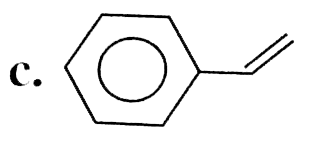
C

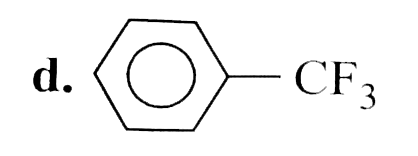
D

Text Solution

AI Generated Solution

The correct Answer is:

To determine in which case the electrophilic substitution (SE) will not occur at the meta position, we need to analyze the substituents attached to the benzene ring. The key is to identify whether the substituents are electron-donating or electron-withdrawing and their directing effects on electrophilic substitution reactions. ### Step-by-Step Solution: 1. **Identify the Substituents**: We need to look at the groups attached to the benzene ring in each case. The groups mentioned are COO, a quaternary amine, ethene, and CF3. 2. **Analyze Each Group**: - **Group A (COO)**: This is a carboxylate group, which is an electron-withdrawing group. Electron-withdrawing groups direct electrophilic substitution to the meta position. Therefore, this group does not satisfy our condition as it directs to the meta position. - **Group B (Quaternary Amine)**: This group is also an electron-withdrawing group. Like the carboxylate group, it will also direct electrophilic substitution to the meta position. Thus, this group cannot be our answer either. - **Group C (Ethene)**: Ethene is a double bond that can act as a deactivating group but it is also ortho-para directing. This means that it will not direct the electrophile to the meta position. Therefore, this group is a candidate for our answer. - **Group D (CF3)**: The trifluoromethyl group (CF3) is a strong electron-withdrawing group. It directs electrophilic substitution to the meta position, similar to the previous two groups. Hence, this group cannot be our answer. 3. **Conclusion**: The only substituent that does not direct electrophilic substitution to the meta position is the ethene group (Group C). Therefore, the answer to the question is **option C**. ### Final Answer: The electrophilic substitution will not occur at the meta position in the case of **option C (Ethene)**. ---

To determine in which case the electrophilic substitution (SE) will not occur at the meta position, we need to analyze the substituents attached to the benzene ring. The key is to identify whether the substituents are electron-donating or electron-withdrawing and their directing effects on electrophilic substitution reactions. ### Step-by-Step Solution: 1. **Identify the Substituents**: We need to look at the groups attached to the benzene ring in each case. The groups mentioned are COO, a quaternary amine, ethene, and CF3. 2. **Analyze Each Group**: - **Group A (COO)**: This is a carboxylate group, which is an electron-withdrawing group. Electron-withdrawing groups direct electrophilic substitution to the meta position. Therefore, this group does not satisfy our condition as it directs to the meta position. ...
Promotional Banner

Topper's Solved these Questions

  • AROMATIC COMPOUNDS AND ALKYL AND ARYL HALIDES

    CENGAGE CHEMISTRY ENGLISH|Exercise Exercises Assertion-Resoning Type|1 Videos
  • AROMATIC COMPOUNDS AND ALKYL AND ARYL HALIDES

    CENGAGE CHEMISTRY ENGLISH|Exercise Exercises Assertion-Resoning|11 Videos
  • AROMATIC COMPOUNDS AND ALKYL AND ARYL HALIDES

    CENGAGE CHEMISTRY ENGLISH|Exercise Exercises Single Correct Answer Type|28 Videos
  • APPENDIX INORGANIC VOLUME 2

    CENGAGE CHEMISTRY ENGLISH|Exercise Short Answer Type|179 Videos
  • BIOMOLECULES

    CENGAGE CHEMISTRY ENGLISH|Exercise Exercises Archives (Analytical And Descriptive)|8 Videos

Similar Questions

Explore conceptually related problems

In which cases delocalisation of charge is possible ?

In Which case gemetrical isomer cis is possible with M as metal ion if complexes are square planar having CN=4 ?

In which case is the junction diode is not reverse bias-

If the volume of the racion flask is reduced to half of its initial value and temperature is kept constant the in which of the following cases the position of equilibrium will shift?

In which case change in entropy is negative?

The codon of m-RNA which determins aminoacid at the 6th position in polypeptide chain of normal haemoglobin is

Which one is not a case of epimorphosis ?

As shown to the right, two blocks with masses m and M (Mgtm) are pushed by a force F in both Case I and Case II. The surface on which blocks lie, is horizontal and frictionless. Let R_I be the force that M exerts on m in case I and R_(II) be the force that m exerts on M in case II. Which of the following statements is true?

CENGAGE CHEMISTRY ENGLISH-AROMATIC COMPOUNDS AND ALKYL AND ARYL HALIDES -Exercises Single Correct
  1. Product (C) is:

    Text Solution

    |

  2. In the follwing reactionsL the rate of reaction (I) and (II) are...

    Text Solution

    |

  3. In which case will SE not be in m- position?

    Text Solution

    |

  4. Which of the folliwng has the highest dipole moment?

    Text Solution

    |

  5. Which of the following is the most stable carbonium or benzenium ion?

    Text Solution

    |

  6. Which of the following ketonic compound is the least stable?

    Text Solution

    |

  7. Which of the following compounds will give curdy precipate with AgNO(3...

    Text Solution

    |

  8. Which of the folliwng compounds is the most reactive towards electroph...

    Text Solution

    |

  9. Which of the folliwng is the most stable species?

    Text Solution

    |

  10. Which of the following in not aromatic in nature?

    Text Solution

    |

  11. Which of the following species will be least stable?

    Text Solution

    |

  12. Which of the follwing compounds will undergo Friedel Creadfts alylatio...

    Text Solution

    |

  13. Which of the following is anti-aromatic in nature?

    Text Solution

    |

  14. Which of the following aromatic compounds is least reactive towards el...

    Text Solution

    |

  15. Which of the folliwng compounds will show faster ArSN^(2) reactions?

    Text Solution

    |

  16. Which of the folliwng is the order of the rate of reaction of C(6)H(6)...

    Text Solution

    |

  17. Which of the folliwng is the correct order of the order of the rate of...

    Text Solution

    |

  18. Which of the following will give SN^(2) mechanism?

    Text Solution

    |

  19. Which of the following compounds gives SN^(1), SN^(2) and SN^(2) mecha...

    Text Solution

    |

  20. Which of the folliwning ether wil always give SN^(2) mechanism in acid...

    Text Solution

    |
