
Home
Class 12
CHEMISTRY
Which of the following compounds will gi...

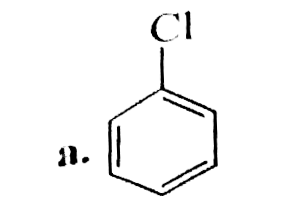
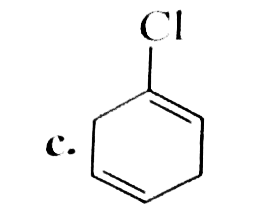
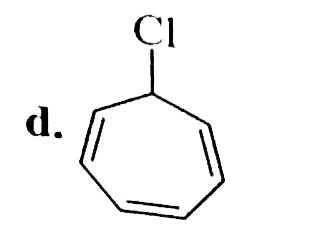
Which of the following compounds will give curdy precipate with `AgNO_(3)` solution?

A

B

C

D

Text Solution

AI Generated Solution

The correct Answer is:

To determine which of the given compounds will give a curdy precipitate with AgNO₃ solution, we need to identify which compound can easily release chloride ions (Cl⁻). The chloride ions react with silver nitrate (AgNO₃) to form a white precipitate of silver chloride (AgCl). ### Step-by-Step Solution: 1. **Understanding the Reaction**: - Silver nitrate (AgNO₃) reacts with chloride ions to form silver chloride (AgCl), which is a white curdy precipitate. - The key to this question is identifying which compound can release chloride ions. 2. **Analyzing Each Compound**: - **Compound A**: This is an aryl halide. In aryl halides, the carbon-chlorine bond has partial double bond character due to resonance. This means that the chlorine is not easily released as a chloride ion. Therefore, it will not give a curdy precipitate with AgNO₃. - **Compound B**: This compound forms a vinylic carbocation upon the removal of chloride. Vinylic carbocations are unstable due to the high s-character of the sp² hybridized carbon. Thus, this compound also does not easily release chloride ions and will not form a precipitate. - **Compound C**: Similar to Compound B, this compound also forms a vinylic carbocation upon the removal of chloride. It shares the same instability issues and therefore will not release chloride ions easily. - **Compound D**: This compound, when fluorine leaves, forms a stable carbocation due to its aromatic nature. Aromatic compounds are highly stable and can easily release chloride ions. The presence of aromaticity allows for the formation of a stable structure, making it likely to react with AgNO₃ and form a curdy precipitate of AgCl. 3. **Conclusion**: - After analyzing all the compounds, we conclude that **Compound D** is the only compound that will give a curdy precipitate with AgNO₃ solution due to its ability to easily release chloride ions. ### Final Answer: **Option D** will give a curdy precipitate with AgNO₃ solution.

To determine which of the given compounds will give a curdy precipitate with AgNO₃ solution, we need to identify which compound can easily release chloride ions (Cl⁻). The chloride ions react with silver nitrate (AgNO₃) to form a white precipitate of silver chloride (AgCl). ### Step-by-Step Solution: 1. **Understanding the Reaction**: - Silver nitrate (AgNO₃) reacts with chloride ions to form silver chloride (AgCl), which is a white curdy precipitate. - The key to this question is identifying which compound can release chloride ions. ...
Promotional Banner

Topper's Solved these Questions

  • AROMATIC COMPOUNDS AND ALKYL AND ARYL HALIDES

    CENGAGE CHEMISTRY ENGLISH|Exercise Exercises Assertion-Resoning Type|1 Videos
  • AROMATIC COMPOUNDS AND ALKYL AND ARYL HALIDES

    CENGAGE CHEMISTRY ENGLISH|Exercise Exercises Assertion-Resoning|11 Videos
  • AROMATIC COMPOUNDS AND ALKYL AND ARYL HALIDES

    CENGAGE CHEMISTRY ENGLISH|Exercise Exercises Single Correct Answer Type|28 Videos
  • APPENDIX INORGANIC VOLUME 2

    CENGAGE CHEMISTRY ENGLISH|Exercise Short Answer Type|179 Videos
  • BIOMOLECULES

    CENGAGE CHEMISTRY ENGLISH|Exercise Exercises Archives (Analytical And Descriptive)|8 Videos

Similar Questions

Explore conceptually related problems

Which of the following compound will give curdy precipiate with AgNO_(3) solution:

Which of the following compounds will produce a precipitate with AgNO_(3) ?

Which of the following compounds will form the precipitate with aq. AgNO_(3) solution most readily?

Which one of the following is likely to give a precipitate with AgNO_(3) solution ?

Which one of the following is likely to give a precipitate with AgNO_(3) solution ?

Which of the following does not give yellow precipitate with "AgNO"_(3) ?

Which of the following does not give a precipitate with alcoholic AgNO_(3) ?

Which of the following compounds will react with NaHCO_(3) solution to give sodium salt and carbon dioxide?

CENGAGE CHEMISTRY ENGLISH-AROMATIC COMPOUNDS AND ALKYL AND ARYL HALIDES -Exercises Single Correct
  1. Which of the following is the most stable carbonium or benzenium ion?

    Text Solution

    |

  2. Which of the following ketonic compound is the least stable?

    Text Solution

    |

  3. Which of the following compounds will give curdy precipate with AgNO(3...

    Text Solution

    |

  4. Which of the folliwng compounds is the most reactive towards electroph...

    Text Solution

    |

  5. Which of the folliwng is the most stable species?

    Text Solution

    |

  6. Which of the following in not aromatic in nature?

    Text Solution

    |

  7. Which of the following species will be least stable?

    Text Solution

    |

  8. Which of the follwing compounds will undergo Friedel Creadfts alylatio...

    Text Solution

    |

  9. Which of the following is anti-aromatic in nature?

    Text Solution

    |

  10. Which of the following aromatic compounds is least reactive towards el...

    Text Solution

    |

  11. Which of the folliwng compounds will show faster ArSN^(2) reactions?

    Text Solution

    |

  12. Which of the folliwng is the order of the rate of reaction of C(6)H(6)...

    Text Solution

    |

  13. Which of the folliwng is the correct order of the order of the rate of...

    Text Solution

    |

  14. Which of the following will give SN^(2) mechanism?

    Text Solution

    |

  15. Which of the following compounds gives SN^(1), SN^(2) and SN^(2) mecha...

    Text Solution

    |

  16. Which of the folliwning ether wil always give SN^(2) mechanism in acid...

    Text Solution

    |

  17. Which of the follwoign ether will always give SN^(2) mechanism in acid...

    Text Solution

    |

  18. Which of the following substrates will gave racemised product?

    Text Solution

    |

  19. The energy of activation is lowest for which reaction?

    Text Solution

    |

  20. Isopentane on monochlorination gives....isomers and out of them .........

    Text Solution

    |
