Home
Class 12
CHEMISTRY
Which of the folliwning ether wil always...

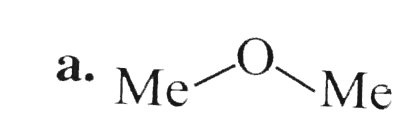
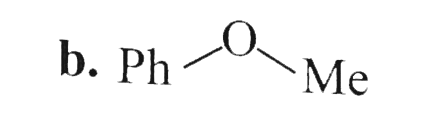
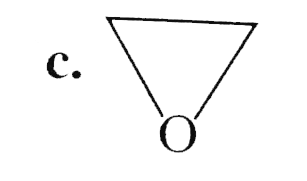
Which of the folliwning ether wil always give `SN^(2)` mechanism in acidic as well as basic conditions?

A

B

C

D

All

Text Solution

AI Generated Solution

The correct Answer is:

To determine which ether will always give an SN2 mechanism in both acidic and basic conditions, we need to analyze the structure of the ethers provided in the options. The key points to consider are the nature of the alkyl groups attached to the ether and how they influence the reaction mechanism. ### Step-by-Step Solution: 1. **Understand the Mechanisms**: - **SN1 Mechanism**: This involves the formation of a carbocation intermediate. The stability of the carbocation is crucial; tertiary carbocations are more stable than secondary, which are more stable than primary. This mechanism is favored in polar protic solvents and with substrates that can stabilize the carbocation. - **SN2 Mechanism**: This is a one-step process where the nucleophile attacks the electrophile simultaneously as the leaving group departs. The reaction rate depends on steric hindrance; less hindered (primary) substrates favor SN2. 2. **Identify the Ethers**: - We need to analyze the ethers given in the options. For an ether to undergo SN2, it should ideally have primary alkyl groups attached to the oxygen atom. 3. **Evaluate Each Ether**: - **Option A**: If it has two primary alkyl groups, it will favor SN2 due to low steric hindrance. - **Option B**: Similar to option A, if it has primary alkyl groups, it will also favor SN2. - **Option C**: Again, if it contains primary alkyl groups, it will favor SN2. - **Option D**: If this ether has primary alkyl groups, it will also favor SN2. 4. **Conclusion**: - Since all options have primary alkyl groups, they will all favor the SN2 mechanism due to low steric hindrance. Therefore, the answer is that all ethers listed will give an SN2 mechanism in both acidic and basic conditions. ### Final Answer: All ethers with primary alkyl groups will always give an SN2 mechanism in both acidic and basic conditions.

To determine which ether will always give an SN2 mechanism in both acidic and basic conditions, we need to analyze the structure of the ethers provided in the options. The key points to consider are the nature of the alkyl groups attached to the ether and how they influence the reaction mechanism. ### Step-by-Step Solution: 1. **Understand the Mechanisms**: - **SN1 Mechanism**: This involves the formation of a carbocation intermediate. The stability of the carbocation is crucial; tertiary carbocations are more stable than secondary, which are more stable than primary. This mechanism is favored in polar protic solvents and with substrates that can stabilize the carbocation. - **SN2 Mechanism**: This is a one-step process where the nucleophile attacks the electrophile simultaneously as the leaving group departs. The reaction rate depends on steric hindrance; less hindered (primary) substrates favor SN2. ...
Promotional Banner

Topper's Solved these Questions

  • AROMATIC COMPOUNDS AND ALKYL AND ARYL HALIDES

    CENGAGE CHEMISTRY ENGLISH|Exercise Exercises Assertion-Resoning Type|1 Videos
  • AROMATIC COMPOUNDS AND ALKYL AND ARYL HALIDES

    CENGAGE CHEMISTRY ENGLISH|Exercise Exercises Assertion-Resoning|11 Videos
  • AROMATIC COMPOUNDS AND ALKYL AND ARYL HALIDES

    CENGAGE CHEMISTRY ENGLISH|Exercise Exercises Single Correct Answer Type|28 Videos
  • APPENDIX INORGANIC VOLUME 2

    CENGAGE CHEMISTRY ENGLISH|Exercise Short Answer Type|179 Videos
  • BIOMOLECULES

    CENGAGE CHEMISTRY ENGLISH|Exercise Exercises Archives (Analytical And Descriptive)|8 Videos

Similar Questions

Explore conceptually related problems

Which of the following give ether ?

Which of the following will give SN^(2) mechanism?

Which of the following is a basic amino acid ?

Which of the following are SN^2 reactions ?

which of the following is basic amino acid

Which of the following is a basic amino acid?

Which of the following give ether as a major product -

In which alkyl halide SN^(2) mechanism is favoured maximum

CENGAGE CHEMISTRY ENGLISH-AROMATIC COMPOUNDS AND ALKYL AND ARYL HALIDES -Exercises Single Correct
  1. Which of the following will give SN^(2) mechanism?

    Text Solution

    |

  2. Which of the following compounds gives SN^(1), SN^(2) and SN^(2) mecha...

    Text Solution

    |

  3. Which of the folliwning ether wil always give SN^(2) mechanism in acid...

    Text Solution

    |

  4. Which of the follwoign ether will always give SN^(2) mechanism in acid...

    Text Solution

    |

  5. Which of the following substrates will gave racemised product?

    Text Solution

    |

  6. The energy of activation is lowest for which reaction?

    Text Solution

    |

  7. Isopentane on monochlorination gives....isomers and out of them .........

    Text Solution

    |

  8. Propane on dichlorinatin gives......isomers and out of them .....are o...

    Text Solution

    |

  9. A solution of (+)2-chloro-2-phenylethane in toluene racemises slowly i...

    Text Solution

    |

  10. The number of isomers for the compounds with molecular formula C(2)B...

    Text Solution

    |

  11. The decreasing basic order of the following compounds is: i. NH(3)...

    Text Solution

    |

  12. The decreasing nucleophilic order of the following compounds is: i...

    Text Solution

    |

  13. The decreasing nucleophilic order of the following compounds is: i...

    Text Solution

    |

  14. The decreasing basic order of the following is: i. F^(o-), ii. Cl^(o...

    Text Solution

    |

  15. The decreasing nucleophillic order fo the following compounds is: i...

    Text Solution

    |

  16. The decreasing leaving group order of the following is: i. F^(o-), i...

    Text Solution

    |

  17. The decreasing basic order of the following is: i. overset(o-)(C)H(...

    Text Solution

    |

  18. The decreasing nucleophilic oder of the following compounds is: i. o...

    Text Solution

    |

  19. The deecreasing leaving group order of the following compounds is: ...

    Text Solution

    |

  20. The decarising basic order of the following is: i. F(3)CSO(3)^(o-), ...

    Text Solution

    |
