

Home
Class 12
CHEMISTRY
The following curve is obtained with mol...

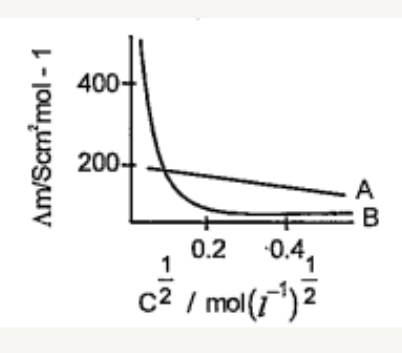
The following curve is obtained with molar conductivity `(A_m)`(y-axis) is plotted against the square root of concentration `C^(1/2)`(x-axis) for two electrolytes A and B.

How do you account for the increase in molar conductivity `A_m` for the electrolytes A and B on dilution?

Promotional Banner

Topper's Solved these Questions

  • CHEMICAL KINETICS

    PATHFINDER|Exercise QUESTION BANK|289 Videos
  • FG-1 (ALCOHOLS, PHENOLS & ETHERS)

    PATHFINDER|Exercise QUESTION BANK|622 Videos

Similar Questions

Explore conceptually related problems

The following curve is obtained with molar conductivity (A_m) (y-axis) is plotted against the square root of concentration C^(1/2) (x-axis) for two electrolytes A and B. What can you say about the nature of the two electrolytes A and B?

At a definite temperature, the molar conductivity of a weak electrolytic solution of concentration, C(M) is Lambda_(m) and the value of the molar conductivity at infinite dilution of the same electrolysis solution is Lambda_(m)^(@) . What will be the value of degree of dissociation of the electrolytr C(M) solution?

(b) At a constant temperature, the molar conductivity at infinite dilution of weak electrolyte is "x ohm"^(-1).cm^(2).mol^(-1) . If at the same temperature, the molar conductivity of the same electrolytic solution of a definite concentration is "0.02 x ohm"^(-1)."cm"^(2)."mol"^(-1) , what is the degree of dissociation of the electrolyte in the solution?

This question has Statement I and Statement II. Of the four choices given after the Statements, choose the one that best describes the two Statements. Statement -1 : As the very dilute solutions of alkali metals in liquid ammonia are made more concentrated, the molar conductivity at first decreases, reaching a minimum at about 0.05 molar, thereafter, it increases again. Statement - II: The molar conductivity of the saturated solution of the alkali metals in liquid ammonia at - 33^@C is comparable to that of a metal.

At a given temperature, the molar conductivity at infinite dilution of the electrolyte A_(2)B and the molar ionic conductance of B^(2-) are x and y" ohm"^(-1)."cm"^(2)."mol"^(-1) respectively. Find the molar ionic conductance of A^(+) ion.

Molar conductivity of 0.1 (M) solution of a weak electrolyte is "0.009 ohm"^(-1)."cm"^(-1). Its molar conductivity at infinite dilution is "260 ohm"^(-1)."cm"^(2)."mol"^(-1) . What is the degree of dissociation of the electrolyte in the solution?

Solutions of two electrolytes 'A' and 'B' are diluted. The Lambda_(m) of 'B' increases 1.5 times while that of A increases 25 times. Which of the two is a strong electrolyte? Justify your answer.

Following is the graph of y = f' (x) , given that f(c) = 0. Analyse the graph and answer the following questions. (a) How many times the graph of y = f(x) will intersect the x - axis? (b) Discuss the type of roots of the equation f (x) = 0, a le x le b . (c) How many points of inflection the graph of y = f(x), a le x le b , has? ,(d) Find the points of local maxima/minima of y = f(x), a le x le b , , (e) f"(x)=0 has how many roots?

Resistance of 0.2 M solution of an electrolyte is 50Omega . The specific conductance of the solutions is "1.4 S.m"^(-1) . The resistance of 0.5 M solution of the same electrolyte is 280Omega . The molar conductivity of 0.5 M solution of the electrolyte is "S.m"^(2)."mol"^(-1) -

The circle with equation x^2 +y^2 = 1 intersects the line y= 7x+5 at two distinct points A and B. Let C be the point at which the positive x-axis intersects the circle. The angle ACB is

PATHFINDER-ELECTROCHEMISTRY-QUESTION BANK
  1. What is the effect of temperature on the electrical conductance of an ...

    Text Solution

    |

  2. The following curve is obtained with molar conductivity (Am)(y-axis) i...

    Text Solution

    |

  3. The following curve is obtained with molar conductivity (Am)(y-axis) i...

    Text Solution

    |

  4. If Zn^(2+) // Zn electrode is diluted 100 times then what will be the ...

    Text Solution

    |

  5. What is the role of ZnCl2 in dry cell?

    Text Solution

    |

  6. Why blocks of magnesium are often strapped to the steel hulls of ocean...

    Text Solution

    |

  7. Why rusting of iron is quicker in saline water than in ordinary water?...

    Text Solution

    |

  8. A current of one ampere is flowing through a wire. Calculate the numbe...

    Text Solution

    |

  9. The specific conductance of a 0.12 N solution of an electrolyte is 2.4...

    Text Solution

    |

  10. Two half cell reactions of an electrochemical cell are: MnO4^-(aq)+8...

    Text Solution

    |

  11. Dilution normally helps in increasing the electrical conductivity of a...

    Text Solution

    |

  12. On electrolysing CuSO4 solution. In presence of Pt the solution becom...

    Text Solution

    |

  13. 0.369 gm of copper was deposited an passing 0.750 A of current through...

    Text Solution

    |

  14. In an experiment 0.40 F was passed through 400 ml of 1M solution of Na...

    Text Solution

    |

  15. The following chemical reaction is occuring in an electrochemical cell...

    Text Solution

    |

  16. The following chemical reaction is occuring in an electrochemical cell...

    Text Solution

    |

  17. The following chemical reaction is occuring in an electrochemical cell...

    Text Solution

    |

  18. The following chemical reaction is occuring in an electrochemical cell...

    Text Solution

    |

  19. The following chemical reaction is occuring in an electrochemical cell...

    Text Solution

    |

  20. At what p(H) will hydrogen electrode at 298K show an electrode potenti...

    Text Solution

    |