Home
Class 12
CHEMISTRY
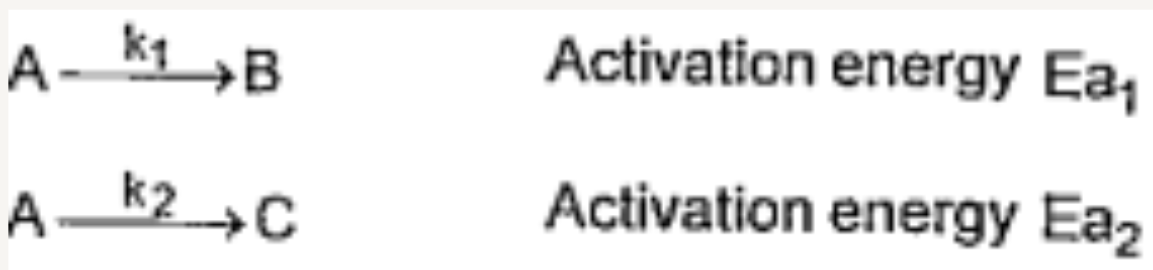
A reaction (A) forms two products Ea...

A reaction (A) forms two products

`Ea_2 =2Ea_1` than `K_1` and `K_2` will be related as.

A

`k_2 =k_1e^(Ea1/RT)`

B

`k_2 =k_1e^(Ea2/RT)`

C

`k_1 =K_2e^(Ea1/RT)`

D

k_-1 =2k_2e^Ea/RT

Text Solution

Verified by Experts

The correct Answer is:

A
Promotional Banner

Topper's Solved these Questions

  • ELECTROCHEMISTRY

    PATHFINDER|Exercise QUESTION BANK|54 Videos

Similar Questions

Explore conceptually related problems

Activation energy ( E_a ) and rate constants ( k_1 and k_2 ) of a chemical reaction at two different temperature ( T_1 and T_2 ) are related by

The equilibrium constants of the reactions : SO_2 +1/2 O_2 iff SO_3 and 2SO_2 + O_2(g) iff 2SO_3(g) and K_1 and K_2 respectively. The relationship between K_1 and K_2 is

Write down the Arrhenius equation relating the rate constant of a reaction with temp. If K_1 and K_2 be the rate constants of reaction at temperature t_1^@C and t_2^@C respectively, Find out the relation between K_1 , K_2 , t_1 and t_2 . Give that the activation energy (E_a) of the reaction remains unchnaged within the temp. range mentioned. The rate constants of a reaction at 400K and 500K are 0.02 S^-1 and 0.085 S^-1 respectively. Determine the activation energy (E_a) of the reaction.

Activation energy (E_(a)) and rate constant (k_(1) and k_(2)) of a chemical reaction at two different temperatures (T_(1) and T_(2)) are related by -

The activation energies of two reactions are E_a & E'_a respectively, where E_altE_a . If the temperature of the reaction mixture is raised from T_1 to T_2 . Then find out the relation between the rate constants at lower temperature T_1 ( k_1 and k_2 ) & higher temperature.

For the reaction N_2 + 3H_2 harr 1/2 N_2 + 3/2 H_2 is K_2 . Then calculate teh relation between K_1 and K_2

At a given temperature, for the reaction AhArrB , the rate constant (k_(f)) of the forward reaction is greater than that of the backward reaction (k_(b)) . Is the value of equilibrium constant (K) for this reaction greater than, less than or equal to 1?

The relation between k_1,k_2 and k_3 may be given as:

PATHFINDER-CHEMICAL KINETICS-QUESTION BANK
  1. For a first order reaction the ratio of times to complete 99.9% and ha...

    Text Solution

    |

  2. The decomposition of a hydrocarbon follows the equation k= (4.5 xx 10^...

    Text Solution

    |

  3. A reaction (A) forms two products Ea2 =2Ea1 than K1 and K2 will be...

    Text Solution

    |

  4. The activation energy of a reaction is 12.89 kcal/mol. The increase in...

    Text Solution

    |

  5. A to B DeltaH=-10KJ mol, Ea=50KJ // mol then activation energy of B t...

    Text Solution

    |

  6. The rate constant, the activation energy and the arrameter parameter o...

    Text Solution

    |

  7. For an exothermic chemical process occurring in two steps as: (i)A+B r...

    Text Solution

    |

  8. if activation energy of a reaction is zero

    Text Solution

    |

  9. For an exothermic reaction where Delta H represents the enthalpy of th...

    Text Solution

    |

  10. The decomposition of phosphine (PH3) an tungsten at low pressure is a ...

    Text Solution

    |

  11. The rate of a first order reaction is 0 04 mol L^-1s^-1 at 10 seconds ...

    Text Solution

    |

  12. The addition of a catalyst during a chemical reaction alters which of ...

    Text Solution

    |

  13. Which of the statements (1) - (4) about the reaction profile below is ...

    Text Solution

    |

  14. 75% of a first order reaction was completed in 32 min. When would 50% ...

    Text Solution

    |

  15. Higher order (gt3) reactions are rare due to

    Text Solution

    |

  16. For the reaction A + 2B to C, the reaction rate is doubled if the conc...

    Text Solution

    |

  17. The increase in rate constant of a chemical reaction with increasing t...

    Text Solution

    |

  18. The rate constant of the reactionA to B is 0.6 x 10^-3 moL^-1s^-1 If t...

    Text Solution

    |

  19. For the elementary reaction M to N, the rate of disappearance of M Inc...

    Text Solution

    |

  20. For the non - stoichometric reaction 2A +B to C+D, the following kinet...

    Text Solution

    |
