Home
Class 12
CHEMISTRY
For a reaction, A+ B to products, the ra...

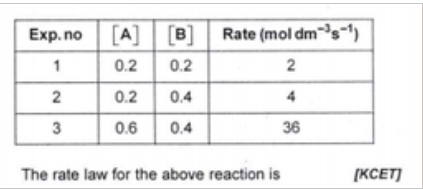
For a reaction, `A+ B to` products, the rate of the reaction at various concentrations are given below ,

A

`r= k[A][B]^2`

B

`r= k[A][B]`

C

`r= k[A]^2[B]^2`

D

`r= k[A]^2[B]`

Text Solution

Verified by Experts

The correct Answer is:

D
Promotional Banner

Topper's Solved these Questions

  • ELECTROCHEMISTRY

    PATHFINDER|Exercise QUESTION BANK|54 Videos

Similar Questions

Explore conceptually related problems

Product (B ) of the above reaction is

For the reaction A+Brarr product , (a) the rate of reaction doubles on doubling the concentration of A. (b) the rate of reaction increases by four times on doubling the concentration of B. Determine the overall order of the reaction ?

For a reaction A to B , the rate of reaction becomes twenty seven times when the concentration of A is increased three times. What is the order of the reaction?

For a reaction : aA rarr bB , the rate of reaction is doubled when the concentration of A is increased by four times. The rate of reaction is equal to

For the reaction PrarrR , the rate of the reaction = r. On doubling the concentration of P, the reaction-rate reduces to (1)/(4) th of it initial value. Find the unit of the rate constant for the reaction.

In a reaction, A+ B to product, rate is doubled when the concentration of B is doubled, and rate increases by a factor of 8 when the concentrations of both the reactants (A and B) are doubled. Rate law for the reaction can be written as

The rate constant a reaction at a given temperature is the rate of reaction when the molar concentration of each reactant is ..........

For the reaction A+BrarrC+D , it is found that rate of reaction doubles when the concentration of B is doubled and increases by 8 times on doubling the concentration of both A and B . Write the rate equation of the reaction.

For the reaction A + 2B to C , the reaction rate is doubled if the concentration of A is doubled The rate is increased by four times when concentrations of bothA and B are increased by four times. The order of the reactions is

PATHFINDER-CHEMICAL KINETICS-QUESTION BANK
  1. The rate of reaction is doubled for every 10^0 rise in temperature. Th...

    Text Solution

    |

  2. Activation energy (Ea) and rate constants (k1 and k2) of a chemical re...

    Text Solution

    |

  3. For a reaction, A+ B to products, the rate of the reaction at various ...

    Text Solution

    |

  4. For the first order reaction, rate constant depends upon

    Text Solution

    |

  5. Units of specific reaction rate for second order reaction is

    Text Solution

    |

  6. Half-life of a reaction is found to be inversely proportional to the c...

    Text Solution

    |

  7. Assertion : The order of reaction may be defined as the sum of the pow...

    Text Solution

    |

  8. Assertion : Acid catalysed hydrolysis of ethyl acetate is a first orde...

    Text Solution

    |

  9. For which order half life period is independent of initial concentrati...

    Text Solution

    |

  10. For a reaction 1/2Ararr2B, rate of disappearance of 'A' is related to ...

    Text Solution

    |

  11. For a chemical reaction, aA=bBrarrcC=dD. The ratio of rate of disappea...

    Text Solution

    |

  12. A drop of solution (volume=0.05 ml) contains 6 x 10^-7 mol of H^+. If ...

    Text Solution

    |

  13. In a reversible chemical reaction, 2NO2 overset(k1) underset(k2) iff N...

    Text Solution

    |

  14. In a second order reaction, first order in each reactant A and B, whic...

    Text Solution

    |

  15. The rate constant for the reaction 2N2O5rarr4NO2+O2 is 3xx10^-5 sec^-1...

    Text Solution

    |

  16. Consider a gaseous reaction, the rate of which is given by k[A][B], th...

    Text Solution

    |

  17. The relation between k1,k2 and k3 may be given as:

    Text Solution

    |

  18. For a reversible reaction of type mA iff nB, it was found that the con...

    Text Solution

    |

  19. What is the unit of rate constant of n^(th) order reaction?

    Text Solution

    |

  20. For a reaction A+BrarrC consider the following data:

    Text Solution

    |
