Home
Class 12
CHEMISTRY
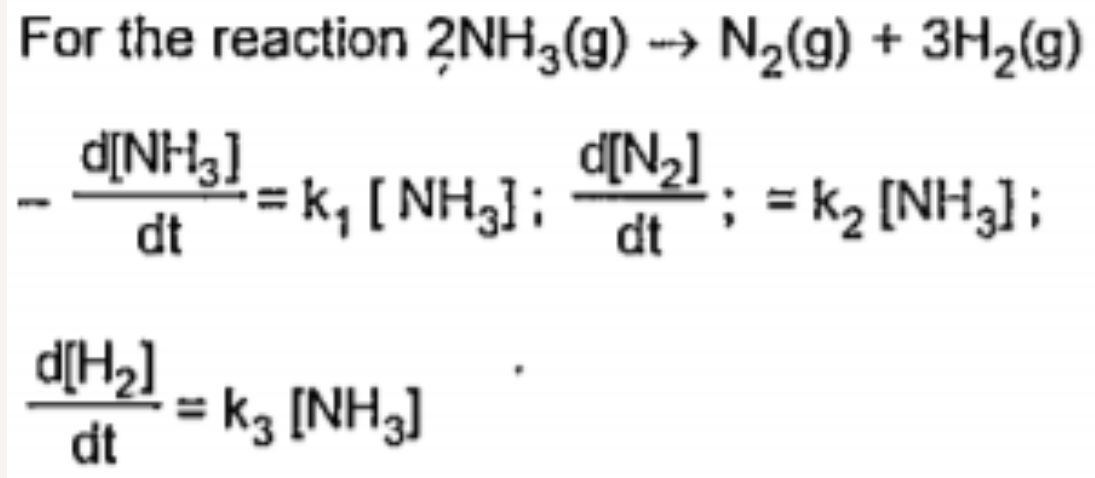
The relation between k1,k2 and k3 may be...


The relation between `k_1,k_2` and `k_3` may be given as:

A

1.5`k_1`=3`k_2`=`k_3`

B

2`k_1`=`k_2`=3`k_3`

C

`k_1`=`k_2`=`k_3`

D

`k_1`=3`k_2`=2`k_3`

Text Solution

Verified by Experts

The correct Answer is:

A
Promotional Banner

Topper's Solved these Questions

  • ELECTROCHEMISTRY

    PATHFINDER|Exercise QUESTION BANK|54 Videos

Similar Questions

Explore conceptually related problems

What is the relation between Y,K and sigma ?

Write down the Arrhenius equation relating the rate constant of a reaction with temp. If K_1 and K_2 be the rate constants of reaction at temperature t_1^@C and t_2^@C respectively, Find out the relation between K_1 , K_2 , t_1 and t_2 . Give that the activation energy (E_a) of the reaction remains unchnaged within the temp. range mentioned. The rate constants of a reaction at 400K and 500K are 0.02 S^-1 and 0.085 S^-1 respectively. Determine the activation energy (E_a) of the reaction.

What will be the relation between K_(p) and K_(c) for the given equilibrium ? CO(g)+H_(2)O(g)hArrCO_(2)(g)+H_(2)(g) .

Write down the Arrhenius equation relating the rate constant of reaction with temperature , mentioning what the terms indicate. If k_(1) and k_(2) be the rate constant of a reaction at temperature t_(1)^(@)C and t_(2)^(@)C , respectively, find out the relation between k_(1) ,k_(2) and t_(1) and t_(2) . Given that the activation energy (E_(a)) of the reaction remains unchanged within the temperature range mentioned. The rate constant of a reaction at 400K and 500K are 0.02s^(-1) and 0.08s^(-1) respectively . Determine the activation energy (E_(a)) of the reaction.

Deduce the relation between K_P and K_C for the following gaseous reaction : aA + bB ,' IL + mM

Consider the reaction 2N_(2)O_(5)(g)rarr4NO_(2)(g)+O_(2)(g) whose rate can be expressed any one of the following expressions (1) (-d[N_(2)O_(5)])/(dt)=k_(1)[N_(2)O_(5)] " or " (2) (d[NO_(2)])/(dt)=k_(2)[N_(2)O_(5)] " or " (3) (d[O_(2)])/(dt)=k_(3)[N_(2)O_(5)] Find the relation between k_(1),k_(2) and k_(3) .

The relation between K_(p) and K_(c) for the following reaction : 2 SO_(2) (g) + O_(2) (g) hArr 2 SO_(3) (g) is -

What is equilibrium constant? Establish the relation between K_p and K_c for a reversible reaction in equilibrium.

Find the relation between K_p and K_c for the following system : 2NaHCO_3(s)

The reaction -rate of the reaction AB_(3)rarr(1)/(2)A_(2)+(3)/(2)B2 can be expressed by any one of the following equations : (-d[AB_(3)])/(dt)=k_(1)[AB_(3)], (d[A_(2)])/(dt)=k_(2)[AB_(3)] " or, " (d[B_(2)])/(dt)=k_(3)[AB_(3)] The ratio between k_(1) , k_(2)and k_(3) is -

PATHFINDER-CHEMICAL KINETICS-QUESTION BANK
  1. The rate constant for the reaction 2N2O5rarr4NO2+O2 is 3xx10^-5 sec^-1...

    Text Solution

    |

  2. Consider a gaseous reaction, the rate of which is given by k[A][B], th...

    Text Solution

    |

  3. The relation between k1,k2 and k3 may be given as:

    Text Solution

    |

  4. For a reversible reaction of type mA iff nB, it was found that the con...

    Text Solution

    |

  5. What is the unit of rate constant of n^(th) order reaction?

    Text Solution

    |

  6. For a reaction A+BrarrC consider the following data:

    Text Solution

    |

  7. The decomposition of ozone proceeds as

    Text Solution

    |

  8. For a reaction Ararr Product. It is found that the rate of reaction in...

    Text Solution

    |

  9. Half of a substance is consumed in 40 minutes. When the quantity of th...

    Text Solution

    |

  10. For a first order reaction, consider the graph below.

    Text Solution

    |

  11. The following data are for the decomposition of ammonium nitrite in aq...

    Text Solution

    |

  12. The half life period of a first order chemical reaction is 6.93 minute...

    Text Solution

    |

  13. The inversion of cane sugar proceeds with half-life of 500 minutes at ...

    Text Solution

    |

  14. Two first order reactions proceed at 25^@C, at the same rate. The temp...

    Text Solution

    |

  15. Rate of a reaction can be expressed by Arrhenius equation as : k=(Ae)^...

    Text Solution

    |

  16. The temperature coefficient for the saponification of ethyl acetate by...

    Text Solution

    |

  17. A catalyst lowers the activation energy of a reaction from 20 kJ/mole ...

    Text Solution

    |

  18. The activation energy for the reaction 2HIrarrH2+I2 is 184 kJ/ mole. H...

    Text Solution

    |

  19. The energies of activation for forward and reverse reaction for A2 + B...

    Text Solution

    |

  20. Consider an endothermic reaction Xrarr Y with the activation energies ...

    Text Solution

    |
