Home
Class 12
CHEMISTRY
The rate of change of concentration of (...

The rate of change of concentration of (A) for reaction:
A`rarr`B is given by `(-d[A])/dt=k[A]^1/3`
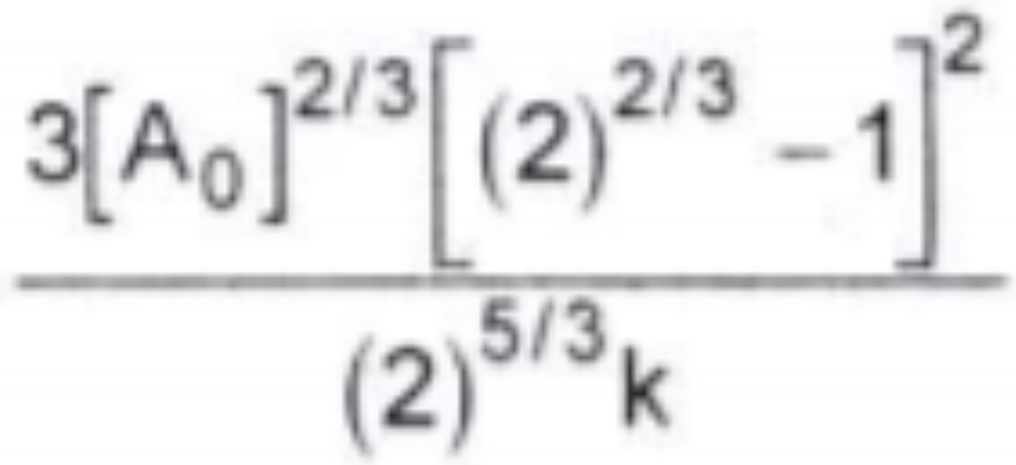
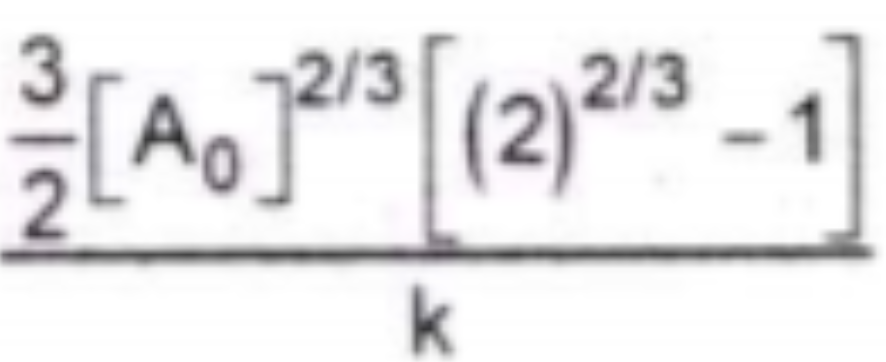
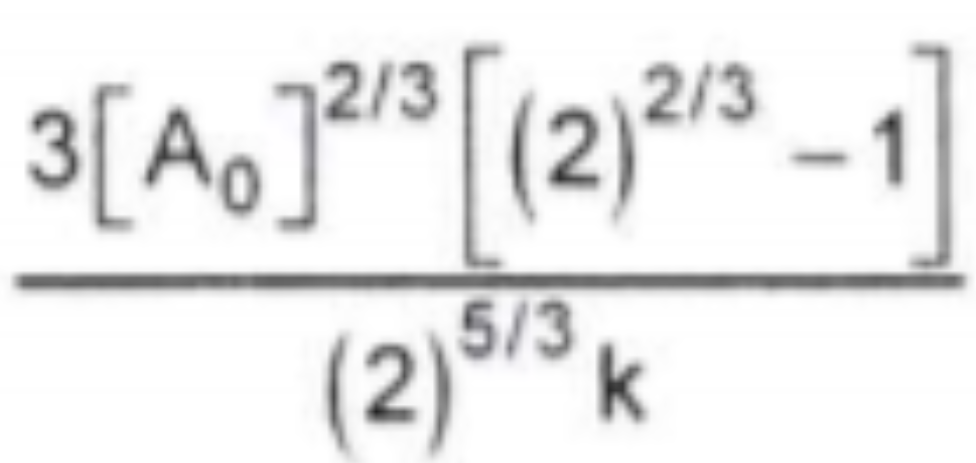
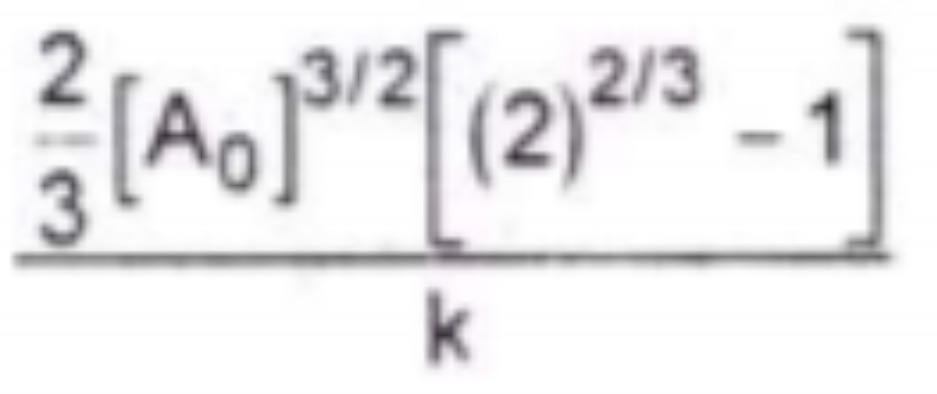
The half-life period of the reaction will be:

A

B

C

D

Text Solution

Verified by Experts

The correct Answer is:

C
Promotional Banner

Topper's Solved these Questions

  • ELECTROCHEMISTRY

    PATHFINDER|Exercise QUESTION BANK|54 Videos

Similar Questions

Explore conceptually related problems

The half life period for a first order reaction is .......

The rate law for a reaction between the substances A and B is given by Rate = k[A]^m[B]^n On doubling the concentration of A and having the concentration of B, the ratio of the new rate to the earlier rate of the reaction will be as:

The initial concentration of the reactant in a zero order reaction is 1.386 "mol.L"^(-1) The half-life of the reaction is 20s. Calculate: the rate constant

For a zero order reaction the initial concentration of the reactant is 1.386 mol L^(-1) . If the half life period of the same be 20S then what. Shall be the concentration of the reaction after 30S.

The initial concentration of the reactant in a zero order reaction is 1.386 "mol.L"^(-1) The half-life of the reaction is 20s. Calculate: the concentration of the reactant after 30s from the initiation of the reaction.

For a reaction , A+Brarr product, rate law is given by, r=k[A]^(1//2)xx[B]^(2) . What is the order of the reaction?

The rate constant of a first order reaction is 2.31xx10^(-3)s^(-1) Calculate the half-life period of the activation energy of the reaction.

The rate equation for a reaction is given by rate, =k[A][B]^(3//2) . Determine if the given reaction is an elementary reaction.

For a chemical reaction, if the concentration of the reactant a doubled, its half-life is halved. Determine the order of the reaction.

PATHFINDER-CHEMICAL KINETICS-QUESTION BANK
  1. If a reaction A+BrarrC is exothermic to the extent of 30 kJ/mol and th...

    Text Solution

    |

  2. In a reaction, A+ B to product, rate is doubled when the concentration...

    Text Solution

    |

  3. The rate of change of concentration of (A) for reaction: ArarrB is gi...

    Text Solution

    |

  4. The following graph shows low t(1/2) (half-life) of a reactant R chang...

    Text Solution

    |

  5. Consider the following first order reaction: The percentage of 'B' i...

    Text Solution

    |

  6. Complete the following reaction

    Text Solution

    |

  7. The reaction, N2O5"(in" CCl4)rarr 2NO2+1/2O2(g) is first order in N2O5...

    Text Solution

    |

  8. For xA+yB rArr zC, - (d[A])/(dt) = (d[B])/(dt) = 1.5 (d[C])/(dt) then ...

    Text Solution

    |

  9. A reaction follows the given concentration-time graph The rate for thi...

    Text Solution

    |

  10. The decomposition of NO2 at 400K proceeds at a rate of 5.4 xx 10^-5 mo...

    Text Solution

    |

  11. Convert Aniline to m-Bromonitrobenzene.

    Text Solution

    |

  12. Which of these factors will affect the specific reaction rate of the g...

    Text Solution

    |

  13. Consider that the first order decomposition reaction of N2O5 written a...

    Text Solution

    |

  14. Which of the following statements is incorrect

    Text Solution

    |

  15. The rate law for a reaction between the substances A and B is given by...

    Text Solution

    |

  16. The following data are for the reaction, A+Brarr products

    Text Solution

    |

  17. For the reaction: H2(g) + Br2(g) rarr 2HBr(g) the experimental data su...

    Text Solution

    |

  18. A hypothetical reaction A2 + B2 rarr 2AB follows the following given m...

    Text Solution

    |

  19. The unit of rate of reaction and rate constant are identical for a

    Text Solution

    |

  20. For a zero order reaction, the plot of [A]t versus t for the reaction ...

    Text Solution

    |
