

Home
Class 12
CHEMISTRY
A reaction follows the given concentrati...

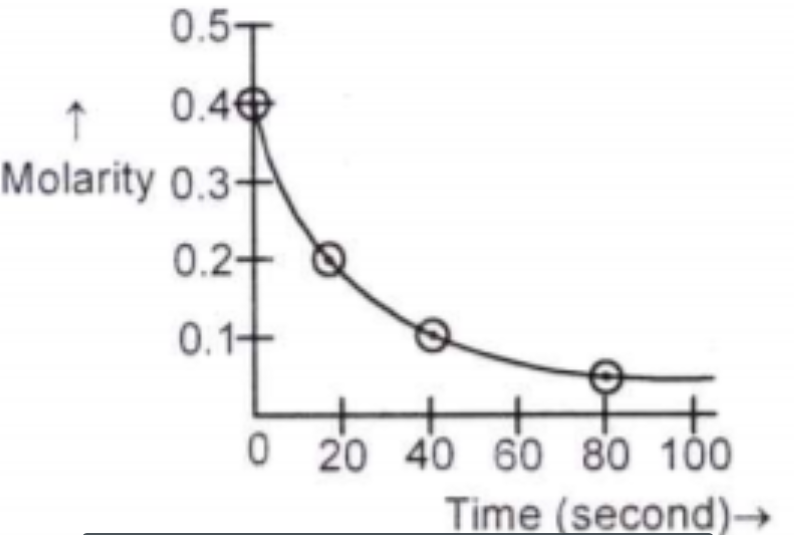
A reaction follows the given concentration-time graph The rate for this reaction at 20 s will be

A

`4xx10^-3 Ms^-1`

B

`8xx10^-3 Ms^-1`

C

`2xx10^-2 Ms^-1`

D

`1xx10^-2 Ms^-1`

Text Solution

Verified by Experts

The correct Answer is:
D
Promotional Banner

Topper's Solved these Questions

  • ELECTROCHEMISTRY

    PATHFINDER|Exercise QUESTION BANK|54 Videos

Similar Questions

Explore conceptually related problems

A+BrarrC , on doubling the concentration of 'A , the rate of the reaction doubles. However on doubling the concentration of B , the rate of the reaction remains unaltered. Write the rate law of the reaction.

xA+yB+zCrarr Product , For this reaction : (a) rate of reaction becomes half when concentration of A is doubled. (b) rate of reaction remains the same when concentration of B is doubled. (c) the rate of reaction becomes eight times when concentration of C is doubled. Determine the overall order of the reaction .

plot a graph of reaction -rate vs concentration of the reactant for a fist order reaction.

In the reaction aA rarrbB , if the concentration of A is doubled , then rate of formation of B also becomes double. The order of the reaction is -

For the reaction A+Brarr product , (a) the rate of reaction doubles on doubling the concentration of A. (b) the rate of reaction increases by four times on doubling the concentration of B. Determine the overall order of the reaction ?

The rate law for a reaction between the substances A and B is given by Rate = k[A]^m[B]^n On doubling the concentration of A and having the concentration of B, the ratio of the new rate to the earlier rate of the reaction will be as:

How does the initial concentration of the reactant in a first order reaction very with time ?

For a reaction : aA rarr bB , the rate of reaction is doubled when the concentration of A is increased by four times. The rate of reaction is equal to

The rate of a reaction at 400 K is 10 times than the rate of the reaction at 200 K . Calculate activation energy of the reaction.

PATHFINDER-CHEMICAL KINETICS-QUESTION BANK
  1. The reaction, N2O5"(in" CCl4)rarr 2NO2+1/2O2(g) is first order in N2O5...

    Text Solution

    |

  2. For xA+yB rArr zC, - (d[A])/(dt) = (d[B])/(dt) = 1.5 (d[C])/(dt) then ...

    Text Solution

    |

  3. A reaction follows the given concentration-time graph The rate for thi...

    Text Solution

    |

  4. The decomposition of NO2 at 400K proceeds at a rate of 5.4 xx 10^-5 mo...

    Text Solution

    |

  5. Convert Aniline to m-Bromonitrobenzene.

    Text Solution

    |

  6. Which of these factors will affect the specific reaction rate of the g...

    Text Solution

    |

  7. Consider that the first order decomposition reaction of N2O5 written a...

    Text Solution

    |

  8. Which of the following statements is incorrect

    Text Solution

    |

  9. The rate law for a reaction between the substances A and B is given by...

    Text Solution

    |

  10. The following data are for the reaction, A+Brarr products

    Text Solution

    |

  11. For the reaction: H2(g) + Br2(g) rarr 2HBr(g) the experimental data su...

    Text Solution

    |

  12. A hypothetical reaction A2 + B2 rarr 2AB follows the following given m...

    Text Solution

    |

  13. The unit of rate of reaction and rate constant are identical for a

    Text Solution

    |

  14. For a zero order reaction, the plot of [A]t versus t for the reaction ...

    Text Solution

    |

  15. For A rarrB (zero order reaction), the t(1/2) is 10 s. find out the co...

    Text Solution

    |

  16. The rate constant for a 1st order reaction is 6.909 min^-1. Therefore ...

    Text Solution

    |

  17. Two substance A and B are present such that [A]=4[B} and half life of ...

    Text Solution

    |

  18. The reaction 2NO(g) + H2(g) = N2O(g) + H2O(g) follows the rate law (dP...

    Text Solution

    |

  19. CH3COOC2H5 + H2O overset(H^+) iff CH3COOH + C2H5OH in an example of .....

    Text Solution

    |

  20. The gas phase decomposition of dimethyl ether follows first order kine...

    Text Solution

    |