Home
Class 12
CHEMISTRY
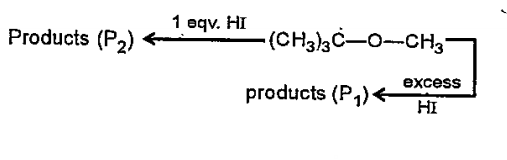
ProductsP-1 and P2 respectively are...


Products`P-1` and `P_2` respectively are

A

`(CH_3)-3 CI+CH_3OH "and" (CH_3)_3 CI+CH_3I`

B

`(CH_3)_3CI+CH_3I"and" (CH_3)_3 COH +CH_3I`

C

`(CH_3)_3CI+CH_3OH `in both the cases

D

`CH_3I and (CH_3)_3 CI in both the cases

Text Solution

Verified by Experts

The correct Answer is:

A
Promotional Banner

Topper's Solved these Questions

  • ELECTROCHEMISTRY

    PATHFINDER|Exercise QUESTION BANK|54 Videos
  • HALOALKANES AND HALOARENES

    PATHFINDER|Exercise QUESTION BANK|222 Videos

Similar Questions

Explore conceptually related problems

A company sells two different products P_(1) and P_(2) The company makes profits of Rs 40 and Rs 30 per unit on product P_(1) and P_(2) respectively. the two products are produced in a common production process and are sold in two different markets the production process has a capacity of 30000 men hours it takes 3 hours to produces one unit of P_(1) and 1 hour to produce one unit of P_(2) the market has been surveyed and company officals feels that the maximum number of P_(1) that can be sold is 8000 and maximum number that of P_(2) is 12000 units. formulate the above problem and solve it by graphical method

N_2O_4 is dissociated to 33% and 40% at total pressures P_1 and P_2 atm respectively. Hence, the ratio of P_1 to P_2 is

P_1 and P_2 are planes passing through origin L_1 and L_2 are two lines on P_1 and P_2, respectively, such that their intersection is the origin. Show that there exist points A ,B and C , whose permutation A^(prime),B^(prime)a n dC^(prime), respectively, can be chosen such that i) A is on L_1,B on P_1 but not on L_1 and C not on P_1; ii) A ' is on L_2,B ' on P_2 but not on L_2 and C ' not on P_2dot

At a given temperature, the reaction, A(g)hArr 2N(g) , is in equilibrium in a closed flask. At the same temperature, the reaction c(g)hArr D(g)+E(g) is in equilibrium in an another closed flask. Values of equilibrium constants of these two reactions are K_(p1) and K_(p2) respectively and the total pressures of the equilibrium mixtures are P_1 and P_2 respectively. If K_(p1) : K_(p2) = 1 : 4 and P_1 : P_2 = 1 : 4 then the ratio of degree of dissociation of A(g) and C(g) are ( assume the degrees of dissociation of both are very small compared to 1)-

Consider three planes P_1 : x-y + z = 1 , P_2 : x + y-z=-1 and P_3 : x-3y + 3z = 2 Let L_1, L_2 and L_3 be the lines of intersection of the planes P_2 and P_3 , P_3 and P_1 and P_1 and P_2 respectively. Statement 1: At least two of the lines L_1, L_2 and L_3 are non-parallel . Statement 2:The three planes do not have a common point

Let x^2/a^2+y^2/b^2=1 and x^2/A^2-y^2/B^2=1 be confocal (a > A and a> b) having the foci at s_1 and S_2, respectively. If P is their point of intersection, then S_1 P and S_2 P are the roots of quadratic equation

In a chemical reaction, if the total enthalpies of reactants and products are H_(R) and H_(P) respectively then H_(P) gt H_(R) for ______ reaction and H_(R) gt H_(P) for _____ reaction.

If two matrices A and B of orders 2 xxm and 3xxn respectively are conformable for the product AB of order p xx 4 , find the values of m, n and p.

A particle, starting from rest, is in uniform acceleration. Its displacement in (P- 1) seconds and P seconds are s_(1) and s_(2) respectively . Then what would be its displacement in the (P^(2)-P+1) -th second?
