

Home
Class 12
CHEMISTRY
The reactivity of compound Z with differ...

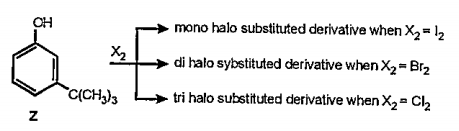
The reactivity of compound Z with different halogens under appropriate conditions is given below

(1)the steric effect of the halogen
(2)the steric effect of tert-butyl group
(3)the electronic effect of the phenolic group
(4)the electronic effect of the tert-butyl group

Text Solution

Verified by Experts

(1,2,3)
Promotional Banner

Topper's Solved these Questions

  • ELECTROCHEMISTRY

    PATHFINDER|Exercise QUESTION BANK|54 Videos
  • HALOALKANES AND HALOARENES

    PATHFINDER|Exercise QUESTION BANK|222 Videos

Similar Questions

Explore conceptually related problems

Screening effect is the effect produced by intervening electrons between nucleus and valence electrons . They shield the nucleus from valence electron and effective nuclear charge decreases if there is less shielding effect the effective nuclear charge decreases Valence electrons are attracted by nucleus and repelled by other electrons. Net effective force on electrons under consideration = Z-sigma = (Nuclear charge -screening effect ) slaters formula for screening constant. If one electron is present in outermost orbit there will be no screening in that orbital. Each electrons contributes 0.35 (total electrons minus 1) present in outermost shell. In penultimate energy level electrons contribute 0.85. A contribution of 1 is from remaining electrons (present in last but one energy level) The effective nuclear charge for 4s electrons of Zn will be

The bromine atom possesses 35 electrons. It contains 6 electrons in 2p orbital. 6 electrons in 3p orbital and 5 electron in 4p orbital. Which of these electron experiences the lowest effective nuclear charge?

Slight difference in identical twins support the hypothesis that 1. dominance may be incomplete 2. single gene may produce multiple effect 3. the expression of genetic character is affected by environment 4. they developed from separate fertilized eggs

The given reaction is carried out in a closed vessel: CaCO_(3)(s)hArr CaO(s)+CO_(2)(g), DeltaH^(0) gt0 . What would be the effect of the following changes on the equilibrium of the reaction if (1) solid CaCO_(3) is added to the reaction system, (2) some amount of CaO is removed from the reaction system, (3) CO_(2)(g) is introduced into the reaction system at constant volume and temperature., (4) temperature is increased, and (5) volume of the reaction vessel is reduced at constant temperature.

PATHFINDER-FG-1 (ALCOHOLS, PHENOLS & ETHERS)-QUESTION BANK
  1. Predict the major product of the following reaction

    Text Solution

    |

  2. The correct statement(s) about the following reaction sequence is (are...

    Text Solution

    |

  3. The reactivity of compound Z with different halogens under appropriate...

    Text Solution

    |

  4. The acidic hydrolysis of ether (X)shown below is fastest when

    Text Solution

    |

  5. For the identification of beta naphthol using dye test, it is necessar...

    Text Solution

    |

  6. Explain why aniline is not as basic as ammonia.

    Text Solution

    |

  7. An unknown alcohol is treated with the "Lucas reagent" to determine wh...

    Text Solution

    |

  8. Which of the following reagents can be used to carry out the following...

    Text Solution

    |

  9. (X)+Mgoverset(dry)underset (ether) rarr (Y) overset ((i)(Z))underset((...

    Text Solution

    |

  10. Among the given geminal diols, which is/are stable with respect to the...

    Text Solution

    |

  11. Dehydration of alcohols take place more rapidly with POCl3 than with H...

    Text Solution

    |

  12. Which of the following alcohols turn(s)CrO3 inH2SO4 into green?

    Text Solution

    |

  13. Complete the following reaction

    Text Solution

    |

  14. Which of the following alcohols respond(s) to iodoform test?

    Text Solution

    |

  15. Ethanol is less acidic than

    Text Solution

    |

  16. Phenol is less acidic than

    Text Solution

    |

  17. Which of the following compounds is/are soluble in NaHCO3?

    Text Solution

    |

  18. Reimer Tiemann introduces an aldehyde group on to the aromatic ring of...

    Text Solution

    |

  19. Reimer Tiemann introduces an aldehyde group on to the aromatic ring of...

    Text Solution

    |

  20. Two isomeric forms of an organic compound A, C11H13OCl readily decolou...

    Text Solution

    |