Home
Class 12
PHYSICS
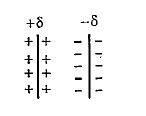
Two infinite nonconducting sheets of uni...

Two infinite nonconducting sheets of uniform charge density `(+delta)` and `(-delta)` are parallel to each other as shown. Electric field at the

A

midpoint in the space between the sheets is `delta/in_0` and is directed towards right.

B

midpoint in the space between the sheets is `(2delta)/in_0` and is directed towards right

C

midpoint between the sheets is zero

D

points to the left or to the right of the sheets is `delta/in_0`

Text Solution

Verified by Experts

Promotional Banner

Topper's Solved these Questions

  • ELECTROSTATIC POTENTIAL AND CAPACITANCE

    PATHFINDER|Exercise QUESTION BANK|50 Videos
  • MAGNETIC EFFECT OF CURRENT AND ELECTROMAGNETISM-I,II AND III

    PATHFINDER|Exercise QUESTION BANK|213 Videos

Similar Questions

Explore conceptually related problems

Two uniform infinite planes of charge having charge densities (+sigma) and (-sigma) intersect at right angle. The magnitude of electric field at any position in the space is

Three infinitely long charge sheets are placed as shown below. Find the electric field at the pint P.

Two infinite parallel sheets A and B having uniform surface charge densities sigma and -sigma are held as shown below Graphically represent the variation of electric field due to the two sheets as one moves from the point O to P.

Two charged conducting spheres of radii r_1 and r_2 connected to each other by a wire. Find the ratio of electric fields at the surface of the two spheres.

Three infinite plane sheets carrying uniform charge densities -sigma , 2 sigma , 4 sigma are placed parallel to XZ plane at Y = a, 3a, 4a respectively. The electric field at the point (0, 2a, 0) is

A cahrged particle is released from rest in a region of steady and uniform electric and magnetic and magnetic fields, which are parallel to each other what will be the nature of the path followed by the charged particle?

The electric field intensity E, current density J and conductivity delta are related as—

PATHFINDER-ELECTROSTATICS-I, II AND III-QUESTION BANK
  1. Assertion. If the bob of a simple pendulum is kept in a horizontal ele...

    Text Solution

    |

  2. Assertion. A metallic shield in the form of a hollow shell may be buil...

    Text Solution

    |

  3. Two infinite nonconducting sheets of uniform charge density (+delta) a...

    Text Solution

    |

  4. Two uniform infinite planes of charge having charge densities (+sigma)...

    Text Solution

    |

  5. A hollow dielectric sphere has inner and outer radii of R1 and R2 resp...

    Text Solution

    |

  6. Figure shows two conducting thin concentric shells of radii r and 3r. ...

    Text Solution

    |

  7. Initially the spheres A and B are at potentials VA and VB. When B is e...

    Text Solution

    |

  8. Figure shows three concentric thin spherical shells A, B and C. They h...

    Text Solution

    |

  9. A small charged particle of mass ‘m’ and charge q is suspended by an i...

    Text Solution

    |

  10. A given charge is situated at a certain distance from an electric dipo...

    Text Solution

    |

  11. The electric flux, leaving spherical surface of radius r and surroundi...

    Text Solution

    |

  12. Linear charge density of arc is lamda and total angle alpha. Derive an...

    Text Solution

    |

  13. A region consists of uniform electric field E and uniform gravity g pe...

    Text Solution

    |

  14. Two (-ve) charge, each of magnitude q are situated at 2r distance apar...

    Text Solution

    |

  15. A proton and an alpha-particle are situated at r distance apart. At ve...

    Text Solution

    |

  16. A charge Q is distributed over two concentric hollow spheres of radius...

    Text Solution

    |

  17. Two equal -ve charges -q are fixed at the points (0, a) and (0, -a) on...

    Text Solution

    |

  18. Two particles of masses m and 2m with charges 2q and 2q are placed in ...

    Text Solution

    |

  19. The work done required to put the four charges together at the comers ...

    Text Solution

    |

  20. A charge Q is placed at each of the two opposite corners of a square, ...

    Text Solution

    |

