

Home
Class 12
PHYSICS
In the figure shown, an observer O1 floa...


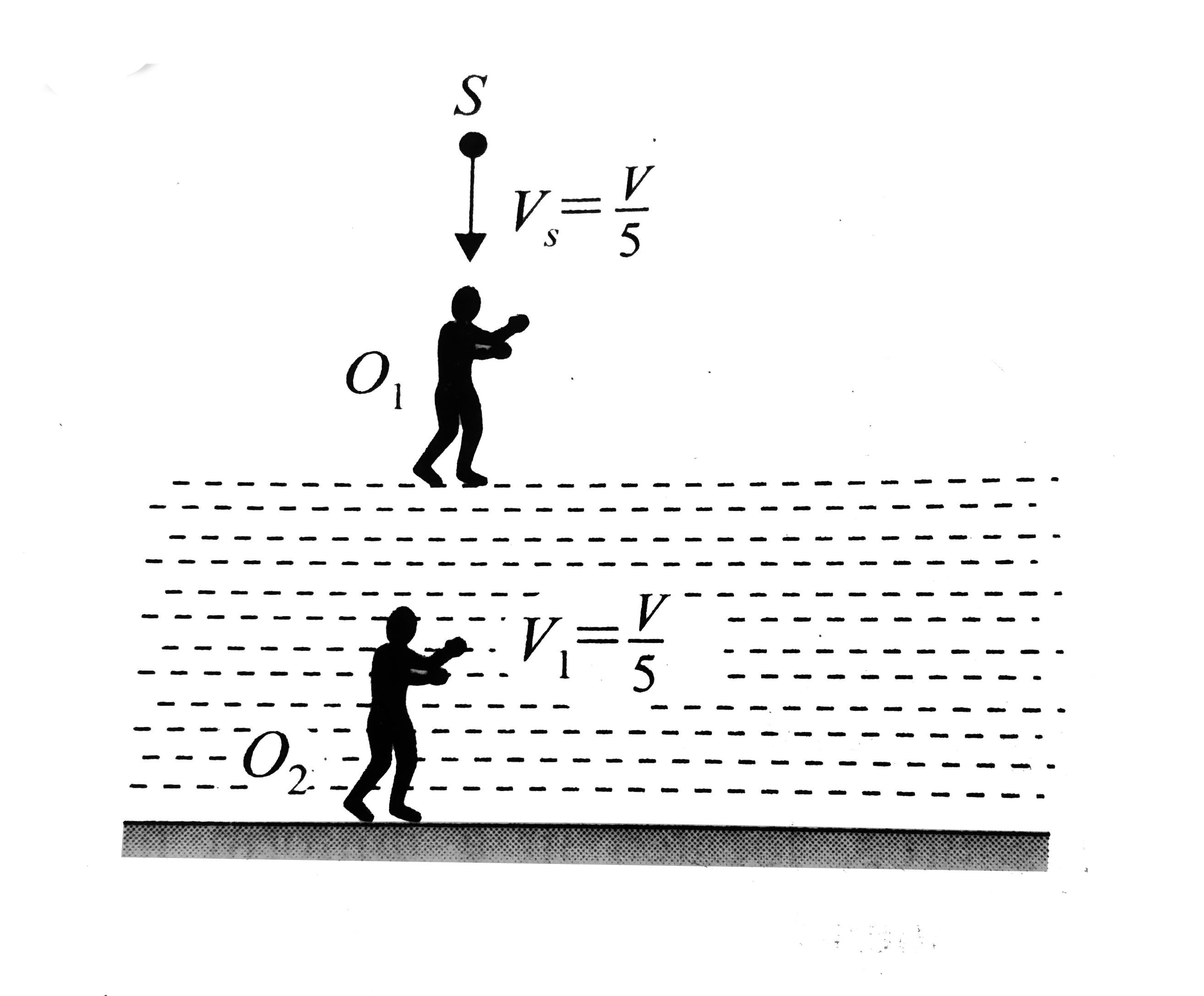
In the figure shown, an observer `O_1` floats (static) on water surface with ears in air while another observer `O_2` is moving upwards with constant velocity `V_1=(V)/(5)` in water. The source moves down with constant velocity `V_S=(V)/(5)` and emits sound of freqeuncy `f`. The velocity of sound in air is `V` and that in water is `4V`. For the situation shown in figure.

Promotional Banner

Similar Questions

Explore conceptually related problems

A wall is moving with constant velocity u towards a fixed source of sound of frequency f . The velocity of sound is v . The wavelength of the sound reflected by the wall is

A particle mass parallel to x-axis with constant velocity v as shown in the figure. The angular velocity of the particle about the origin O

If a source emitting waves of frequency f moves towards an observer with a velocity (v)/(4) and the observer moves away from the source with a velocity (v)/(6) , the apparent frequency as heard by the observer will be (v=velocity of sound)

A source of frequency n is moving with a uniform velocity v towards a stationary observer. If the velocity of sound is V, then the change in frequency would be -

A car is moving along X-axis with a velocity v=20m//s . It sounds a whistle of frequency 660 Hz. If the speed of sound is 340m//s . The apparent frequency heard by the observer O (shown in figure) is:

A drop of water of radius r is falling rhough the air of coefficient of viscosity eta with a constant velocity of v the resultant force on the drop is

When the observer moves towards the stationary source with velocity, v_1 , the apparent frequency of emitted note is f_1 . When the observer moves away from the source with velocity v_1 , the apparent frequency is f_2 . If v is the velocity of sound in air and f_1/f_2 = 2,then v/v_1 = ?

If an observer is moving with uniform velocity v to wards a stationary source of frequency n, and if the velocity of sound in the medium is V, then the apparent change in the frequency of the sound, heard by the observer, is -