

Home
Class 11
PHYSICS
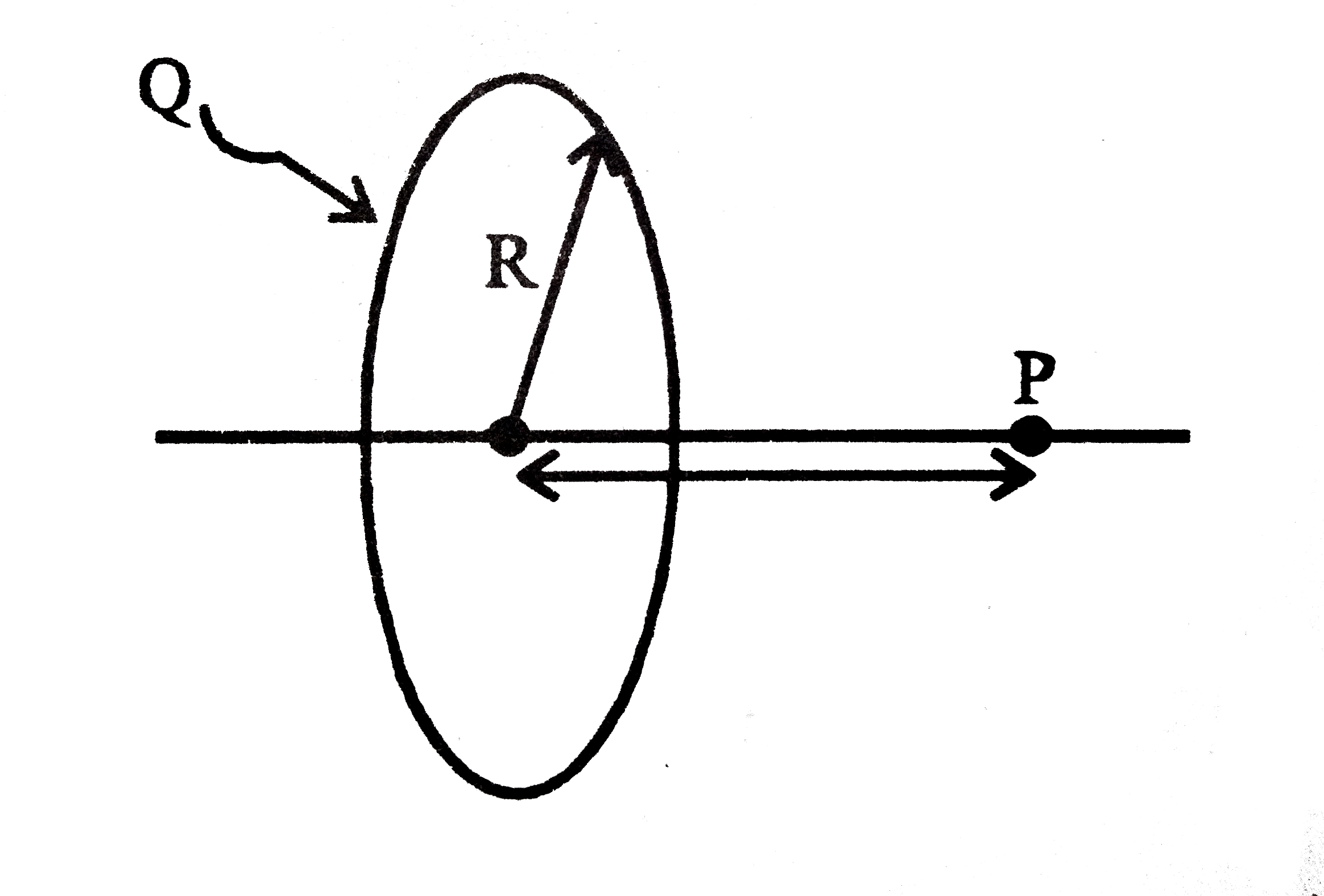
A small particle of mass m and charge-q ...

A small particle of mass m and charge-q is placed at point `P` on the axis of uniformly charged ring and releases. If `R gtgt x`, the particle will undergo oscillations along the axis of symmetry with an angular frequency that is equal to-
.

Promotional Banner

Similar Questions

Explore conceptually related problems

A small particle of mass m and charge-q is placed at point P on the axis of uniformly chrarged ring and releases. If R gtgt x , the particle will undergo oscillations along the axis of symmetry with an angurlar frequency that isequal to- .

The maximum electric field intensity on the axis of a uniformly charged ring of charge q and radius R will be

A particle of mass m and charge +q approaches from a very large distance towards a uniformly charged ring ofradius Rand charge, mass same as that of particle, with initial velocity v_(0) along the axis of the ring as shown in the figure-1.420. What is the closest distance of approach between the ring and the particle? Assume the space to be gravity free and frictionless :

A charged particle of charge q moving with the velocity v, enters along the axis of a solenoid carrying a current. If B is the magnetic induction along the axis of the solenoid then the force acting on the charged particle will be

A charged particle of mass m and charge q is released from rest the position (x_0,0) in a uniform electric field E_0hatj . The angular momentum of the particle about origin.

The maximum electric field intensity on the axis of a uniformly charged ring of charge q and radius R is at a distance x from the centre of the ring.The value of x is

Which statement is true :- (i) A ring of radius R carries a uniformly distributed charge +Q. A point charge -q is placed on the axis of the ring at a distance 2R from the centre of the ring and released from rest. The particle executes a smiple harmonic motion along the axis of the ring. (ii) Electrons move from a region of higher potential to that of lower potential

A charge particle of mass m and charge q is projected with velocity v along y-axis at t=0. Find the velocity vector and position vector of the particle vec v (t) and vec r (t) in relation with time.

A charge q is placed at the point P as shown in figure on the axis of the ring of elemental thickness 't' and radius R then flux through the ring is :-

Positive charge Q is distributed uniformly over a circular ring of radius R. A particle having a mass m and a negative charge q, is placed on its axis at a distance x from the centre. Find the force on the particle. Assuming x ltltR, find the time period of oscillation of the particle if it is released from there.