

Home
Class 11
PHYSICS
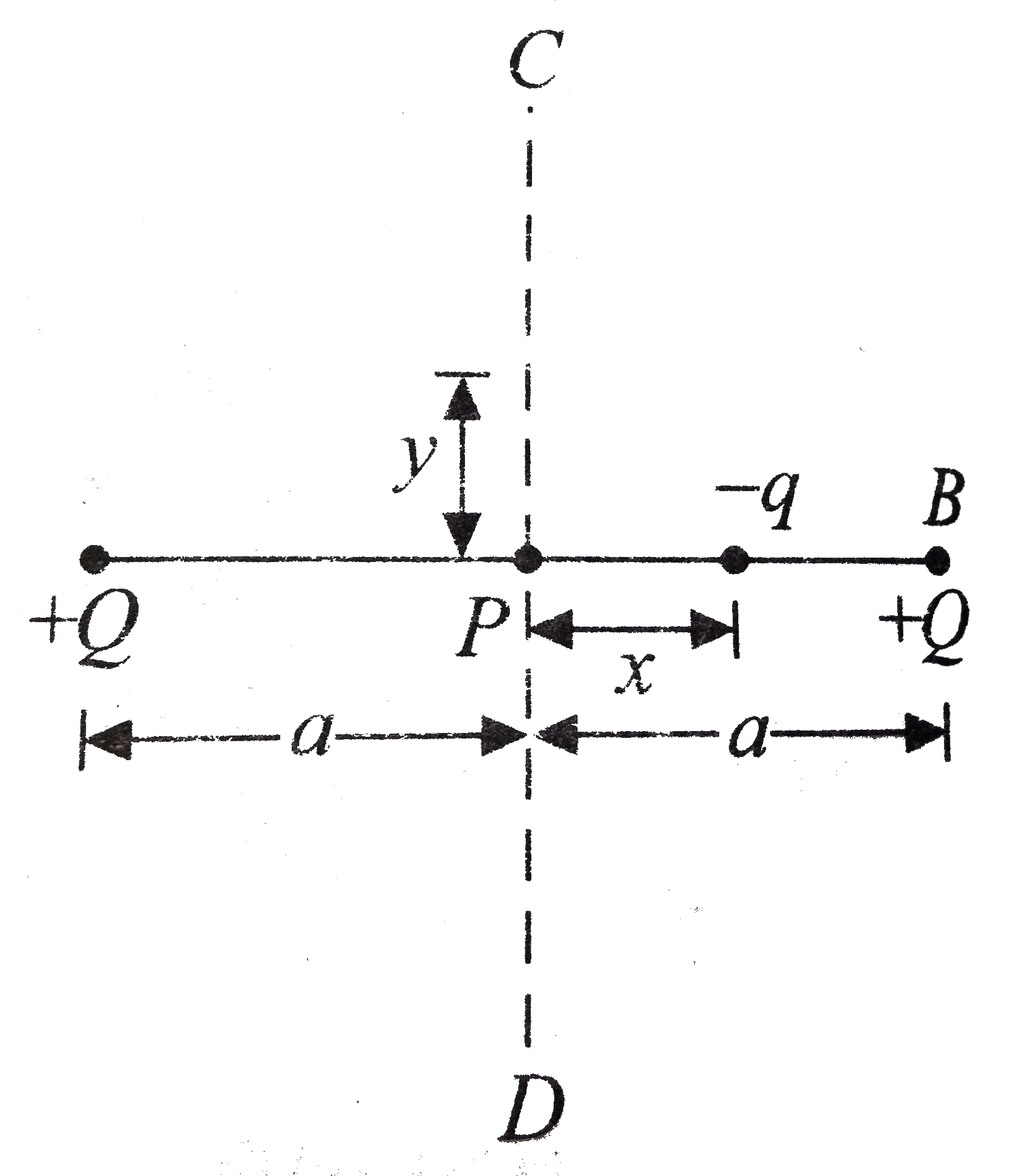
In the arrangement shown in fig. two pos...

In the arrangement shown in fig. two positive charges, `+Q` each,are fixed. Mark the correct statement(s) regarding a third charged particle `-q` place at the midpoint P that can be displaced along or perpendicular to the line connecting the charges.

Promotional Banner

Similar Questions

Explore conceptually related problems

Two charges -q each are fixed separated by distance 2d. A third charge q of mass m placed at the mid-point is displaced at the mid-point is placed slightly by x (xltltd) perpendicular to the line joining the two fixed charges as shown in Fig. Show that q will perform simple harmonic oscillarion of time period. T = [(8pi^(3) in_(0) md^(3))/(q^(2))]^(1//2)

Two positive point charges , each Q , are fixed at separation d . A third charge q is placed in the middle. Describe the equilibrium of the third charge.

In the arrangement shown in fig. The two point charge are in equilibrium. The infinete wire is fixed in the horizontal plane, and the two point charges are placed one above and the other below the wire. Consifering the gravitational effect of the earth, the nature of q_(1) and q_(2) can be

Two small particles charged with equal positive charges Q each, are fixed apart at a distance 2a. Another small particle having a charge q lies midway between the fixed charges. Show that (i) For small displacement (relative to a) along line joining the fixed charges, the middle charge executes SHM'if it is +ve and (ii) For small lateral displacement, it executes SHM ifit is-ve. Compare the frequencies of oscillation in the two cases

Two infinitely long line charges having charge density lamda each are parallel to each other and separated by distance d. A charge particle of mass m and charge q is placed at mid point between them. This charge displaced slightly along a line AB which is perpendicular to the line charges and in the plane of the charges. prove that the motion of the particle will be SHM for small displacement and lamda q gt 0 Neglect gravity. Find the time period.

Two point charges q each are fixed at (a,0) and (-a,0). A third charge Q is placed at origin. Electrons potential energy of the system will

Two identical charges +Q are kept fixed some distance apart.A small particles P with charge q is placed midway between them . If P is given a small displacement Delta ,it will undergo simple harmonic motion if (i) q is positive and Delta is along the line joining the charges (ii) q is positive and Delta is perpendicular to the line joining the charges (iii) q is negative and Delta is perpendicular to the line joining the charges (iv) q is positive and Delta is along the line joining the charges

Two points charges , each Q , are fixed at separation 2d . A charged particle having charge q and mass m is placed between them. (a) Now this charged particle is slightly displaced along the line joining the charges , slow that it will execute simple harmonic motion and find the time period of oscillation. (b) If charge q is negative and it is displaced slightly perpendicular to the line joining the charges , repeat the part (a) .

Two electrons each are fixed at a distance '2d'. A third charge proton placed at the midpoint is displaced slightly by a distance x (x lt lt d) perpendicular to the line joining the two fixed charges. Proton will execute simple harmonic motion having angular frequency : (m = mass of charged particle)

Four positive charges (2sqrt2-1)Q are arranged at the four corners of a square. Another charge q is placed at the center of the square. Resulting force acting on each corner charge is zero if q is