

Home
Class 11
PHYSICS
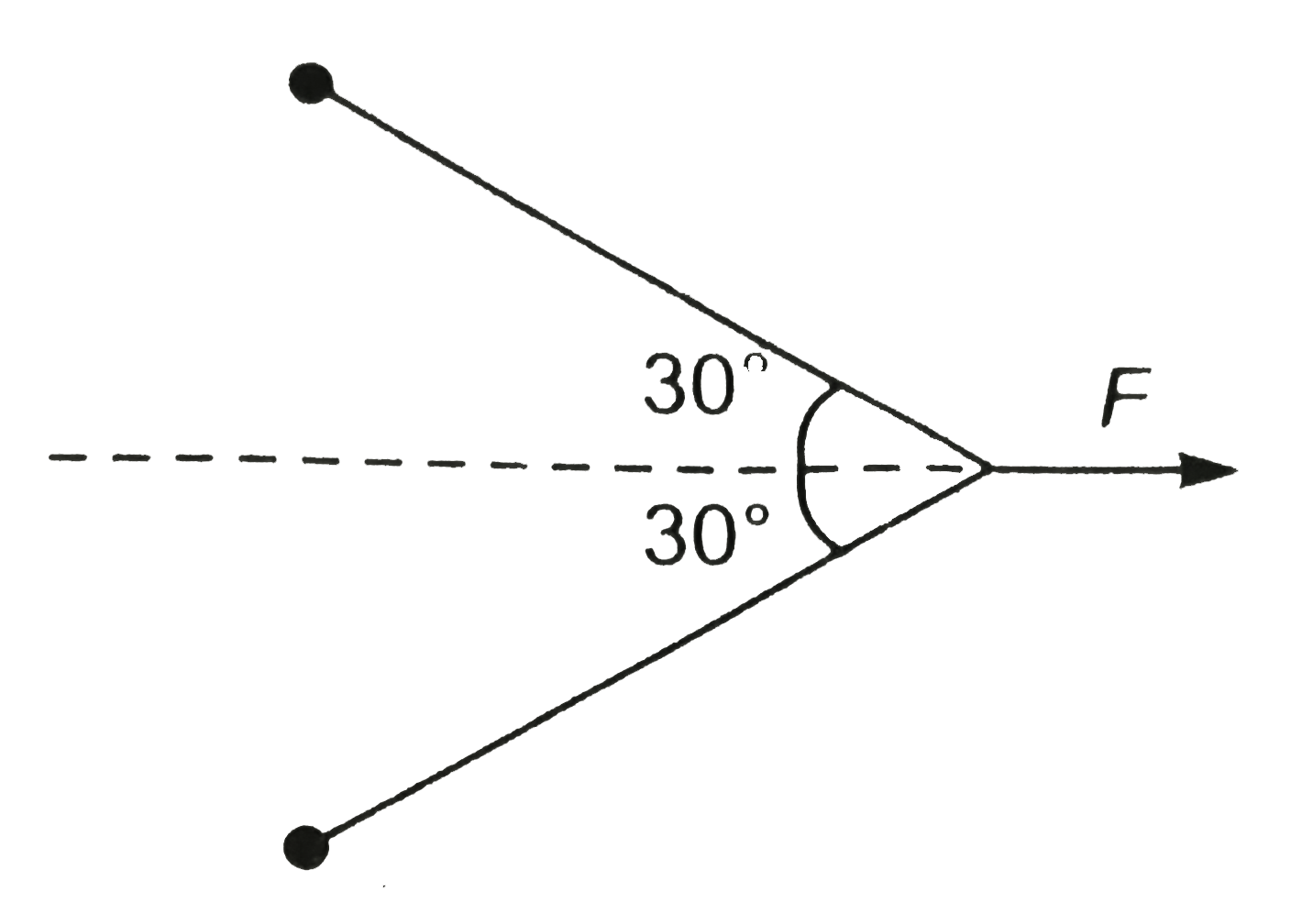
In figure two identical particles each o...

In figure two identical particles each of mass `m` are tied together with an inextensible string. This is pulled at its centre with a constant force `F`. If the whole system lines on a smooth horizontal plane, then the acceleration of each particle towards each other is

Promotional Banner

Similar Questions

Explore conceptually related problems

In figure two identical particals each of mass m are tied together with an inextensible string. This is pulled at its centre wwith a constant force F . If the whole system lines on a smooth horizontal plane, then the aceleration of each partical towards each other is

Two particles each of mass m are connected by a light inextensible string and a particle of mass M is attached to the midpoint of the string. The system is at rest on a smooth horizontal table with string just taut and in a straight line. The particle M is given a velocity v along the table perpendicular to the string. Prove that when the two particles are about to collide : (i) The velocity of M is (Mv)/((M + 2m)) (ii) The speed of each of the other particles is ((sqrt2M (M + m))/((M + 2m)))v .

Two blocks o equal mass m are tied to each other through light string. One of the blocks is pulled along the line joining them with a constnt force F. Find the tension in the string joining the blocks.

Two particles each of mass m are connected by a light string of length 2L as shown in the figure. A constant force F is applied continuoulsly at the mid - point of the string at right - angle to intial position of the string. Find the acceleration of each particle and the acceleration of approach between the particles when separation between them is 2x

A system consits of n identical particles each of mass m. The total number of interactions between particles possible are :

Two identical particles move towards each other with velocity 2v and v respectively. The velocity of centre of mass is

Two particles of a mass 2m and m are tied with an inextensible string the particle of mass m is given a speed V as shown in the figure. Find the speed with which the particle of mass 2m starts moving.

Two particles having mass ratio n:1 are interconnected by a light inextensible string that passes over a smooth pulley . If the system is released , then the acceleration of the centre of mass of the system is

A fixed wedge withboth surface inclined at 45^(@) to the horizontal as shwon in the figure. A particle P of mass m is held on the smooth plane by a light string which passes over a smooth pulley A and attached to a particle Q of mass 3m which rest on the rough plane. The system is released from rest. Given that the acceleration of each particle is of magnitude ( g)/( 5sqrt( 2)) then, the tension in the string is :