

Home
Class 12
PHYSICS
Two bodies of masses 1 kg and 4 kg are c...

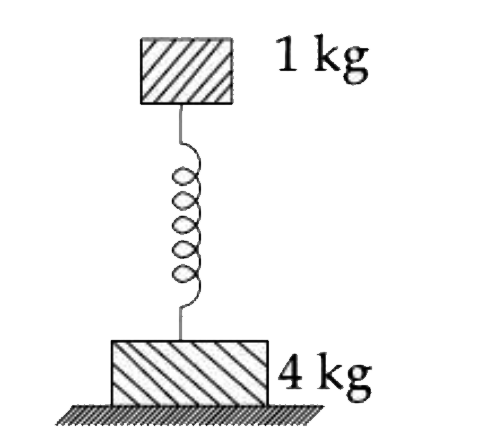
Two bodies of masses 1 kg and 4 kg are connected to a vertical spring, as shown in the figure. The smaller mass executes simple harmonic motion of angular frequency `"25 rad s"^(-1)`, and amplitude 1.6 cm while the bigger mass remains stationary on the ground. The maximum force exerted by the system on the floor is `("take "g=10ms^(-2))`.

Promotional Banner

Similar Questions

Explore conceptually related problems

Two simple harmonic motions of angular frequency 100 rad s^(-1) and 1000 rad s^(-1) have the same displacement amplitude. The ratio of their maximum accelerations is

Two bodies of mass 6 kg and 4 kg are tied to a string as shown in the following figure. If the table is smooth and pulley frictionless, then acceleration of mass 6 kg will be ( g =10 ms^(-2) )

A ball hung from a vertical spring oscillates in simple harmonic motion with an angular frequency of 2.6 rad/s and an amplitude of 0.075m. What is the maximum acceleration of the ball?

A block of mass 5 kg executes simple harmonic motion under the restoring force of a spring. The amplitude and the time period of the motion are 0.1 m and 3.14 s respectively. Fnd the maximum force exerted by the spring on the block.

A bob B of mass 1kg is suspended form the ceiling of a toy train as shown in the figure the train oscillates simple harmonically in horizontal direction with angular frequency omega = 5rad //s amd amplitude a=0.1m what is the ratio of maximum and minimum tensions in the string AB during the motion (g=10ms^(-2)&tan 37^(@)=3//4)

A block of mass 2kg executes simple harmonic motion under the reading from at a spring .The angular and the time period of motion are 0.2 cm and 2pi sec respectively Find the maximum force execute by the spring in the block.

Two blocks of masses 5 kg and 10 kg are connected by a massless spring as shown in the diagram. A force of 100 N acts on 10kg mass as shown. At a certain instant the acceleration of 5 kg mass is 12 m//s^(2) find the force in the spring and acceleration of 10 kg mass.

A liquid of mass 1 kg is filled in a flask as shown in figure. The force exerted by the flask on the liquid is (g=10m//s^(2)) [Neglect atmospheric pressure]:

A body A of mass m_(1)=1kg and a body B of mass m_(2)=4kg are attached to the ends of a spring. The body A performs vertical simple harmonic oscillations of amplitude a=1.6 cm and angular frequency omeg=25rads . Neglecting the mass of the sppring determine the maximum and minimum values of force the system exerts on the surface on which in rests. ["Take g"=10 m//s^(2)]

A body of mass 0.01 kg executes simple harmonic motion about x = 0 under the influence of a force as shown in figure. The time period of SHM is