

Home
Class 11
PHYSICS
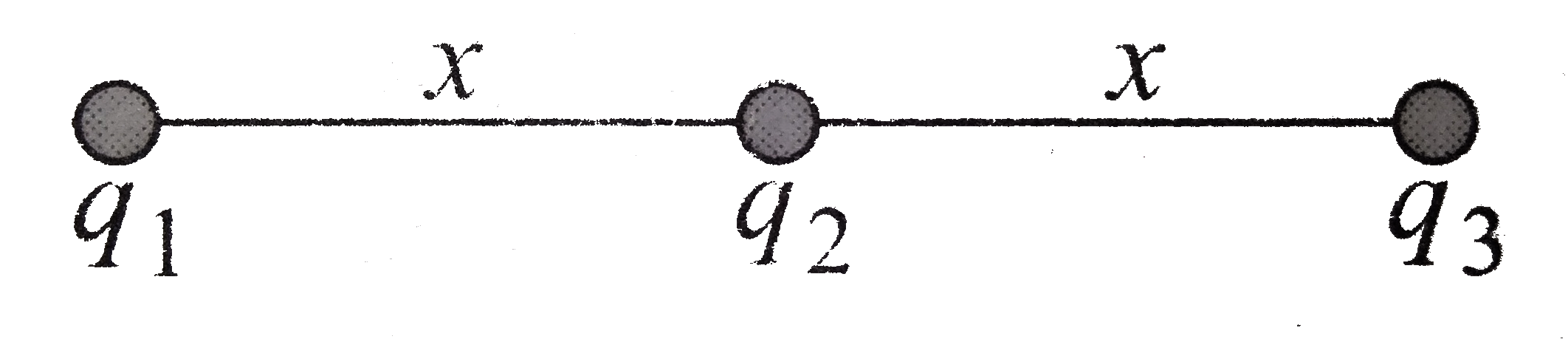
Three charged particles are placed on a ...

Three charged particles are placed on a straight line as shown in fig. `q_(1)` and `q_(2)` are fixed but `q_(3)` can be moved. Under the action of the forces from `q_(1),q_(2)` and `q_(3)` is in equilibrium. What is the relation between `q_(1)` and `q_(2)`.

Promotional Banner

Similar Questions

Explore conceptually related problems

Three charged paricles are placed on a straight line as shown in fig. q_(1) and q_(2) are fixed but q_(3) can be moved. Under the action of the forces from q_(1),q_(2) and q_(3) is in equilbrium. What is the relation between q_(1) and q_(2) .

Calculate Q_(1),Q_(2)and Q_(3),

Three charges -q,+2q, and -q are arranged on a line as shown in fig. Calculate the field at a distance rgtgta on the line.

The value of charge q_1 ,q_2 and q_3 as shown in the figure are

Threee charges +Q_(1),+Q_(2) and q are placed on a straight line such that q is somewhere in between +Q_(1) and Q_(2) . If this system of charges is in equlibirium what should be the magnitude and sign of charge q?

Three point charges Q_(1), Q_(2), Q_(3) in the order are placed equally spaced along a straight line. Q_(2) and Q_(3) are equal in magnitude but opposite in sign. If the net force on Q_(3) is zero. The value of Q_(1) is

Three equal charges are placed on the three corners of a square. If the force between q_(1) and q_(2) is F_(12) and that between q_(1) and q_(3) is F_(13) , then the ratio of magnitudes (F_(12)//F_(13)) is

In Fig., three charged particles lie on an x axis. Particles 1 and 2 are fixed in place. Particle 3 is free to move, but the net electrostatic force on it from particles 1 and 2 happens to be zero. If 2.0 L_(23) = L_(12) , what is the ratio q_(1)//q_(2) ?

Two charges +q_(1) and -q_(2) are placed at A and B respectively. A line of force emanates from q_(1) at an angle alpha with the line AB. At what angle will it terminate at -q_(2) ?