

Home
Class 11
PHYSICS
A collar B of mass m is at rest and when...

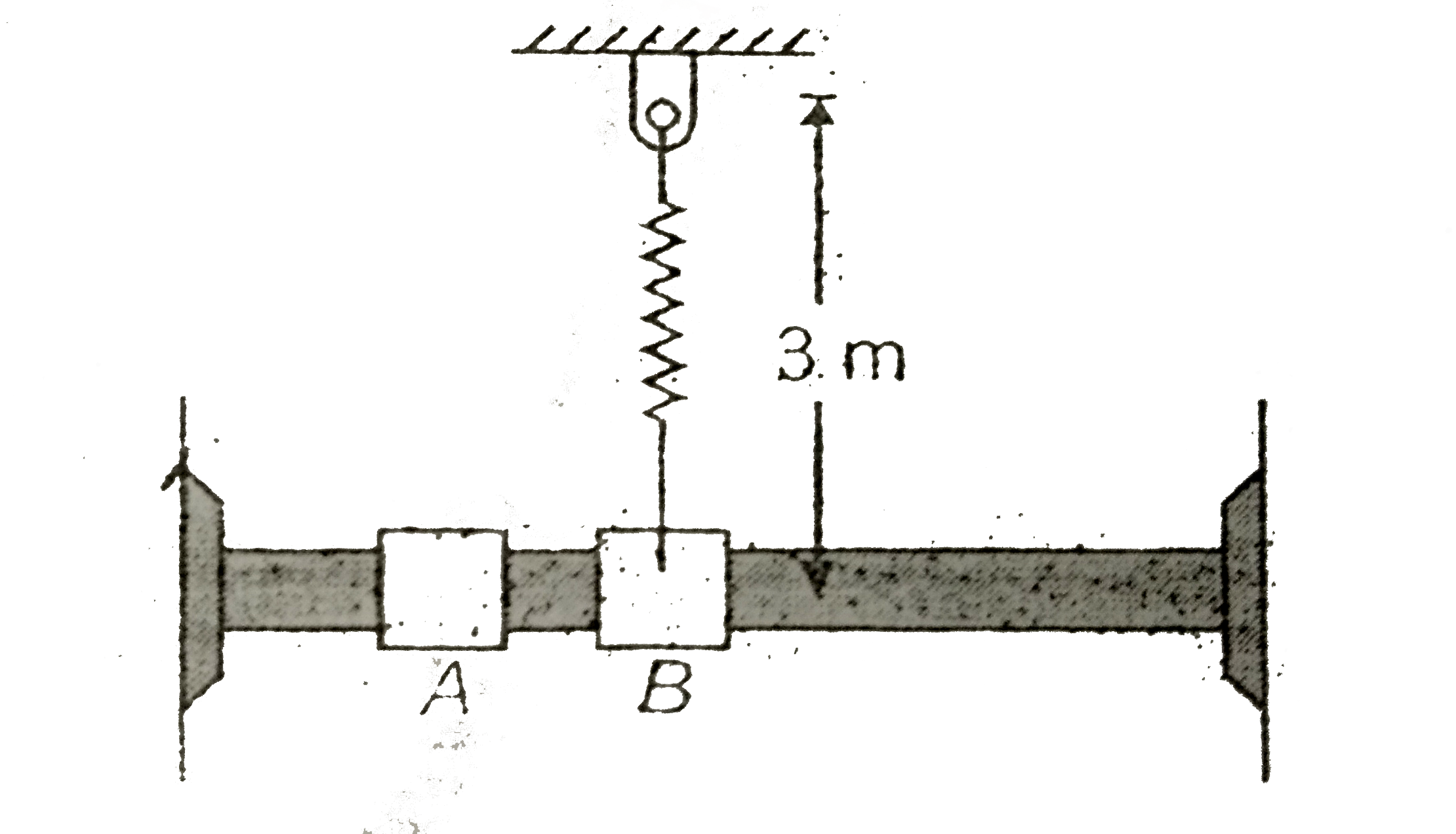
A collar `B` of mass `m` is at rest and when it is in the position shown, the spring is unstretched. If another collar `A` of mass `(m)/(n)` strikes it so that `B` slides a distance `4m` on the smooth rod before momentarily stopping, determine the velocity of `A` just after the impact. The coefficient of restitution is `e`. The spring constant is `k`.

Promotional Banner

Similar Questions

Explore conceptually related problems

A wedge of mass M is kept at rest on smooth surface a particle of mass m hits the wedge normally. Find the velocity of wedge and particle just after collision. Take coefficient of restitution as e .

A ball of mass 2m impinges directly on a ball of mass m, which is at rest. If the velocity with which the larger ball impringes be equal to the velocity of the smaller mass after impact then the coefficient of restitution :-

A ball of mass m moving with velocity u strikes another identical ball at rest. Find the velocities of the balls after the collision if the coefficient of restitution is e and the collision is head -on. Also , calculate the loss in K.E.

A particle of mass m, collides with another stationary particle of mass M. If the particle m stops just after collision, then the coefficient of restitution for collision is equal to

A sphere of mass m falls on a smooth hemisphere of mass M resting with its plane face on smooth horizontal table, so that at the moment of impact, line joining the centres makes an angle with the vertical. The velocity of sphere just before impact is u and e is the coefficient of restitution.

A ball of mass M strikes another smooth ball of mass m at rest. If they separate in mutually perpendicular directions, then the coefficient of impact (e) is :

A mass m = 8kg is attached to a spring as shown in figure and held in positioin so that the spring remains unstretched. The spring constant is 200 N/m. The mass m is then released and begins to undergo small oscillations. The maximum velocity of the mass will be (g=10m/ s^(2))

A mass M=5 kg is attached to a string as shown in the figure and held in position so that the spring remains unstretched. The spring constant is 200 Nm^(-1) . The mass M is then released and begins to undergo small oscillations. The amplitude of oscillation is