

Home
Class 12
PHYSICS
A disc is rolling (without slipping) on ...

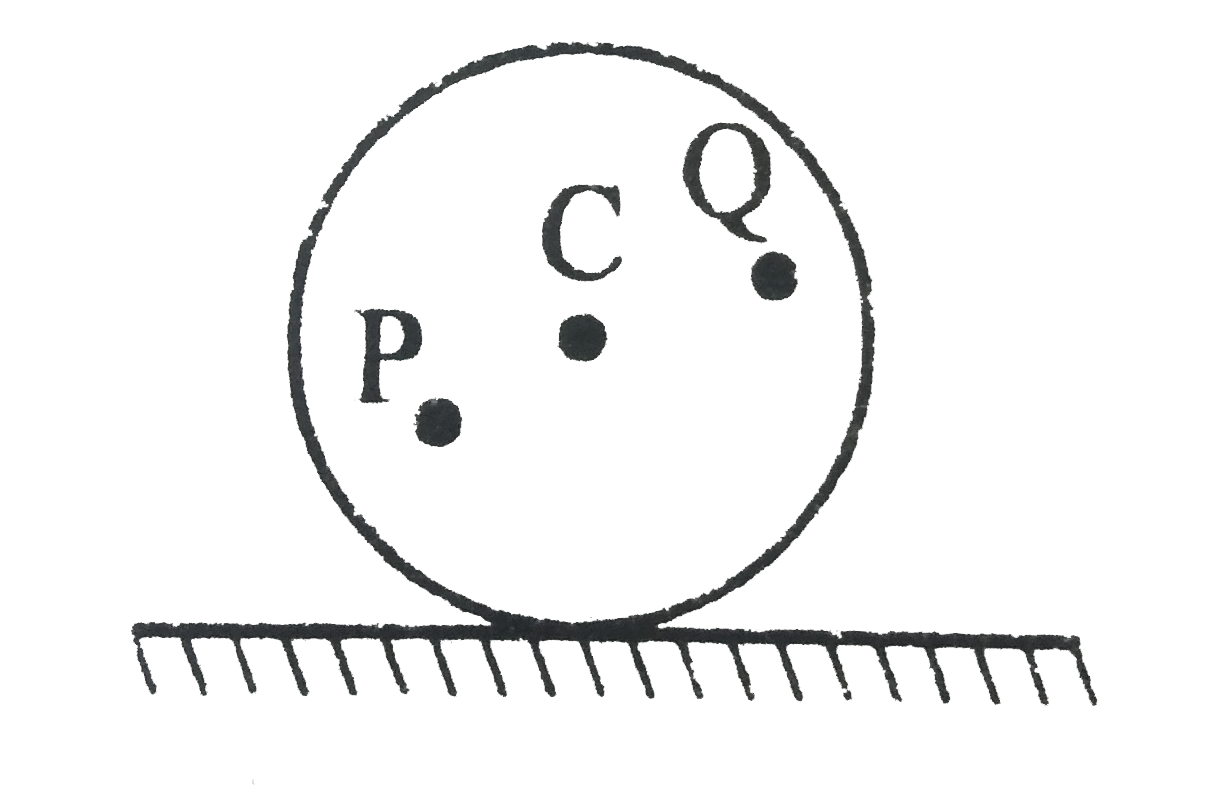
A disc is rolling (without slipping) on a horizontal surface. `C` is its center and `Q` and `P` are two points equidistant from `C`. Let `V_(P), V_(Q)` and `V_(C)` be the magnitude of velocities of points `P, Q` and `C` respectively, then
.

Promotional Banner

Similar Questions

Explore conceptually related problems

A disc is rolling without slipping on a horizontal surface with C, as its centre and Q and P the two points equidistant from C. Let v_(P),v_(Q) and v_(C) be the magnitudes of velocities of point P,Q and C respectively, then

A disc is rolling (without slipping) on a horizontal surface. C is its centre and Q and P are two point equidistanec from C. let upsilon_(p),upsilon_(Q) and upsilon_(C) be the magnitude of velocities of points P, Q, and C repsectively, (a). upsilon_(Q)gtupsilon_(C)gtupsilon_(P) (b). upsilon_(Q)ltupsilon_(C)ltupsilon_(P) (c). upsilon_(Q)=upsilon_(P),upsilon_(C)=(1)/(2)upsilon_(P) (d). upsilon_(Q)ltupsilon_(C)gtupsilon_(P)

A disc is rolling without slipping with angular velocity omega . P and Q are two points equidistant from the centre C. the order of magnitude fo velocity is

A disc rolls without slipping on a horizontal surface such that its velocity of center of the mass is v . Find the velocity of points A , B , C and D .

A disc is rolling without sliding on a horizontal surface. Velocity of the centre of the disc is V . Then the maximum relative sped of any point on the circumference of the disc with respect to point P is.

A hollow conducting sphere is placed in an electric field produced by a point charge placed at P as shown in figure. Let V_(A), V_(B), V_(C ) be the potentials at points A, B and C respectively. Then

A solid sphere of mass m and radius R rolls without slipping on a horizontal surface such that v_(c.m.)=v_(0) .

A wheel rolls without slipping on a horizontal surface such that its velocity of center of mass is v . The velocity of a particle at the highest point of the rim is

A solid disc rolls clockwise without slipping over a horizontal path with a constant speed v . Then the magnitude of the velocities of points A, B and C (see figure) with respect to a standing observer are, respectively, .

The point P(x,y) is equidistant from the points Q(c+d,d-c) and R(c-d,c+d) then