

Home
Class 10
BIOLOGY
K stands for Kharif while R stands for R...

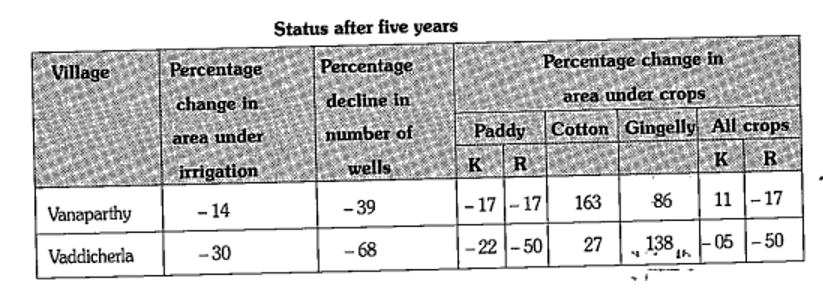
K stands for Kharif while R stands for Rabi. Negative values indicate loss/ decline, while positive ones show gain/ rise.
If the number of wells is 155 now , what was it 5 years back ?

Promotional Banner

Topper's Solved these Questions

  • NATURAL RESOURCES

    NCERT TELUGU|Exercise MEDICINE ORIENTED MATERIAL |27 Videos
  • NATURAL RESOURCES

    NCERT TELUGU|Exercise IMPROVE YOUR LEARNING|24 Videos
  • MOSQUITOES WOES

    NCERT TELUGU|Exercise ENVIRONMENTAL EDUCATION |5 Videos
  • NATURE IS A SACRED PLACE

    NCERT TELUGU|Exercise ENVIRONMENTAL EDUCATION |3 Videos

Similar Questions

Explore conceptually related problems

K stands for Kharif while R stands for Rabi. Negative values indicate loss/ decline, while positive ones show gain/ rise. Which village do you think is more affected

K stands for Kharif while R stands for Rabi. Negative values indicate loss/ decline, while positive ones show gain/ rise. What do you think 'decline in number of wells' represents ?

K stands for Kharif while R stands for Rabi. Negative values indicate loss/ decline, while positive ones show gain/ rise. Compare table 1 and 2 and state what they tell us about the area under irrigation in both the villages ?

K stands for Kharif while R stands for Rabi. Negative values indicate loss/ decline, while positive ones show gain/ rise. How would crops be affected due to decline in the number of wells ?

Figure shows a potentiometer circuit for comprasion of two resistances. The balance point with a standard resistor R = 10.0 Omega is found to be 58.3 cm, while that with the unknown resistance X is 68.5 Cm. determine the value of X. What might you do if you failed to find a balance point with the given cell of emf epsilon ?

The only electron in the hydrogen atom resides under ordinary conditions on the first orbit. When energy is supplied, the electron moves to higher energy orbit depending on the amount of energy absorbed. When this electron returns to any of the lower orbits, it emits energy. Lyman series is formed when the electron returns to the lowest orbit while Balmer series is formed when the electron returns to second orbit. Similarly, Paschen, Brackett and Pfund series are formed when electron returns to the third, fourth orbits from higher energy orbits respectively (as shown in figure) Maximum number of lines produced when an electron jumps from nth level to ground level is equal to (n(n-1))/(2) . For example, in the case of n = 4, number of lines produced is 6. (4 rarr 3, 4 rarr 2, 4 rarr 1, 3 rarr 2, 3 rarr 1, 2 rarr 1) . When an electron returns from n_(2) to n_(1) state, the number of lines in the spectrum will be equal to ((n_(2) - n_(1))(n_(2)-n_(1) +1))/(2) If the electron comes back from energy level having energy E_(2) to energy level having energy E_(2) then the difference may be expressed in terms of energy of photon as E_(2) - E_(1) = Delta E, lambda = (h c)/(Delta E) . Since h and c are constant, Delta E corresponds to definite energy, thus each transition from one energy level to another will prouce a higher of definite wavelength. THis is actually observed as a line in the spectrum of hydrogen atom. Wave number of the line is given by the formula bar(v) = RZ^(2)((1)/(n_(1)^(2)) - (1)/(n_(2)^(2))) Where R is a Rydberg constant (R = 1.1 xx 10^(7)) (i) First line of a series : it is called .line of logest wavelength. or .line of shortest energy.. (ii) Series limit of last of a series : It is the line of shortest wavelength or line of highest energy. In a single isolated atom in electron makes transition from 5^(th) excited state to 2^(nd) state the maximum number of different types of photons observed as

It is tempting to think that all possible transitions are permissible, and that an atomic spectrum arises from the transition of the electron from any initial orbital to any other orbital. However, this is not so, because a photon has an intrinsic spin angular momentum of sqrt2 (h)/(2pi) corresponding to S = 1 although it has no charge and no rest mass. On the other hand, an electron has got two types of angular momentum : Orbital angular momentum, L=sqrt(l(l+1))h/(2pi) and spin angular momentum, arising from orbital motion and spin motion of electron respectively. The change in angular momentum of the electron during any electronic transition must compensate for the angular momentum carries away by the photon. to satisfy this condition the difference between the azimuthal quantum numbers of the orbital within which transition takes place must differ by one. Thus, an electron in a d-orbital (1 = 2) cannot make a transition into an s = orbital (I = 0) because the photon cannot carry away enough angular momentum. An electron as is well known, possess four quantum numbers n, I, m and s. Out of these four I determines the magnitude of orbital angular momentum (mentioned above) while (2n m determines its z-components as m((h)/(2pi)) he permissible values of only integers right from -1 to + l. While those for I are also integers starting from 0 to (n − 1). The values of I denotes the sub shell. For I = 0, 1, 2, 3, 4,..... the sub-shells are denoted by the symbols s, p, d, f, g, .... respectively The maximum orbital angular momentum of an electron with n= 5 is