

Home
Class 7
MATHS
Carefully study the following parallelog...

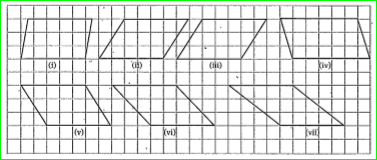
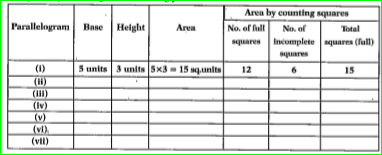
Carefully study the following parallelograms. i) find the area of each parallelogram by counting the squares enclosed in it. For counting incomplete squares check weather two incomplete squares make a complete square in each parallelogram. complete the following table accordingly. ii) do parallelograms with equal bases and equal heights have the same area?

Promotional Banner

Topper's Solved these Questions

  • AREA AND PERIMETER

    NCERT TELUGU|Exercise EXERCISE - 2|9 Videos
  • AREA AND PERIMETER

    NCERT TELUGU|Exercise EXERCISE - 3|16 Videos
  • ALGEBRIC EXPRESSIONS

    NCERT TELUGU|Exercise EXERCISE|349 Videos
  • CONGRUENCY OF TRIANGLES

    NCERT TELUGU|Exercise Exerciese - 4|12 Videos

Similar Questions

Explore conceptually related problems

Carefully study the parallelograms. (i) Find the area of each parallelogram by counting the squares enclosed in it. For counting incomplete squares check whether two incomplete squares make a complete square in each parallelogram. Complete the following table accordingly-

Find the areas of the following figures by counting squares.

find the area of each of the following parallelograms.

A square and a parallelogram have same area. If a side of the square is 40cm and the height of the parallelogram is 20cm, find the base of the parallelogram.

Draw circles having different radius on à graph paper. Find the area by counting the number of squares, Also find the area by using formula. Compare the two answers.

Four equal circles are described about the four corners of a square so that each circle touches two of the others. Find the area of the space enclosed between the circumferences of the circles, each side of the square mea suring 24 cm.

Four equal circles are described about the four corners of a square so that each circle touches two of the others. Find the area of the space enclosed between the circumferences of the circles, each side of the square measuring 14 cm.

ABCD is a parallelogram. The diagonals AC and BD intersect each other at ‘O’. Prove that ar(DeltaAOD) = ar(DeltaBOC) . (Hint: Congruent figures have equal area)