

Home
Class 6
MATHS
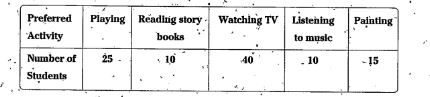
A survey of 120 school students was cond...

A survey of 120 school students was conducted to find which activity they prefer to do in their free time. Draw a bar graph to illustrate the above data.

Promotional Banner

Similar Questions

Explore conceptually related problems

A survey was conducted by a group of students as a part of their environment awareness programme, in which they collected the following data regarding the number of plants in 20 houses in a locality. Find the mean number of plants per house.

A survey was conducted by a group of students as a part of their environmental awareness programme, in which they collected the following data regarding the number of plants In 20 houses in a locality. Find the mean number of plants per house.

A survey was conducted by a group of students as a part of their environment awareness programme , in which they collected the follwing data regarding the number of plants in 20 houses in a locality . Find the mean number of plants per house . {:("Number of plants","Number of houses"),(0-2,1),(2-4,2),(4-6,1),(6-8,5),(8-10,6),(10-12,2),(12-14,3):}

25% of the students in a school are girls and others are boys. Form an equation and draw a graph for this. By observing the graph, answer the following: Find the number of boys, if the number of girls is 25.

25% of the students in a school are girls and others are boys. Form an equation and draw a graph for this. By observing the graph, answer the following: Find the number of girls, if the number of boys is 45.

25% of the students in a school are girls and others are boys. Form an equation and draw a graph for this. By observing the graph, answer the following: Take three different values for number of boys and find the number of girls. Similarly take three different values for number of girls and find the number of boys?

The products of bond breaking, shown below, are not stable, and cannot be isolated for prolonged study. Such species are referred to as reactive intermediate, and are belived to be transient intermediates in many reactions. The general structures and names of four such intermediates are, Charged Intermediates Uncharged Intermediates Carbocations (called carbonium ions in the older literature) are electrophiles and carbananions are nucleophiles. Carbenes have only a valence shell sextet of electrons and are therefore electron deficient. In this sense they are elecrophiles, but the non-bonding electron pair also gives carbenes nucleophilic character. As a rule, the electrophilic character dominates carbene reactivity. Carbon radicals have only seven valence electrons, and may be considered electron deficient, however, they do not in general bond to nucleophilic electron pair, so their chemistry exhibits differences from that of conventional electrophiles. Radical intermediates are often called free radicals. Intermediates are in general stabilised with conjugation, electron donating and electron with drawing groups. R-N^(+) equiv N" "Cl^(-) rarr R^(+)+N_(2)+Cl^(-) based on the above, which of the following from R^(+) most readily

The products of bond breaking, shown below, are not stable, and cannot be isolated for prolonged study. Such species are referred to as reactive intermediate, and are belived to be transient intermediates in many reactions. The general structures and names of four such intermediates are, Charged Intermediates Uncharged Intermediates Carbocations (called carbonium ions in the older literature) are electrophiles and carbananions are nucleophiles. Carbenes have only a valence shell sextet of electrons and are therefore electron deficient. In this sense they are elecrophiles, but the non-bonding electron pair also gives carbenes nucleophilic character. As a rule, the electrophilic character dominates carbene reactivity. Carbon radicals have only seven valence electrons, and may be considered electron deficient, however, they do not in general bond to nucleophilic electron pair, so their chemistry exhibits differences from that of conventional electrophiles. Radical intermediates are often called free radicals. Intermediates are in general stabilised with conjugation, electron donating and electron with drawing groups. R-N^(+) equiv N" "Cl^(-) rarr R^(+)+N_(2)+Cl^(-) based on the above, which of the following from R^(+) most readily