

Home
Class 10
BIOLOGY
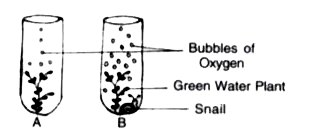
The diagram below shows two test-tubos A...

The diagram below shows two test-tubos A and B. Test-tube A contains a green water plant Test-tube B contains both a green water plant and a snail. Both test tubes are kept in sunlight Answer the questions that follow

Name the physiological process that releases the bubbles of oxygen

Promotional Banner

Topper's Solved these Questions

  • SELF ASSESSMENT PAPER 3

    ICSE|Exercise SECTION - II|59 Videos
  • SELF ASSESSMENT PAPER 2

    ICSE|Exercise SECTION II 7. (b)|5 Videos
  • SELF ASSESSMENT PAPER 4

    ICSE|Exercise SECTION - II|57 Videos

Similar Questions

Explore conceptually related problems

The diagram below shows two test-tubes A and B. Test-tube A contains a green water plant Test-tube B contains both a green water plant and a snail. Both test tubes are kept in sunlight Answer the questions that follow Explain the physiological process as mentioned above

The diagram below shows two test-tubes A and B. Test-tube A contains a green water plant Test-tube B contains both a green water plant and a snail. Both test tubes are kept in sunlight Answer the questions that follow Write the overall chemical reaction for the above process.

The diagram below shows two test-tubos A and B. Test-tube A contains a green water plant Test-tube B contains both a groen water plant and a snail. Both test tubes are kept n sunlight Answer the questions that follow Why does test-tube 'B' have more bubbles of oxygen

The diagram below shows two test-tubes A and B. Test-tube A contains a green water plant Test-tube B contains both a green water plant and a snail. Both test tubes are kept in sunlight Answer the questions that follow What is the purpose of keeping a snail in test-tube "B?

The diagram below shows two test-tubos A and B. Test-tube A contains a green water plant Test-tube B contains both a groen water plant and a snail. Both test tubes are kept n sunlight Answer the questions that follow Give an example of a water plant that can be used in the above experiment.

The diagrams given below represent the relationship between a mouse and a physiological process that occurs in green plants. Study the diagrams and answer the questions that follow Name the physiological process occurning in the green plant that has kept the mouse alive

The following diagram demonstrates a physiological process taking place in green plants. The whole set up was placed in bright sunlight for several hours. Study the diagram and answer the questions that follow : Explain the physiological process

The diagram below represents a process in plants. The setup was placed in bright sunlight. Answer the following questions : Name the physiological process depicted in the diagram . Why was oil added to the water?

The following diagram demonstrates a physiological process taking place in green plants. The whole set up was placed in bright sunlight for several hours. Study the diagram and answer the questions that follow : What aspect of the physiological process is being examined ?

The following diagram demonstrates a physiological process taking place in green plants. The whole set up was placed in bright sunlight for several hours. Study the diagram and answer the questions that follow: What aspect of the physiological process is being examined?

ICSE-SELF ASSESSMENT PAPER 3 -SECTION - II
  1. The condition due to a blockage in the coronary artery.

    Text Solution

    |

  2. Give technical term : Non-identical twins produced by the fertilis...

    Text Solution

    |

  3. The diagram below shows two test-tubos A and B. Test-tube A contains a...

    Text Solution

    |

  4. The diagram below shows two test-tubes A and B. Test-tube A contains a...

    Text Solution

    |

  5. The diagram below shows two test-tubes A and B. Test-tube A contains a...

    Text Solution

    |

  6. The diagram below shows two test-tubes A and B. Test-tube A contains a...

    Text Solution

    |

  7. The diagram below shows two test-tubes A and B. Test-tube A contains a...

    Text Solution

    |

  8. Draw a diagram of the human eye as seen in a vertical section and labe...

    Text Solution

    |

  9. Draw a diagram of the human eye as seen in a vertical section and labe...

    Text Solution

    |

  10. Draw a diagram of the human eye as seen in a vertical section and labe...

    Text Solution

    |

  11. Draw a diagram of the human eye as seen in a vertical section and labe...

    Text Solution

    |

  12. Draw a diagram of the human eye as seen in a vertical section and labe...

    Text Solution

    |

  13. Draw a diagram of the human eye as seen in a vertical section and labe...

    Text Solution

    |

  14. The diagram given below is a representation of a phenomenon pertaining...

    Text Solution

    |

  15. The diagram given below is a representation of a phenomenon pertaining...

    Text Solution

    |

  16. The diagram given below is a representation of a phenomenon pertaining...

    Text Solution

    |

  17. The diagram given below is a representation of a phenomenon pertaining...

    Text Solution

    |

  18. How does the arrangement of neurons in the spinal cord differ from tha...

    Text Solution

    |

  19. Mention three adaptations found in plants to reduce transpiration.

    Text Solution

    |

  20. Give scientific reasons for the following statements: We feel blinde...

    Text Solution

    |