

Home
Class 10
BIOLOGY
The diagram given below is a representat...

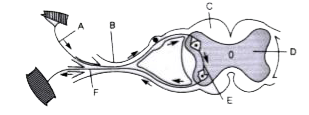
The diagram given below is a representation of a phenomenon pertaining to the nervous system. Study the diagram and answer the following questions:

(i) Name the phenomenon that is being depicted.
(ii) Give the technical term for the point of contact between the two nerve cells.
(iii) Name the parts A, B, C and D.
(iv) Write the functions of parts E and F.
(v) How does the arrangement of neurons in the spinal cord differ from that of the brain.

Promotional Banner

Topper's Solved these Questions

  • SELF ASSESSMENT PAPER 3

    ICSE|Exercise SECTION - II|59 Videos
  • SELF ASSESSMENT PAPER 2

    ICSE|Exercise SECTION II 7. (b)|5 Videos
  • SELF ASSESSMENT PAPER 4

    ICSE|Exercise SECTION - II|57 Videos

Similar Questions

Explore conceptually related problems

The diagram given belwo represents a system in the human body. Study the diagram and answer the following question: Name the two hormones secreted by 1.

Given below is a diagram representing a stage during the mitotic cell division। Study the diagram and answer the following questions : Name the four nitrogenous bases.

Study the diagram and answer the questions that follow : Name the pigment that gives colour to the skin.

Study the diagram and answer the questions that follow : Explain the function of part 3.

The diagram given below shows the internal structure of a spinal cord depicting a phenomenon. Study the diagram and answer the questions: Name the parts numbered 1, 2 and 3.

Given below is a diagram depicting a physiological process in plants. Study the same and answer the following questions : Define the part X.

Study the diagram and answer the questions that follow: Give the function of parts .5. and .6..

Name the parts A, B , C , D and E in the given diagram .

Study the diagram and answer the questions that follow : Explain the function of parts 5 and 6.

Study the diagram and answer the questions that follow : Name the rounded cells filled with fat.

ICSE-SELF ASSESSMENT PAPER 3 -SECTION - II
  1. Draw a diagram of the human eye as seen in a vertical section and labe...

    Text Solution

    |

  2. Draw a diagram of the human eye as seen in a vertical section and labe...

    Text Solution

    |

  3. The diagram given below is a representation of a phenomenon pertaining...

    Text Solution

    |

  4. The diagram given below is a representation of a phenomenon pertaining...

    Text Solution

    |

  5. The diagram given below is a representation of a phenomenon pertaining...

    Text Solution

    |

  6. The diagram given below is a representation of a phenomenon pertaining...

    Text Solution

    |

  7. How does the arrangement of neurons in the spinal cord differ from tha...

    Text Solution

    |

  8. Mention three adaptations found in plants to reduce transpiration.

    Text Solution

    |

  9. Give scientific reasons for the following statements: We feel blinde...

    Text Solution

    |

  10. Explain how the rate of transpiration Is affected on : a windy day

    Text Solution

    |

  11. A nitrogenous base in DNA.

    Text Solution

    |

  12. The pigment present in red blood cells.

    Text Solution

    |

  13. The given diagram represents a nephron and its blood supply. Study the...

    Text Solution

    |

  14. The given diagram represents a nephron and its blood supply. Study the...

    Text Solution

    |

  15. The given diagram represents a nephron and its blood supply. Study the...

    Text Solution

    |

  16. The given diagram represents a nephron and its blood supply. Study the...

    Text Solution

    |

  17. The given diagram represents a nephron and its blood supply. Study the...

    Text Solution

    |

  18. Mention the effets of two individuals in a street fight on the followi...

    Text Solution

    |

  19. Give the specific function of: (i) Centrosome (ii) Stoma (iii) T...

    Text Solution

    |

  20. Name the following : That part of the chloroplast where the light re...

    Text Solution

    |