Home
Class 11
PHYSICS
If a hollow pipe passes across the centr...

If a hollow pipe passes across the centre of gravity of the Earth, then what changes would take place in the velocity and acceleration of a ball dropped in the pipe ?

Text Solution

Verified by Experts
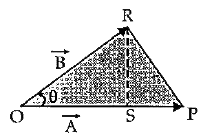
Let the vectors `vecA and vecB` represent the sides OP and OR of a triangle OPR. Let `theta ` be the angle between the vectors `vecA. vecB.`
The area of the triangle OPR is :

`1/2 xx ` base `xx ` height `= 1/2 xx (OP) xx RS `
`= 1/2 xx (OP) xx (OR sin theta)`
`= 1/2 AB sin theta `
`= 1/2 |vecA xx vecB|`
Promotional Banner

Topper's Solved these Questions

  • SAMPLE QUESTION PAPER-2

    ICSE|Exercise SECTION-C|9 Videos
  • SAMPLE QUESTION PAPER-2

    ICSE|Exercise SECTION-D|10 Videos
  • SAMPLE QUESTION PAPER-2

    ICSE|Exercise SECTION-D|10 Videos
  • SAMPLE QUESTION PAPER 5

    ICSE|Exercise SECTION - D (Answer all questions.)|6 Videos
  • SAMPLE QUESTION PAPER-3

    ICSE|Exercise SECTION-D|6 Videos

Similar Questions

Explore conceptually related problems

Assume that if the earth were made of lead of relative density 11.3, then what would be the value of acceleration due to gravity on the earth surface ?

A player throwsa a ball upwards with an initial speed of 29.4 ms^(-1) . (i) What is the direction of acceleration during the upwared motion of the ball? (ii) What are the velocity and acceleration of the ball at the highest point of its motion? (iii) Choose the x=0 and t=0 to be the location and time of the ball at its highest point, vertically downward direction to be the positive direction of X-axis, and give the signs of positive, velocity and acceleration of the ball during its upward, and downward motion. (iv) To what height does the ball rise and after how long does the ball return to the player's hand?( Take g =9.8 ms^(-2) , and neglect air resistance).

A ball is thrown upwards with a velocity of 29.4 ms^(-1) in the absence of air resistance. (i) Mention the direction of the acceleration during the upward motion of the ball. (ii) What are the velocity and acceleration of the ball at the highest point? (iii) How much high the ball goes up? (iv) Find the time taken by the ball to reach the ground. Take g = 9.8 ms^(-2)

Does the concentration of the earth's mass near its centre change the variation of g (acceleration due to gravity) with height from its surface?

Two balls of mass m and 4m are connected by a rod of length L. The mass of the rod is small and can be treated as zero . The size of the balls also can of the neglected . We also assume the centre of the rod is hinged ,but the rod can rotate about its centre in the vertical plane without friction . What is the gravity - induced angular acceleration of the rod when the angle between the rod and the vertical is theta as shown ?

A radioactive substance is oxidised. What changes would you expect to take place in the nature of radioactivity ? Explain your answer.

A ball of mass m is fired vertically upwards from the surface of the earth with velocity nv_(e) , where v_(e) is the escape velocity and nlt1 . Neglecting air resistance, to what height will the ball rise? (Take radius of the earth=R):-

If the radius of the earth shrinks by 3.5% ( mass remains constant) then how would the value of acceleration due to gravity change?

A certain nucleus X has a mass number 14 and atomic number 6. The nucleus X changes to ""_(7)Y^(14) after the loss of a particle. A radioactive substance is oxidized. What change would you expect to take place in the nature of its radioactivity ? Give a reason for your answer.

A disc of mass m and radius R is free to rotate in a horizontal plane about a vertical smooth fixed axis passing through its centre. There is a smooth groove along the diameter of the disc and two small balls of mass m//2 each are placed in it on either side of the centre of the disc as shown in Fig. The disc is given an initial angular velocity omega_(0) and released. The speed of each ball relative to the ground just after they leave the disc is

