It is common that Governments revise travel fares from time to time based on various factors such as inflation ( a general increase in prices and fall in the purchasing value of money) on different types of vehicles like auto, Rickshaws, taxis, Radio cab etc. The auto charges in a city comprise of a fixed charge together with the charge for the distance covered. Study the following situations
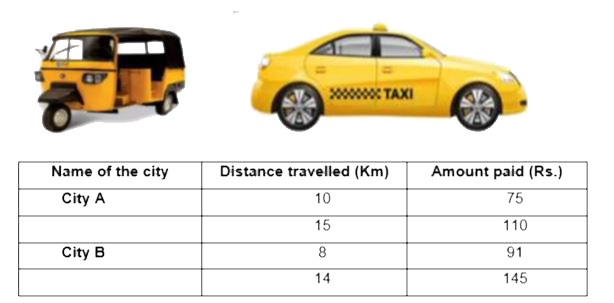
Situation 1: In city A, for a journey of 10 km, the charge paid is Rs 75 and for a journey of 15 km, the charge paid is Rs 110.
Situation 2: In a city B, for a journey of 8km, the charge paid is Rs91 and for a journey of 14km, the charge paid is Rs 145.
The graph of lines representing the conditions are: (situation 2)
It is common that Governments revise travel fares from time to time based on various factors such as inflation ( a general increase in prices and fall in the purchasing value of money) on different types of vehicles like auto, Rickshaws, taxis, Radio cab etc. The auto charges in a city comprise of a fixed charge together with the charge for the distance covered. Study the following situations
Situation 1: In city A, for a journey of 10 km, the charge paid is Rs 75 and for a journey of 15 km, the charge paid is Rs 110.
Situation 2: In a city B, for a journey of 8km, the charge paid is Rs91 and for a journey of 14km, the charge paid is Rs 145.
The graph of lines representing the conditions are: (situation 2)
Situation 1: In city A, for a journey of 10 km, the charge paid is Rs 75 and for a journey of 15 km, the charge paid is Rs 110.
Situation 2: In a city B, for a journey of 8km, the charge paid is Rs91 and for a journey of 14km, the charge paid is Rs 145.
The graph of lines representing the conditions are: (situation 2)
A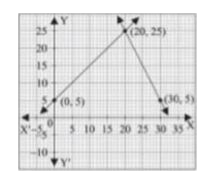
B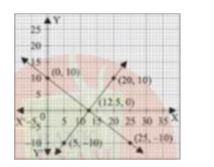
C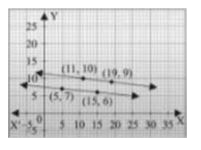
D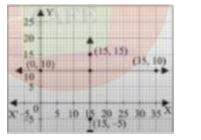
Text Solution
Verified by Experts
The correct Answer is:
C



Topper's Solved these Questions
QUESTION BANK 2021
CBSE MODEL PAPER|Exercise QUADRATIC EQUATIONS(CASE STUDY 1)|4 VideosQUESTION BANK 2021
CBSE MODEL PAPER|Exercise QUADRATIC EQUATIONS(CASE STUDY 2)|5 VideosQUESTION BANK 2021
CBSE MODEL PAPER|Exercise LINEAR EQUATIONS INTWO VARIABLES ((CASE STUDY 3)|3 VideosPRACTICE PAPER 2022
CBSE MODEL PAPER|Exercise Multiple Choice Questions|60 VideosSAMPLE PAPER (MATHEMATICS STANDARD)
CBSE MODEL PAPER|Exercise PART - B|16 Videos
Similar Questions
Explore conceptually related problems
It is common that Governments revise travel fares from time to time based on various factors such as inflation ( a general increase in prices and fall in the purchasing value of money) on different types of vehicles like auto, Rickshaws, taxis, Radio cab etc. The auto charges in a city comprise of a fixed charge together with the charge for the distance covered. Study the following situations Situation 1: In city A, for a journey of 10 km, the charge paid is Rs 75 and for a journey of 15 km, the charge paid is Rs 110. Situation 2: In a city B, for a journey of 8km, the charge paid is Rs91 and for a journey of 14km, the charge paid is Rs 145. If the fixed charges of auto rickshaw be Rs x and the running charges be Rs y km/hr, the pair of linear equations representing the situation is
It is common that Governments revise travel fares from time to time based on various factors such as inflation ( a general increase in prices and fall in the purchasing value of money) on different types of vehicles like auto, Rickshaws, taxis, Radio cab etc. The auto charges in a city comprise of a fixed charge together with the charge for the distance covered. Study the following situations Situation 1: In city A, for a journey of 10 km, the charge paid is Rs 75 and for a journey of 15 km, the charge paid is Rs 110. Situation 2: In a city B, for a journey of 8km, the charge paid is Rs91 and for a journey of 14km, the charge paid is Rs 145. Refer to situation 2: What will a person have to pay for travelling a distance of 30km?
It is common that Governments revise travel fares from time to time based on various factors such as inflation ( a general increase in prices and fall in the purchasing value of money) on different types of vehicles like auto, Rickshaws, taxis, Radio cab etc. The auto charges in a city comprise of a fixed charge together with the charge for the distance covered. Study the following situations Situation 1: In city A, for a journey of 10 km, the charge paid is Rs 75 and for a journey of 15 km, the charge paid is Rs 110. Situation 2: In a city B, for a journey of 8km, the charge paid is Rs91 and for a journey of 14km, the charge paid is Rs 145. Refer to situation 1: A person travels a distance of 50km. The amount he has to pay is
The taxi charges in a city comprise of a fixed charge together with the charge for the distance covered.For a journey of 10km the charge paid is Rs75 and for a journey of 15km the charge paid is Rs 110. What will a person have to pay for travelling a distance of 25km?
The car hire charges in a city comprise of a fixed charges together with the charge for the distance covered.For a journey of 12km, the charge paid is Rs89 and for a journey of 20km, the charge paid is Rs 145. What will a person have to pay for travelling a distance of 30km?
The autorickshaw fare consists of a fixed charge together with the charge for the distance covered. For a journey of 10 km, the charge paid is 85 and for a journey of 15 km, the charge paid is 120. The fare for a journey of 25 km will be
The taxi charges in a city comprise of a fixed charge, together with the charge of the distance covered. For a journey of 16 km, the charges paid are Rs 156 and for a journey of 24 km, the charges paid are Rs 204. What will a person have to pay for travelling a distance of 30 km? (a) Rs 236 (b) Rs 240 (c) Rs 248 (d) Rs 252
[" (IV) The taxi charges in a city consist of a fixed charge together with the charge for the "],[" distance covered.For a distance of "10km" ,the charge paid is "₹105" and for a "],[" journey of "15km" ,the charge paid is "₹155" .What are the fixed charges and the "],[" charge per km? How much does a person have to pay for travelling a distance of "],[25km" ? "]
The taxi charges in a city consist of a fixed charge together with the charge for the distance covered. For a distance of 20 km, the charge paid is 205 and for a distance of 25 km, the charge paid is 255. Find the fixed charges and the charge per km. How much does a person have to pay for covering a distance of 50 km? Sol. Let the fixed charges be x and charge per km be y.