Home
Class 12
CHEMISTRY
Read the passage given below and answer ...

Read the passage given below and answer the following questions:
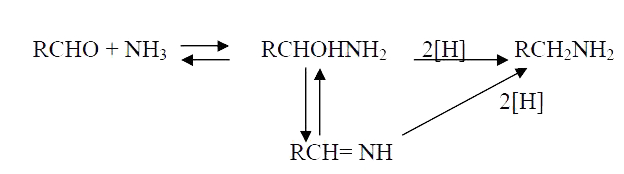
Reductive alkylation is the term applied to the process of introducing alkyl groups into ammonia or a primary or secondary amine by means of an aldehyde or ketone in the presence of a reducing agent. The present discussion is limited to those reductive alkylations in which the reducing agent is hydrogen and a catalyst or "nascent" hydrogen, usually from a metalacid combination, most of these reductive alkylations have been carried out with hydrogen and a catalyst. The principal variation excluded is that in which the reducing agent is formic acid or one of its derivatives, this modification is known as the Leuckart reaction. The process of reductive alkylation of ammonia consists in the addition of ammonia to a carbonyl compound and reduction of the addition compound or its dehydration product. The reaction usually is carried out in ethanol solution when the reduction is to be effected catalytically

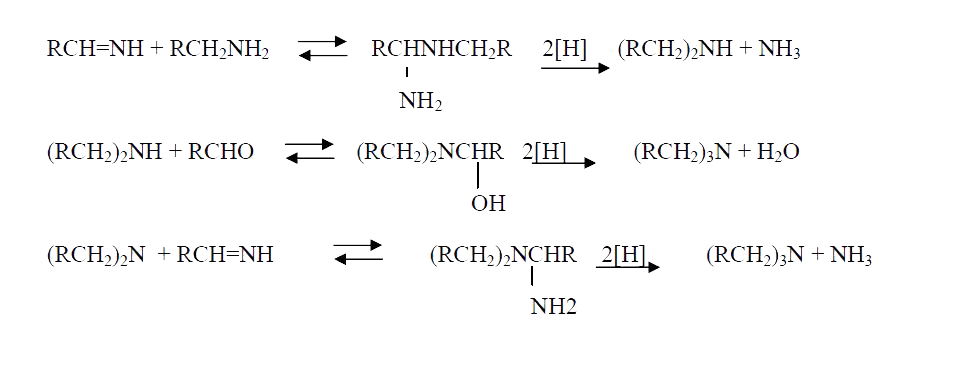
Since the primary amine is formed in the presence of the aldehyde it may react in the same way as ammonia, yielding an addition compound, a Schiff's base `(RCH= NCH_(2)R)` and finally, a secondary amine. Similarly, the primary amine may react with the imine, forming an addition product which also is reduced to a secondary amine Finally, the secondary amine may react with either the aldehyde or the imine to give products which are reduced to tertiary amines.

Similar reactions may occur when the carbonyl compound employed is a ketone.
(source: Emerson, W. S. (2011). The Preparation of Amines by Reductive Alkylation. Organic Reactions, 174–255. doi:10.1002/0471264180.or004.03 )
`(CH_(3)CH_(2)CH_(2))_(2)NH +CH_(3)CH_(2)CHO to P overset(2[H])to Q`
The ompound Q is :

A

`(CH_(3)CH_(2)CH_(2))_(3)N`

B

`(CH_(3)CH_(2)CH_(2))_(2)N(CH_(2)CH_(3))`

C

`(CH_(3)CH_(2))_(3)N`

D

`(CH_(3)CH_(2))_(2)NH`

Text Solution

Verified by Experts

The correct Answer is:

A
Promotional Banner

Topper's Solved these Questions

  • Additional Practice Questions

    CBSE MODEL PAPER|Exercise Question|39 Videos
  • SAMPLE PAPER 2022

    CBSE MODEL PAPER|Exercise SECTION C|6 Videos

Similar Questions

Explore conceptually related problems

Read the passage given below and answer the following questions: Reductive alkylation is the term applied to the process of introducing alkyl groups into ammonia or a primary or secondary amine by means of an aldehyde or ketone in the presence of a reducing agent. The present discussion is limited to those reductive alkylations in which the reducing agent is hydrogen and a catalyst or "nascent" hydrogen, usually from a metalacid combination, most of these reductive alkylations have been carried out with hydrogen and a catalyst. The principal variation excluded is that in which the reducing agent is formic acid or one of its derivatives, this modification is known as the Leuckart reaction. The process of reductive alkylation of ammonia consists in the addition of ammonia to a carbonyl compound and reduction of the addition compound or its dehydration product. The reaction usually is carried out in ethanol solution when the reduction is to be effected catalytically Since the primary amine is formed in the presence of the aldehyde it may react in the same way as ammonia, yielding an addition compound, a Schiff's base (RCH= NCH_(2)R) and finally, a secondary amine. Similarly, the primary amine may react with the imine, forming an addition product which also is reduced to a secondary amine Finally, the secondary amine may react with either the aldehyde or the imine to give products which are reduced to tertiary amines. Similar reactions may occur when the carbonyl compound employed is a ketone. (source: Emerson, W. S. (2011). The Preparation of Amines by Reductive Alkylation. Organic Reactions, 174–255. doi:10.1002/0471264180.or004.03 ) The reaction of ammonia and its derivatives with aldehydes is called:

Read the passage given below and answer the following questions: Reductive alkylation is the term applied to the process of introducing alkyl groups into ammonia or a primary or secondary amine by means of an aldehyde or ketone in the presence of a reducing agent. The present discussion is limited to those reductive alkylations in which the reducing agent is hydrogen and a catalyst or "nascent" hydrogen, usually from a metalacid combination, most of these reductive alkylations have been carried out with hydrogen and a catalyst. The principal variation excluded is that in which the reducing agent is formic acid or one of its derivatives, this modification is known as the Leuckart reaction. The process of reductive alkylation of ammonia consists in the addition of ammonia to a carbonyl compound and reduction of the addition compound or its dehydration product. The reaction usually is carried out in ethanol solution when the reduction is to be effected catalytically Since the primary amine is formed in the presence of the aldehyde it may react in the same way as ammonia, yielding an addition compound, a Schiff's base (RCH= NCH_(2)R) and finally, a secondary amine. Similarly, the primary amine may react with the imine, forming an addition product which also is reduced to a secondary amine Finally, the secondary amine may react with either the aldehyde or the imine to give products which are reduced to tertiary amines. Similar reactions may occur when the carbonyl compound employed is a ketone. (source: Emerson, W. S. (2011). The Preparation of Amines by Reductive Alkylation. Organic Reactions, 174–255. doi:10.1002/0471264180.or004.03 ) Reductive alkylation of ammonia by means of an aldehyde in presence of hydrogen as reducing agents results in formation of:

Read the passage given below and answer the following questions: Reductive alkylation is the term applied to the process of introducing alkyl groups into ammonia or a primary or secondary amine by means of an aldehyde or ketone in the presence of a reducing agent. The present discussion is limited to those reductive alkylations in which the reducing agent is hydrogen and a catalyst or "nascent" hydrogen, usually from a metalacid combination, most of these reductive alkylations have been carried out with hydrogen and a catalyst. The principal variation excluded is that in which the reducing agent is formic acid or one of its derivatives, this modification is known as the Leuckart reaction. The process of reductive alkylation of ammonia consists in the addition of ammonia to a carbonyl compound and reduction of the addition compound or its dehydration product. The reaction usually is carried out in ethanol solution when the reduction is to be effected catalytically Since the primary amine is formed in the presence of the aldehyde it may react in the same way as ammonia, yielding an addition compound, a Schiff's base (RCH= NCH_(2)R) and finally, a secondary amine. Similarly, the primary amine may react with the imine, forming an addition product which also is reduced to a secondary amine Finally, the secondary amine may react with either the aldehyde or the imine to give products which are reduced to tertiary amines. Similar reactions may occur when the carbonyl compound employed is a ketone. (source: Emerson, W. S. (2011). The Preparation of Amines by Reductive Alkylation. Organic Reactions, 174–255. doi:10.1002/0471264180.or004.03 ) Acetaldehyde is reacted with ammonia followed by reduction in presence of hydrogen as a catalyst. The primary amine so formed further reacts with acetaldehyde. The Schiff’s base formed during the reaction is:

Read the passage given below and answer the following questions: Reductive alkylation is the term applied to the process of introducing alkyl groups into ammonia or a primary or secondary amine by means of an aldehyde or ketone in the presence of a reducing agent. The present discussion is limited to those reductive alkylations in which the reducing agent is hydrogen and a catalyst or "nascent" hydrogen, usually from a metalacid combination, most of these reductive alkylations have been carried out with hydrogen and a catalyst. The principal variation excluded is that in which the reducing agent is formic acid or one of its derivatives, this modification is known as the Leuckart reaction. The process of reductive alkylation of ammonia consists in the addition of ammonia to a carbonyl compound and reduction of the addition compound or its dehydration product. The reaction usually is carried out in ethanol solution when the reduction is to be effected catalytically Since the primary amine is formed in the presence of the aldehyde it may react in the same way as ammonia, yielding an addition compound, a Schiff's base (RCH= NCH_(2)R) and finally, a secondary amine. Similarly, the primary amine may react with the imine, forming an addition product which also is reduced to a secondary amine Finally, the secondary amine may react with either the aldehyde or the imine to give products which are reduced to tertiary amines. Similar reactions may occur when the carbonyl compound employed is a ketone. (source: Emerson, W. S. (2011). The Preparation of Amines by Reductive Alkylation. Organic Reactions, 174–255. doi:10.1002/0471264180.or004.03 ) Ethanal on reaction with ammonia forms an imine (X) which on reaction with nascent hydrogen gives (Y). Identify ‘X’ and ‘Y’.

Define reductants or reducing agents

In self -reduction used in extraction of copper, the reducing agent is

The reducing agent used for the reduction of copper oxide.

CBSE MODEL PAPER-QUESTION BANK 2021-Multiple Choice Questions
  1. Read the passage given below and answer the following questions: Red...

    Text Solution

    |

  2. Read the passage given below and answer the following questions: Red...

    Text Solution

    |

  3. Read the passage given below and answer the following questions: Red...

    Text Solution

    |

  4. Read the passage given below and answer the following questions: Red...

    Text Solution

    |

  5. Read the passage given below and answer the following questions: Som...

    Text Solution

    |

  6. Read the passage given below and answer the following questions: Som...

    Text Solution

    |

  7. Read the passage given below and answer the following questions: Som...

    Text Solution

    |

  8. Read the passage given below and answer the following questions: Som...

    Text Solution

    |

  9. Read the passage given below and answer the following questions: Som...

    Text Solution

    |

  10. Read the passage given below and answer the question: Industrially ...

    Text Solution

    |

  11. Read the passage given below and answer the question: Industrially ...

    Text Solution

    |

  12. Read the passage given below and answer the question: Industrially ...

    Text Solution

    |

  13. Read the passage given below and answer the question: Industrially ...

    Text Solution

    |

  14. Read the passage given below and answer the question: Industrially ...

    Text Solution

    |

  15. Read the passage given below and answer the question: Biopolymers ar...

    Text Solution

    |

  16. Read the passage given below and answer the question: Biopolymers ar...

    Text Solution

    |

  17. Read the passage given below and answer the question: Biopolymers ar...

    Text Solution

    |

  18. Read the passage given below and answer the question: Biopolymers ar...

    Text Solution

    |

  19. Read the passage given below and answer the question: Biopolymers ar...

    Text Solution

    |

  20. Read the passage given below and answer question: In the last 10 yea...

    Text Solution

    |
