

Home
Class 7
MATHS
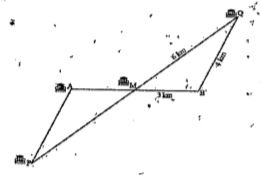
The map given below shows five different...

The map given below shows five different villages. Village M lies exactly halfway between the two pairs of villages A and B as well as P and Q. What is the distance between village A and village P. (Hint: check if `DeltaPAM~= DeltaQBM`)

Promotional Banner

Similar Questions

Explore conceptually related problems

The following pictograph shows the number of tractors in five different villages. How many more tractors does village C have as compared to village B.

The following pictograph shows the number of tractors in five different villages. What is the total number of tractors in all the five villages?

An orbital is designated by certain values of first three quantum numbers (n, l and m) and according to Pauli.s exclusion principle, no two electrons in a atom can have all the for quantum numbers equal. N, l and m denote size, shape and orientation of the orbital. The permissible values of n are 1,2,3.... prop while that of 1 are all possible integral values from 0 to n-n. Orbitals with same values of n and 1 but different values of m (where m can have any integral values from 1 to +1 including zero) are of equal energy and are called degenerate orbitals. However degeneracy is destroyed in homogeneous external magnetic field due to different extent of interaction between the applied field and internal electronic magnet of different orbitals differing in orientations. In octahedral magnetic field external magnetic field as oriented along axes while in tetrahedral field the applied field actas more in between the axes than that on the axes themselves. For 1=0, 1,2,3,...., the states (called sub-shells) are denoted by the symbol s,p,d,f.....respectively. After f, the subshells are denoted by letters alphabetically 1 determines orbital angular motion (L) of electron as L = sqrt(l(l+1))(h)/(2pi) ON the other hand, m determines Z-component of orbital angular momentum as L_(Z) = m((h)/(2pi)) Hund.s rule states that in degenerate orbitals electrons do not pair up unless and until each each orbitals has got an electron with parallesl spins Besides orbital motion,an electron also posses spin-motion. Spin may be clockwise and anticloskwise. Both these spin motions are called two spins states of electrons characterized by spin Q.N (s) : s = +(1)/(2) and = -(1)/(2) respectively The sum of spin Q.N. of all the electrons is called total spin(s) and 2s+1 is called spin multiplicity of the configuration as a whole. The spin angular momentum of an electron is written as L_(s) = sqrt(s(s+1))(h)/(2pi) According to Hund.s rule, the distribution of electron within the various orbitals of a given sub-shell is one which is associated with