Text Solution
Verified by Experts
The correct Answer is:



Topper's Solved these Questions
ECOSYSTEM
AAKASH INSTITUTE ENGLISH|Exercise Section - D (Assertion - Reasion Type questions)|15 VideosECOSYSTEM
AAKASH INSTITUTE ENGLISH|Exercise Assignment (Section B)|35 VideosDIGESTION AND ABSORPTION
AAKASH INSTITUTE ENGLISH|Exercise Assignment (SECTION-D Assertion - Reason Type Questions )|10 VideosENVIRONMENTAL ISSUES
AAKASH INSTITUTE ENGLISH|Exercise ASSIGNMENT SECTION D|15 Videos
Similar Questions
Explore conceptually related problems
AAKASH INSTITUTE ENGLISH-ECOSYSTEM-Assignment (Section C)
- The mass of living material at a trophic level at a particular time is...
Text Solution
|
- Match the following and select the correct option :
Text Solution
|
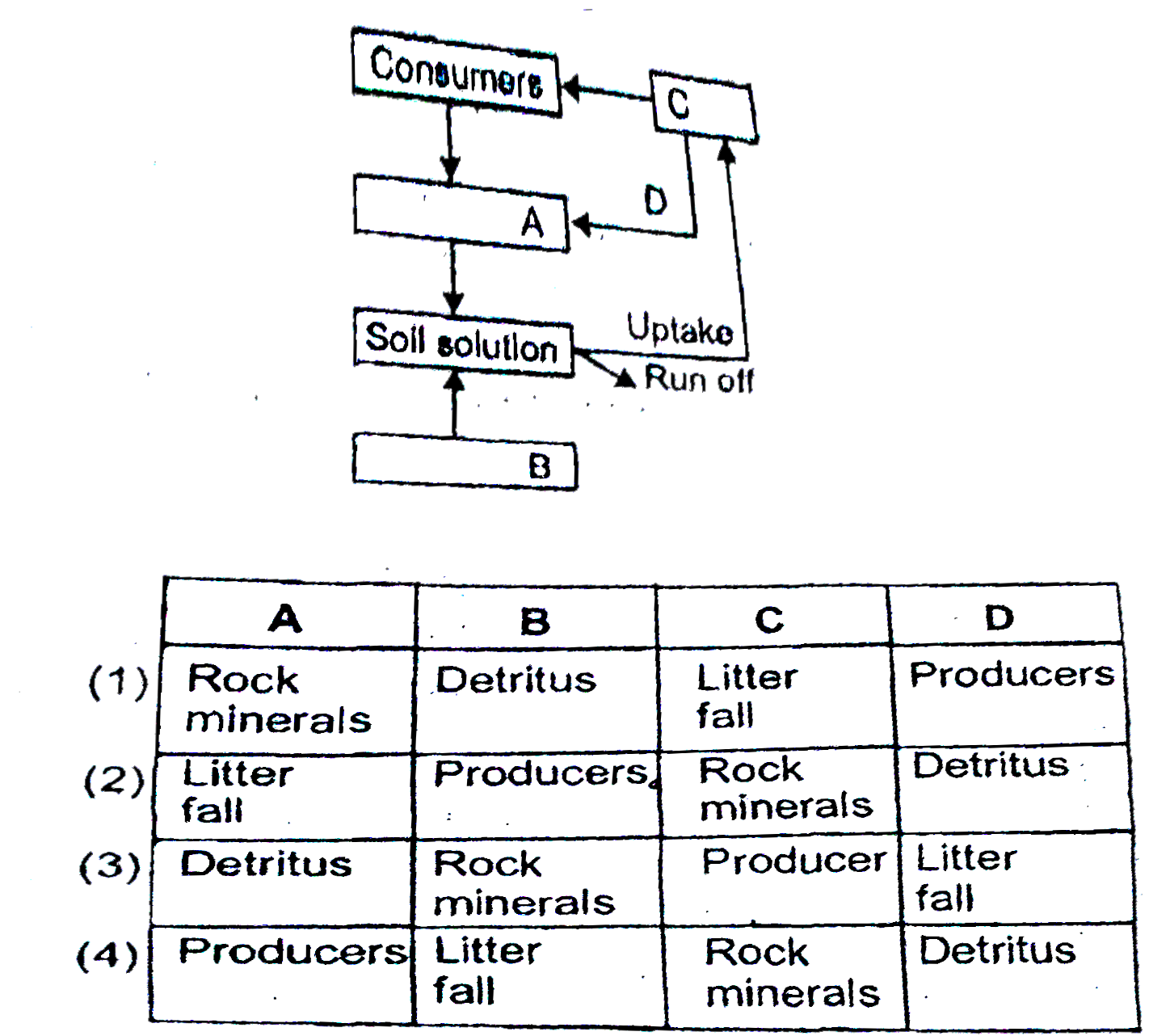
- Given below is a simplified model of phosphorus cycling in a terrestri...
Text Solution
|
- If 20J of energy is trapped at producer level, then how much energy wi...
Text Solution
|
- Natural reservoir of phosphorus is
Text Solution
|
- Secondary productivity is rate of formation of new organic matter by
Text Solution
|
- Which one of the following processes during decomposition is correctly...
Text Solution
|
- Which one of the following is not a functional unit of an ecosystem
Text Solution
|
- The upright pyramid of number is absent in
Text Solution
|
- Which one of the following is not a gaseous biogeochemical cycle in ec...
Text Solution
|
- Given below is an imaginary pyramid of numbers. What could be one of t...
Text Solution
|
- Identify the possible link ''A'' in the following food chain Plant ...
Text Solution
|
- The rate of formation of new organic matter by rabbit in a grassland, ...
Text Solution
|
- The second stage of hydrosere is occupied by plants like
Text Solution
|
- Identify the likely organisms (A), (B), (C ) and (D) in the food web s...
Text Solution
|
- Mass of Living matter at a trophic level in an area at any time is c...
Text Solution
|
- Which one of the following statements is correct for secondary success...
Text Solution
|
- Which one of the following statements for pyramid of energy is incorre...
Text Solution
|
- Which one of the following animals may occupy more than one trophic le...
Text Solution
|
- Both, hydrarch and xerarch successions lead to
Text Solution
|