Home
Class 12
CHEMISTRY
For the synthesis of ammonia by the reac...

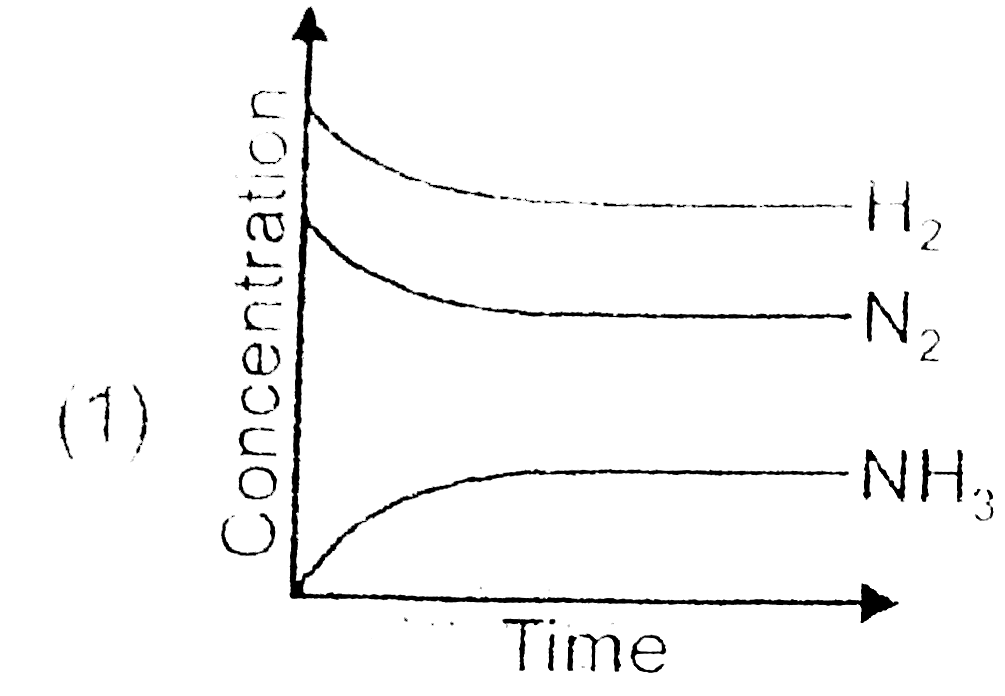
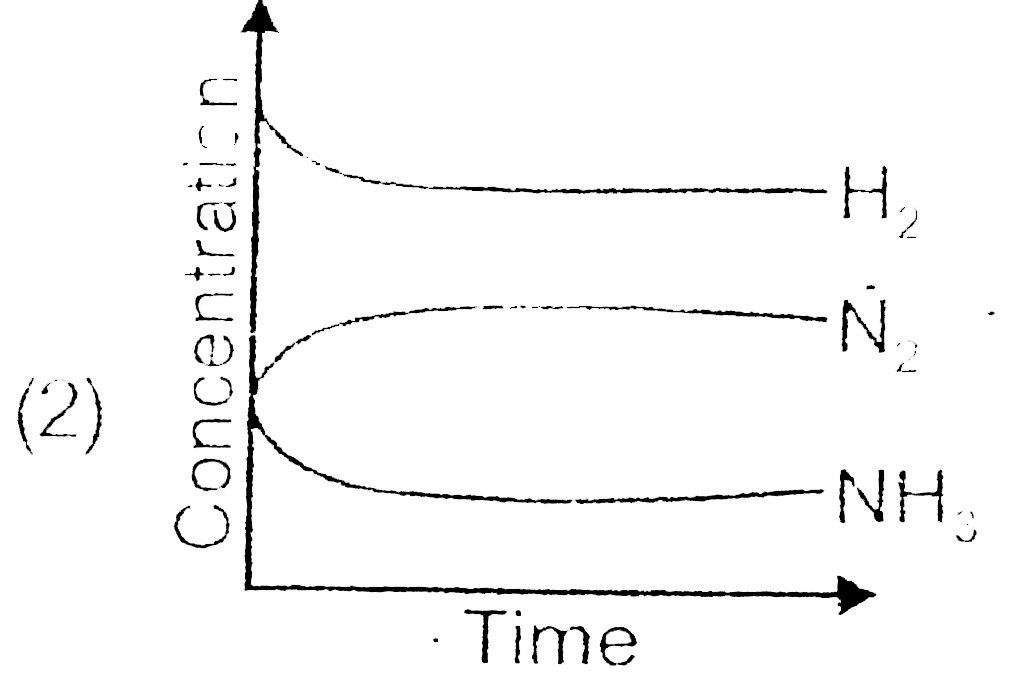
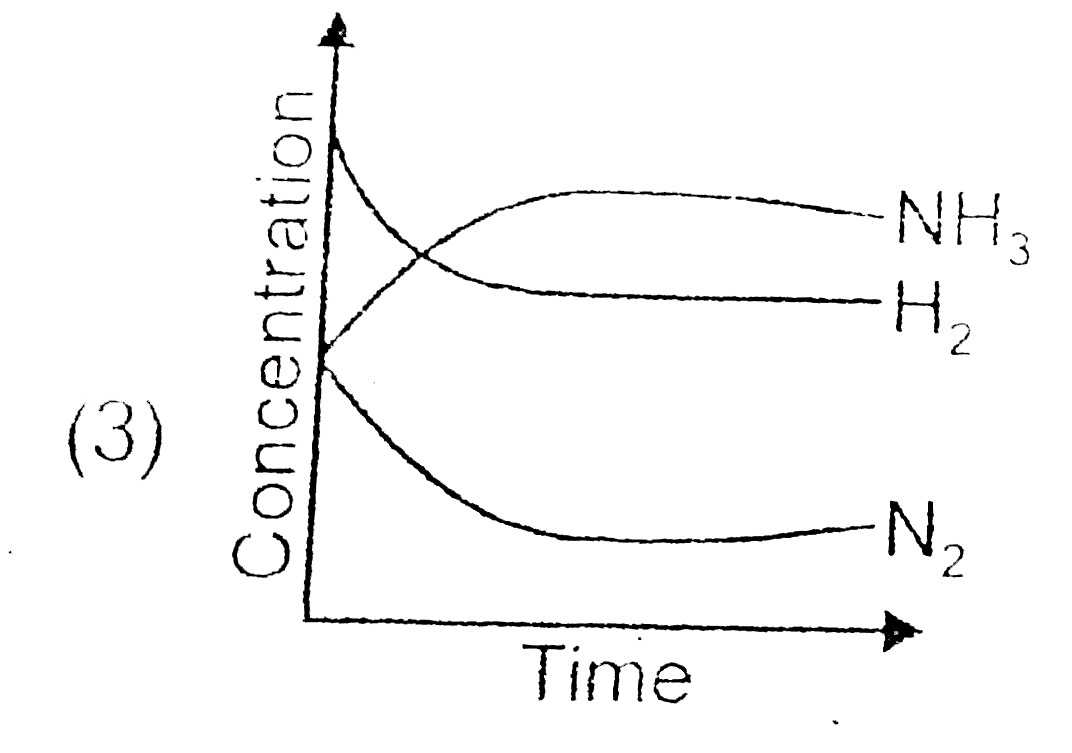
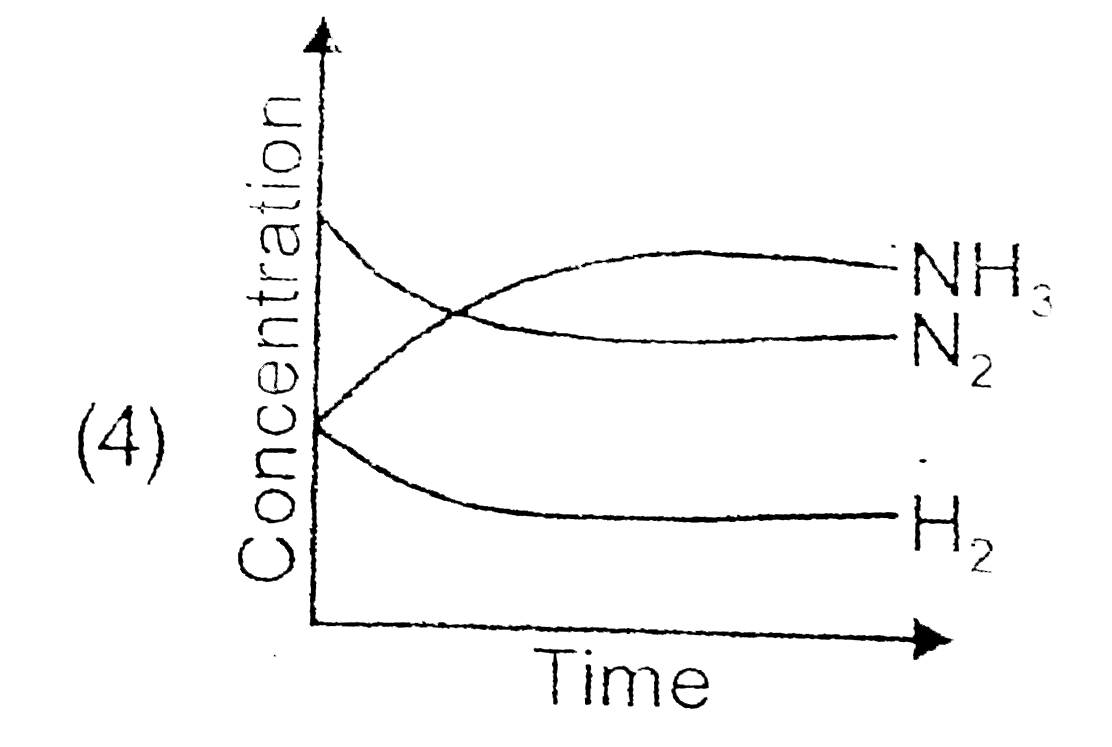
For the synthesis of ammonia by the reaction `N_(2)+3H_(2)hArr2NH_(3)` in the Haber's process ,the attainment of equilibrium is correctly predicated bt the curve

A

B

C

D

Text Solution

AI Generated Solution

The correct Answer is:

To solve the question regarding the synthesis of ammonia in the Haber process, we need to analyze the reaction and the equilibrium state it reaches. The reaction can be represented as: \[ N_2 + 3H_2 \rightleftharpoons 2NH_3 \] ### Step-by-Step Solution: 1. **Understanding the Reaction**: - The reaction involves nitrogen gas (\(N_2\)) reacting with hydrogen gas (\(H_2\)) to form ammonia (\(NH_3\)). - The stoichiometry of the reaction shows that 1 mole of nitrogen reacts with 3 moles of hydrogen to produce 2 moles of ammonia. 2. **Initial Concentrations**: - At the start of the reaction (time \(t = 0\)), we assume: - Concentration of \(N_2\) = \(A\) - Concentration of \(H_2\) = \(B\) - Concentration of \(NH_3\) = 0 (no ammonia is formed initially). 3. **Change in Concentrations**: - As the reaction progresses, \(N_2\) and \(H_2\) will decrease in concentration while \(NH_3\) will increase. - Let the change in concentration of \(N_2\) be \(-x\), then: - Change in \(H_2\) = \(-3x\) (since 3 moles of \(H_2\) are consumed for every mole of \(N_2\)). - Change in \(NH_3\) = \(+2x\) (2 moles of \(NH_3\) are produced). 4. **Equilibrium Concentrations**: - At equilibrium, the concentrations can be expressed as: - Concentration of \(N_2\) = \(A - x\) - Concentration of \(H_2\) = \(B - 3x\) - Concentration of \(NH_3\) = \(2x\) 5. **Graphical Representation**: - The graph should show: - The concentration of \(NH_3\) starting from 0 and increasing to a maximum value (indicating formation). - The concentrations of \(N_2\) and \(H_2\) should start from \(A\) and \(B\) respectively, and decrease over time until they reach a constant value at equilibrium. 6. **Identifying the Correct Graph**: - The correct graph will show: - \(NH_3\) starting from 0 and increasing, eventually leveling off at a certain concentration. - Both \(N_2\) and \(H_2\) should decrease and also level off, indicating that they are being consumed to form \(NH_3\). - Based on the analysis, the first graph (Graph A) matches this description, as it shows the correct trends for all species involved in the reaction. ### Conclusion: The correct graph that represents the attainment of equilibrium in the synthesis of ammonia via the Haber process is Graph A.
Promotional Banner

Topper's Solved these Questions

  • EQUILIBRIUM

    AAKASH INSTITUTE ENGLISH|Exercise Assignment (SECTION-B)(OBJECTIVE TYPE QUESTIONS (ONE OPTION IS CORRECT)|20 Videos
  • EQUILIBRIUM

    AAKASH INSTITUTE ENGLISH|Exercise Assignment (SECTION-C) (OBJECTIVE TYPE QUESTIONS (MORE THAN ONE OPTION ARE CORRECT)|10 Videos
  • EQUILIBRIUM

    AAKASH INSTITUTE ENGLISH|Exercise ASSIGNMENT (SECTION -D)|20 Videos
  • ENVIRONMENTAL CHEMISTRY

    AAKASH INSTITUTE ENGLISH|Exercise ASSIGNMENT (SECTION-D) (Assertion - Reason Type Questions)|4 Videos
  • GENERAL PRINCIPLES AND PROCESSES OF ISOLATION OF ELEMENTS

    AAKASH INSTITUTE ENGLISH|Exercise Assignment (Section-D) Assertion-Reason Type Question|15 Videos

Similar Questions

Explore conceptually related problems

In the Haber’s process of synthesis of NH_3

For N_(2)+3H_(3) hArr 2NH_(3)+"Heat"

For the the manufacture of ammonia by the reaction N_(2)+3H_(2)hArr 2NH_(3)+"21.9 Kcal." the favourable condition are

In a chemical reaction N_(2)+3H_(2) hArr 2NH_(3) , at equilibrium point

In the reaction N_(2)(g)+3H_(2)(g)hArr 2NH_(3)(g) , the value of the equlibrium constant depends on

For a reaction N_(2)+3H_(2)hArr2NH_(3) , the value of K_(C) does not depends upon:

In the reaction, N_2(g) +3H_2(g) hArr 2NH_3(g) the value of the equilibrium constant depends on

For the reaction N_(2)(g) + 3H_(2)(g) hArr 2NH_(3)(g), DeltaH=?

1 mol of N_(2) is mixed with 3 mol of H_(2) in a litre container. If 50% of N_(2) is converted into ammonia by the reaction N_(2)(g)+3H_(2)(g) hArr 2NH_(3)(g) , then the total number of moles of gas at the equilibrium are

For the reaction : N_(2(g))+3H_(2(g))hArr2NH_(3(g)) , DeltaH=-ve , the correct statement is :

AAKASH INSTITUTE ENGLISH-EQUILIBRIUM-Assignment (SECTION-A) (SUBJECTIVE TYPE QUESTIONS(ONE OPTION IS CORRECT)
  1. If K(1) and K(2) are respective equilibrium constants for two reactio...

    Text Solution

    |

  2. For the reaction CO(g)+(1)/(2) O(2)(g) hArr CO(2)(g),K(p)//K(c) is

    Text Solution

    |

  3. 500 ml vessel contains 1.5 M each of A, B, C and D at equlibrium. If 0...

    Text Solution

    |

  4. 9.2 grams of N(2)O(4(g)) is taken in a closed one litre vessel and hea...

    Text Solution

    |

  5. For the synthesis of ammonia by the reaction N(2)+3H(2)hArr2NH(3) in t...

    Text Solution

    |

  6. The equilibrium: P(4)(g)+6Cl(2)(g) hArr 4PCl(3)(g) is attained by ...

    Text Solution

    |

  7. For the hypothetical reactions, the equilibrium constant (K) value are...

    Text Solution

    |

  8. Partial pressure of O(2) in the reaction 2Ag(2)O(s) hArr 4Ag(s)+O(2)...

    Text Solution

    |

  9. For the following gases equilibrium, N(2)O(4)(g)hArr2NO(2)(g) K(p) i...

    Text Solution

    |

  10. NH(4)COONH(2)(s)hArr2NH(3)(g)+CO(2)(g) If equilibrium pressure is 3 at...

    Text Solution

    |

  11. The following two reactions: i. PCl(5)(g) hArr PCl(3)(g)+Cl(2)(g) ...

    Text Solution

    |

  12. When hydrogen molecules decompose into its atoms, which conditions giv...

    Text Solution

    |

  13. Equilivalent amounts of H(2) and I(2) are heated in a closed vessel ti...

    Text Solution

    |

  14. The dissociation constants for acetic acid and HCN at 25^(@)C are 1.5x...

    Text Solution

    |

  15. Hg(2)Cl(2)(g) in saturated aqeous solution has equilibrium constant eq...

    Text Solution

    |

  16. K(rho) for the following reaction will be equal to 3Fe(s)+4H(2)O(g)hAr...

    Text Solution

    |

  17. Which of the following factors will favour the reverse reaction in a c...

    Text Solution

    |

  18. The pH of 10^(-8)M solution of HCl in water is

    Text Solution

    |

  19. The pH of 0.05 M solution of a strong dibasic acid is

    Text Solution

    |

  20. Among the following the one which does not represent a conjugate acid-...

    Text Solution

    |
